Rabu, 19 Mei 2021

Israel-Gaza: Hamas chiefs targeted as truce efforts stall - BBC News

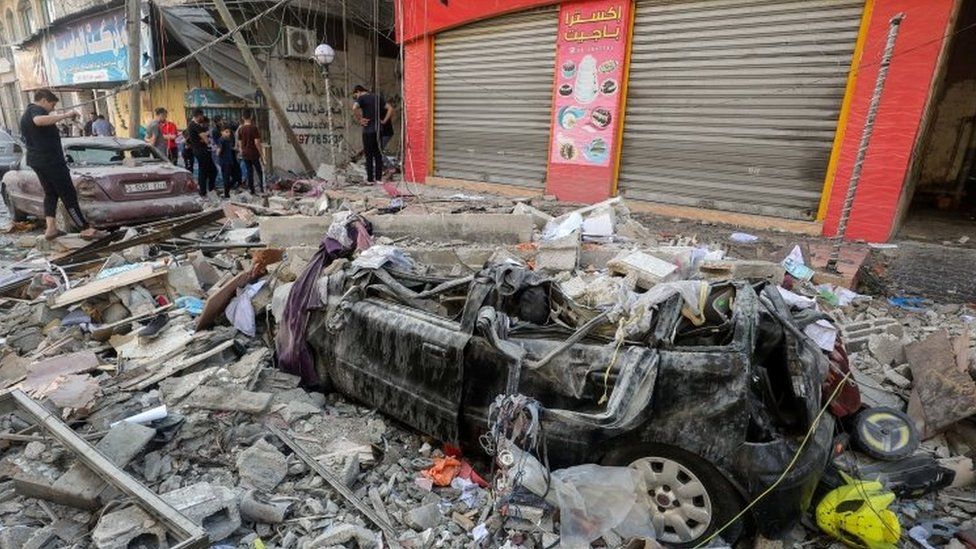
Damage from an Israeli air strike overnight in Gaza City
Reuters

Israel says it has targeted the homes of Hamas commanders as deadly fighting with Palestinian militants in the Gaza Strip enters a 10th day.

Israel said it had tried to kill Hamas military chief Mohammed Deif "several times". Overnight, two militants died in a strike on an apartment.

Fresh barrages of rockets were also fired into Israel and sirens continued to sound on Wednesday morning.

Ceasefire moves continue behind the scenes but have made little headway.

The BBC's Yolande Knell in Jerusalem says reports began circulating that a truce - brokered by Egypt - could come into force within days. However, these were quickly denied.

Israeli PM Benjamin Netanyahu said on Wednesday: "We're not standing with a stopwatch. We are taking care of the operation's objectives."

A Hamas leader said that efforts by mediators were "serious and continuous" but that Palestinian demands had to be met.

The fighting began after weeks of rising Israeli-Palestinian tension in occupied East Jerusalem that culminated in clashes at a holy site revered by both Muslims and Jews. Hamas, which controls Gaza, began firing rockets after warning Israel to withdraw from the site, triggering retaliatory air strikes.
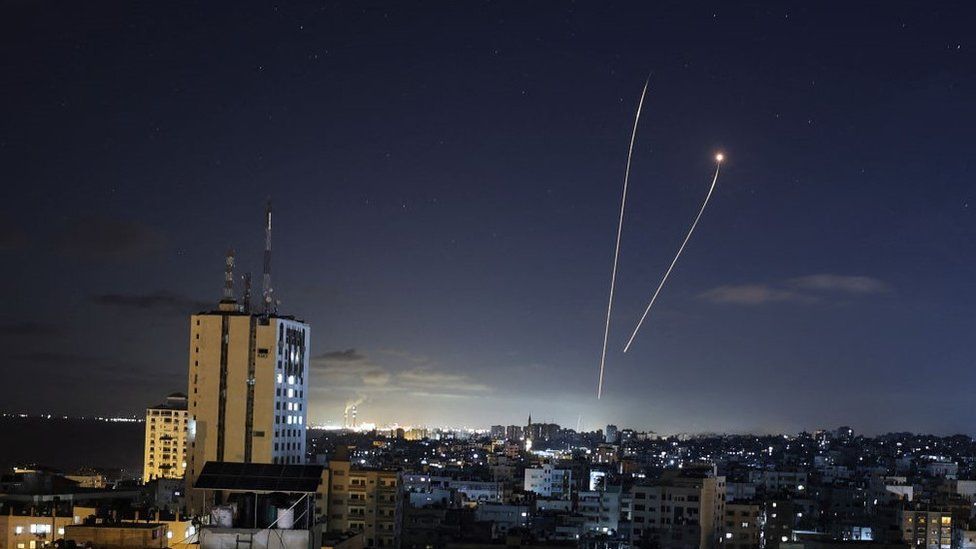
A streak of light appears as Israel's Iron Dome anti-missile system intercepts rockets launched from the Gaza Strip on May 18, 2021.
Getty Images

At least 219 people, including almost 100 women and children, have been killed in Gaza so far, according to its health ministry. Israel has said at least 150 militants are among those killed in Gaza. Hamas does not give casualty figures for fighters.

In Israel 12 people, including two children, have been killed, its medical service says. Israel says some 3,750 rockets have been fired towards its territory by militants in Gaza.

Air base targeted

The rocket attacks and Israeli air strikes continued overnight and into Wednesday.

The Israeli military said its fighter jets had attacked military infrastructure and the homes of Hamas commanders in Gaza.

The BBC's Rushdi Abualouf in Gaza says two Palestinian militants were killed in an apartment in a building in central Gaza City as Israeli warplanes carried out more than 70 strikes.

About 50 strikes targeted the southern Gaza Strip city of Khan Younis, with attacks on militant groups' training facilities, a Hamas-run security compound, and roads and farms, our correspondent says.

Gaza City mother of seven Randa Abu Sultan, 45, told AFP news agency: "My four-year-old son tells me he's scared that if he falls asleep, he'll wake up to find us dead."

The Israel Defense Forces (IDF) said they had again targeted a network of underground tunnels used by militants.
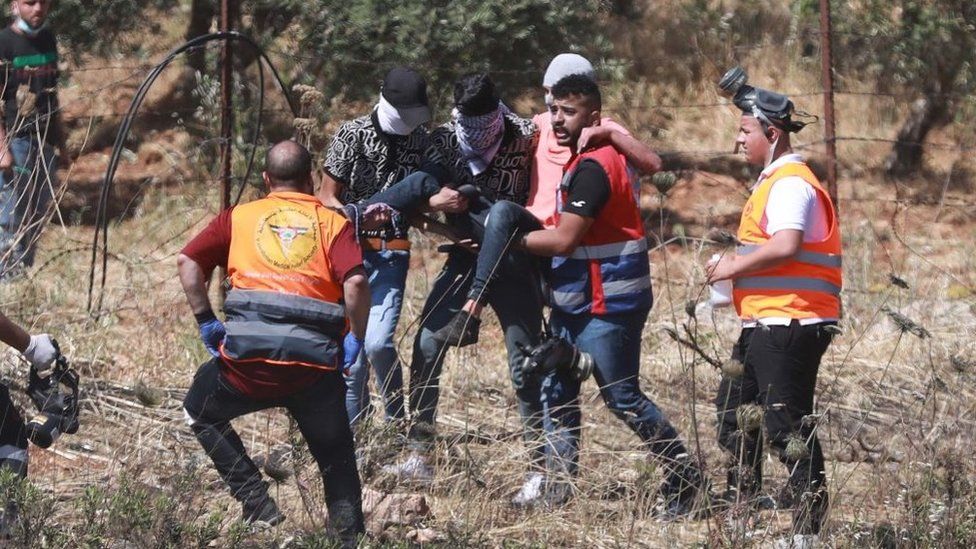
A protestor is injured following during a clash with Israeli police
Getty Images

IDF spokesman Brig Gen Hidai Zilberman also said: "Throughout the operation we have tried to assassinate Mohammed Deif. We've tried to kill him several times."

Mohammed Deif is the head of Hamas's military wing, the Izzedine al-Qassam Brigades, and has survived repeated attempts on his life, including in the last major conflict in 2014. He tends to stay in the background and his whereabouts remain unknown.

Sirens warning of rocket fire sounded overnight in parts of south and central Israel, including the cities of Ashkelon and Ashdod, and continued to sound in some areas on Wednesday morning.

Hamas said it had launched rockets at the Palmachim air base for a second time overnight. Israel said no military bases had been hit.

Two Thai workers died in a rocket strike on a farm in Israel on Tuesday.

Of the 3,750 rockets fired from the Gaza Strip since the fighting began, 550 have fallen short in Gaza, according to the IDF. Israel's Iron Dome missile defence system has intercepted about 90% of the rockets that have crossed into Israeli territory, it says.

The IDF estimated that at the start of the conflict, Hamas and Islamic Jihad, the two main groups in Gaza, had an arsenal of about 12,000 rockets or mortars.

Mr Netanyahu said the Israeli operation had "set Hamas back by many years".

On Wednesday, he said that he knew that Hamas would try to declare victory whatever happened but that if it were able to do so it would be "a defeat for us all".

There has also been unrest within Israel and in the occupied West Bank and East Jerusalem, where Palestinians took part in a general strike on Tuesday. There were clashes in several locations.

Diplomatic deadlock

In New York on Tuesday, the latest meeting of the UN Security Council again failed to reach agreement.

France, in co-ordination with Egypt and Jordan, filed a resolution calling for an end to the violence, but it was only a draft.

The US, a long-standing ally of Israel, has been blocking attempts to issue a joint statement, saying it would not help with de-escalation, although it has called for a ceasefire.

The Palestinian representative at the UN, Riyad Mansour, called the Security Council's failure to express a unified position "shameful".

One Israeli military source told Reuters that Israel was assessing whether conditions were right for a truce.

The Ynet news website said that the Israelis were talking with the Egyptians. It quoted sources in the Israeli cabinet as saying Israel could achieve its objectives and end the fighting "within days".

UN humanitarian chief Mark Lowcock said the fighting had caused "immense suffering" and "must stop".

"I call on all parties to the hostilities to agree to a humanitarian pause to allow for emergency humanitarian relief distribution," he said.
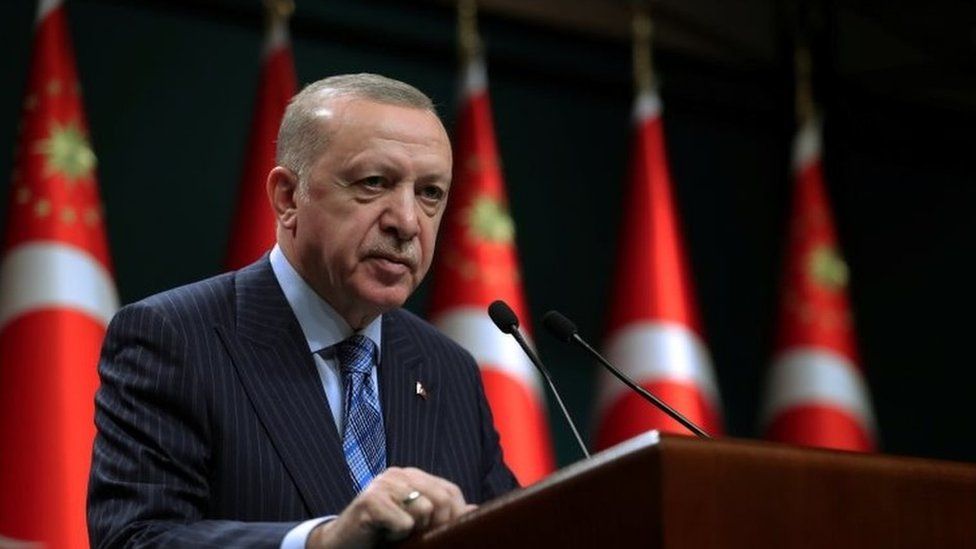
Turkish President Erdogan
Reuters

Separately on Wednesday, Turkey rejected US accusations that President Recep Tayyip Erdogan had made anti-Semitic remarks about Israel.

He had accused Israel of "terrorism" against the Palestinians and recently said: "It is in their nature".

State department spokesman Ned Price said the US found the remarks "reprehensible".

Omer Celik, a spokesman for Mr Erdogan's party, said the president had given very strong messages against anti-Semitism, adding: "Accusing our president of anti-Semitism is an illogical and untrue approach. This is a lie."

Timeline: How the violence escalated

The worst violence in years between Israel and the Palestinian territory of the Gaza Strip has seen dozens killed. It follows a month of spiralling tensions before open conflict broke out. Here is what happened in the lead-up to the fighting.
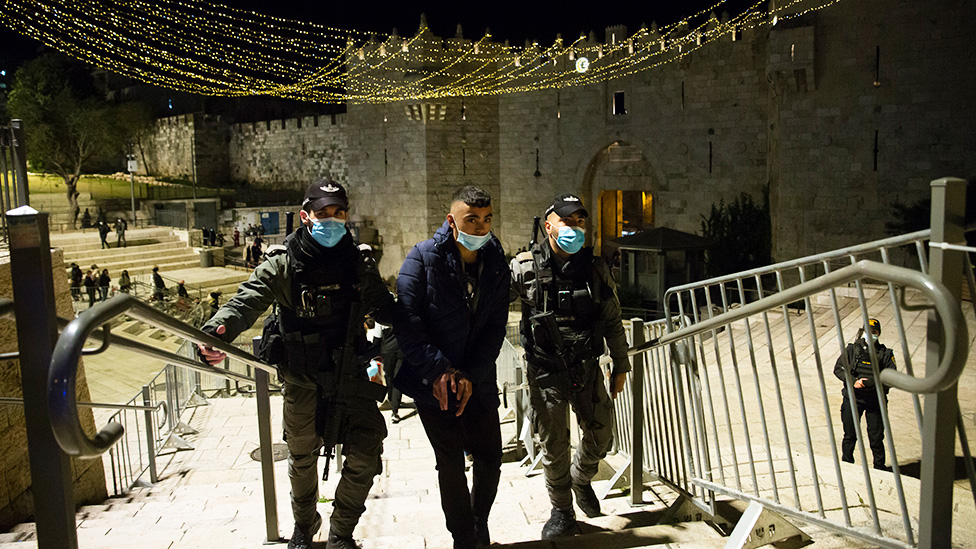
Israeli police officers detain a young Palestinian man at the Damascus Gate

Clashes erupt in East Jerusalem between Palestinians and Israeli police.

Palestinians are angry over barriers which had been placed outside the Damascus Gate entrance to the Jerusalem‘s Old City preventing them from gathering there after prayers at the Old City’s al-Aqsa Mosque on what is the first night of the Islamic holy month of Ramadan.

Palestinian discontent had been stoked earlier in the day when President Mahmoud Abbas called off planned elections, implicitly blaming Israel over voting arrangements for Palestinians in East Jerusalem.

Hamas - Mr Abbas' Islamist rivals who control Gaza and were running in the elections - react angrily to the postponement.

Violence around Damascus Gate and elsewhere in East Jerusalem continues nightly.

Rockets are fired from Gaza at Israel, which responds with air strikes after a relative period of calm between Israel and the Palestinian enclave.

Clashes spread to the mixed Arab-Jewish port city of Jaffa, next to Tel Aviv.

In Jerusalem, Jewish youths, angry over a spate of filmed assaults by Palestinians on Orthodox Jews posted on the TikTok video-sharing app, attack Arabs and chant anti-Arab slogans.
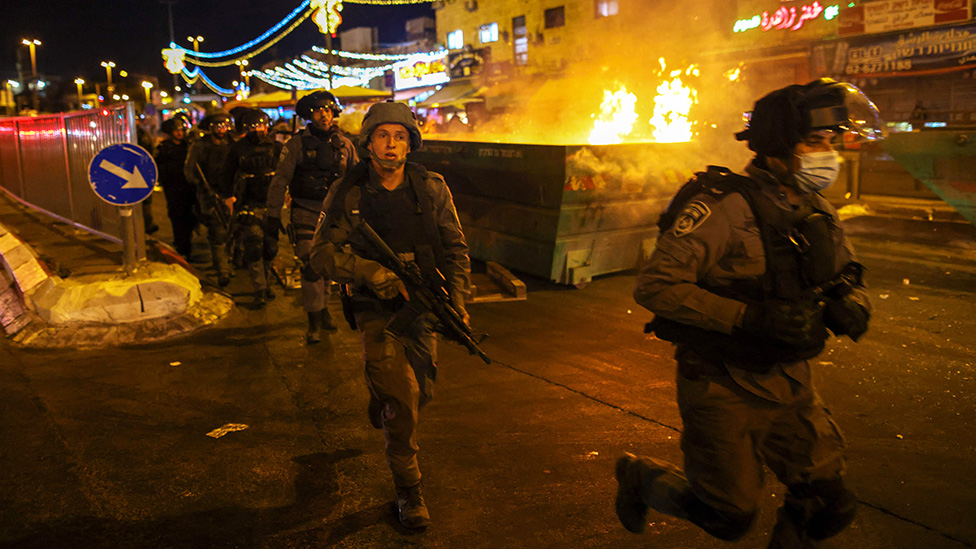
Israeli security forces clash with Palestinians outside the Damascus Gate

Hundreds of ultra-nationalist Jews shouting “Death to Arabs” march towards Damascus Gate in protest at the Arab assaults on Jews. Clashes erupt at the site between Palestinians and police trying to separate the two groups, injuring dozens of people.

Violence between Arabs and Jews spreads to other parts of the city.

Militants fire dozens of rockets at Israel from Gaza, drawing retaliatory air strikes.

President Abbas' Fatah faction and Hamas condemn the looming threatened eviction of Palestinian families from their homes in the Sheikh Jarrah district of East Jerusalem by Jewish settlers ahead of a planned court hearing. Hamas calls on Arabs to form “human shields of resistance” there.

In the days that follow, police and protesters repeatedly clash at the site as it becomes a focal point for Palestinian anger.

Militants in Gaza begin sending incendiary balloons into Israel over successive days, causing dozens of fires.

Two Palestinian gunmen are shot dead and a third is wounded after opening fire on Israeli security forces in the northern West Bank. Israeli authorities say the group planned to carry out a “major attack” in Israel.
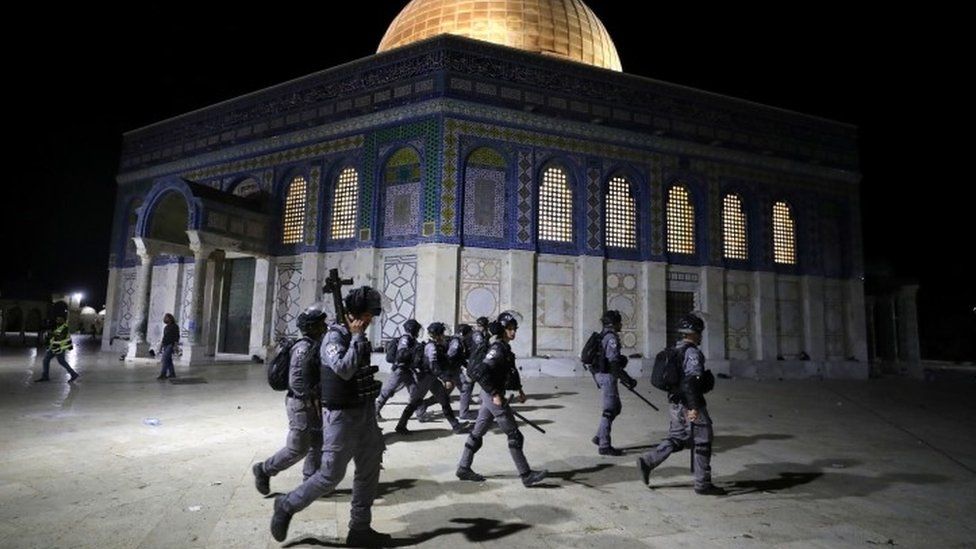
The al-Aqsa mosque has been a frequent flashpoint for violence

Later on after Friday prayers - the last of Ramadan - major clashes erupt at the al-Aqsa mosque compound, injuring more than 200 people. Israel's police force says it used “riot dispersal means”, firing rubber bullets and stun grenades after officers came under a hail of stones and bottles.

A second night of violence erupts in East Jerusalem after tens of thousands of worshippers prayed at the al-Aqsa mosque for Laylat al-Qadr, the holiest night of Ramadan.

Police and protesters clash at Damascus Gate, with police using water cannon, rubber bullets and tear gas against crowds of Palestinians, some throwing stones.

More than 120 Palestinians and some 17 police are injured.

Israel's Supreme Court postpones the hearing on the Sheikh Jarrah case following calls to delay it because of the growing unrest. Tensions remain high though and more clashes take place between Israeli police and Palestinians in Sheikh Jarrah and at Damascus Gate.

Early morning clashes break out between police and Palestinians at the al-Aqsa mosque compound, where crowds throw stones and officers fire stun grenades.

Palestinian anger has been inflamed by an annual Jerusalem Day march planned for later in the day by hundreds of Israeli nationalists to celebrate Israel's capture of East Jerusalem in 1967.

The march is due to pass through predominantly Arab parts of the Old City in what is seen by Palestinians as a deliberate provocation. It is rerouted at the 11th hour, but the atmosphere remains volatile with more than 300 Palestinians and some 21 police injured in the violence at the holy site.

Hamas issues an ultimatum to Israel to “withdraw its soldiers... from the blessed al-Aqsa mosque and Sheikh Jarrah” by 18:00. When the deadline passes without an Israeli response, rockets are fired towards Jerusalem for the first time in years.

Israeli Prime Minister Benjamin Netanyahu says the group has “crossed a red line” and Israel retaliates with air strikes, killing three Hamas fighters.

A continuing exchange of rocket-fire and air strikes quickly escalates into the fiercest hostilities between the two sides since they fought a war in 2014.


Presentational white space
Banner saying 'Get in touch'

Are you in Israel or Gaza and affected by the fighting? Share your experiences by emailing haveyoursay@bbc.co.uk.

Please include a contact number if you are willing to speak to a BBC journalist. You can also get in touch in the following ways:

If you are reading this page and can't see the form you will need to visit the mobile version of the BBC website to submit your question or comment or you can email us at HaveYourSay@bbc.co.uk. Please include your name, age and location with any submission.

Adblock test (Why?)


https://news.google.com/__i/rss/rd/articles/CBMiNWh0dHBzOi8vd3d3LmJiYy5jby51ay9uZXdzL3dvcmxkLW1pZGRsZS1lYXN0LTU3MTY4MDUx0gE5aHR0cHM6Ly93d3cuYmJjLmNvLnVrL25ld3Mvd29ybGQtbWlkZGxlLWVhc3QtNTcxNjgwNTEuYW1w?oc=5

2021-05-19 10:31:59Z
52781577069323

Selasa, 18 Mei 2021

Israel-Gaza: Young Americans on the conflict - and online activism - BBC News

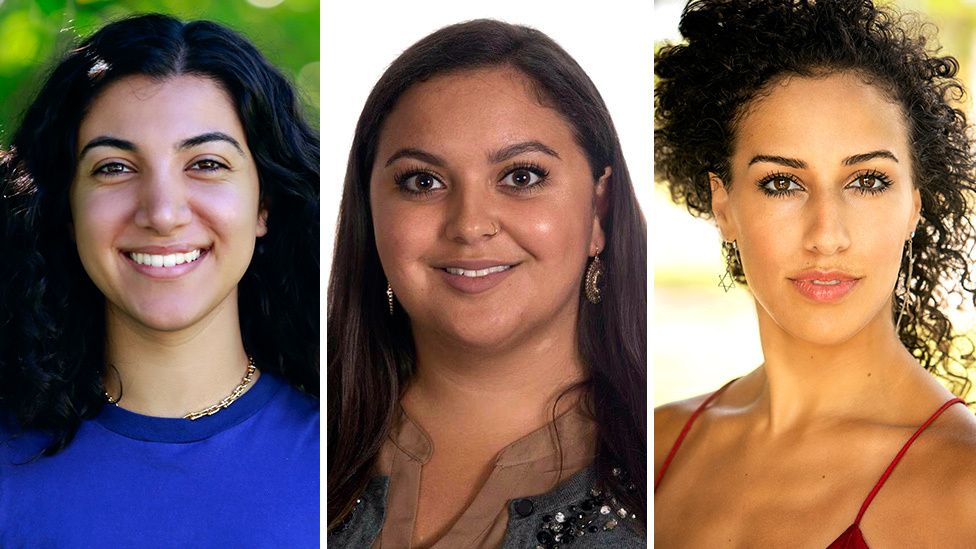
Composite image of three Ask America sources

As violence escalates between Israelis and Palestinians, scenes of destruction and calls to action are ricocheting across phone screens in the US. Are these social media messages shifting attitudes in the country often viewed as Israel's strongest ally or simply removing nuance from what is a complex and long-running conflict?

Those of Palestinian descent say the ongoing social media activism is a watershed moment similar to last summer's global demonstrations against racial injustice.

Those who hold ties to Israel say online narratives are misleading and simplify the issues in favour of an 'oppressed versus oppressor' narrative.

According to a recent Gallup poll, 75% of Americans still hold favourable views of Israel, but a growing number are sympathetic towards the Palestinians.

These are the testimonials of young people deeply invested in the struggle.

Short presentational grey line

'I'm glad that people get it now'

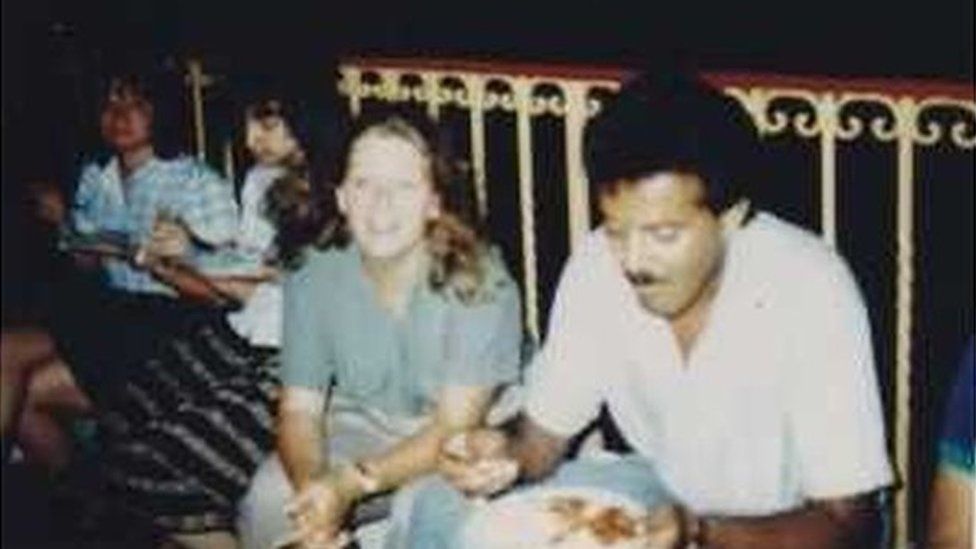
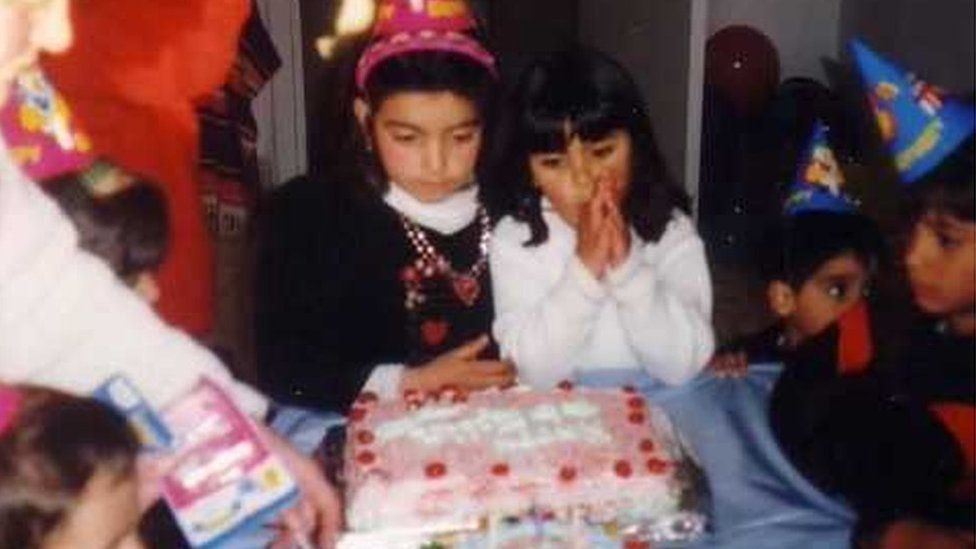
Leila, 30, lives in New Orleans, Louisiana, but her first memories come from the two years she lived in the Israeli-occupied West Bank in the 1990s, attending kindergarten in Ramallah, its administrative capital.

She reminisces of how fluently she spoke Arabic back then. But she also remembers the checkpoints on the way to school every day and the warnings from her parents to steer clear of Israeli soldiers.

"When I played with the kids in our neighbourhood, all the girls were Palestinians and the boys would play Israeli soldiers. A kind of war games," Leila recalls.

She adds: "I was always afraid of Israeli soldiers. I didn't need anyone to tell me, as a little girl, that they didn't think kindly of us."

The family intended to build their lives in the West Bank, until the crumbling Israel-Palestinian peace accords forced them to fly back to the United States. Leila have never since been able to return.

Leila's parents in Ramallah
Leila A

As she grew increasingly distant from family members trapped in Gaza, as well as from the Arabic language and the Islamic faith, Leila retained her identity by tapping into the rich history of her family: of ancestors from seven centuries ago; of her grandparents' expulsion during the 1948-49 Middle East war following Israel's creation; and of her father's role as a student leader in the first Palestinian uprising, or intifada, from 1987-1993.

In college, however, her Palestinian American pride hit a roadblock.

Leila claims she was singled out for her family ties, harassed when she spoke out and even spat on during an on-campus protest. In her senior year, she says the school put her dorm under surveillance for a week after a conservative student publicly vilified her as an anti-Semite.

But the continued attacks on Palestinians lives and homes in recent years have prompted many progressive Americans - such as Democratic presidential hopeful Bernie Sanders, young anti-Zionist liberals and organisations like the left-wing Jewish Voice for Peace - to speak out against what they see as injustices, particularly through social media.

"The support of that demographic has really opened the door for people like myself to be able to speak our truths without facing as much vitriol," says Leila. "It feels a lot less scary."

Celebrating a birthday
Leila A

Accompanying the cresting wave of progressive energy, she says, is that Palestinians on the ground have phones and social media, and can "take control of the narrative" in order to more accurately portray their plight to the rest of the world.

"Much like with the Black Lives Matter movement, where it was a lot more horrifying to witness George Floyd dying than to read about it, being able to witness the atrocities means that it runs counter to the mainstream narratives that we're seeing on TV," she explains.

Leila says her community feels "a bittersweet sense of hope, seeing the unification of Palestinians, seeing that the world is watching, and feeling like a change might be coming".

What change looks like remains unclear amid the escalating violence of the past two weeks, but she is cautiously optimistic that creating greater awareness online keeps alive "any hope for a free future, a liberated Palestine".

"In a way, it's frustrating too because I wonder: where the [expletive] have you been for the last 20 years?" she remarks.

"I'm glad that people get it now."

Short presentational grey line

The fierce debate over Israeli-Palestinian clashes has become more pronounced within the Democratic Party.

For the first time since Gallup began conducting its annual poll in 2000, a majority of Democratic voters expressed support for the US pressuring Israel to make necessary compromises between the two sides.

But this young liberal says it isn't quite so easy.

'You can't apply an American context here'

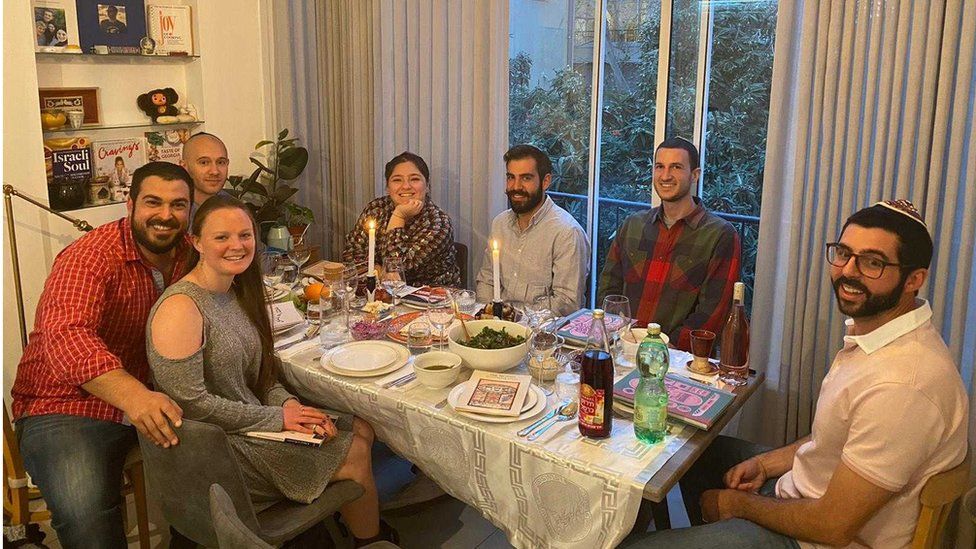
When Adam moved to Tel Aviv a couple of months ago, he did not anticipate needing to run for cover at any given moment.

The Chicago native, 28, has no immediate family in Israel, but he grew up in a proudly Jewish family and had an acute desire "to experience life in the only Jewish country in the world".

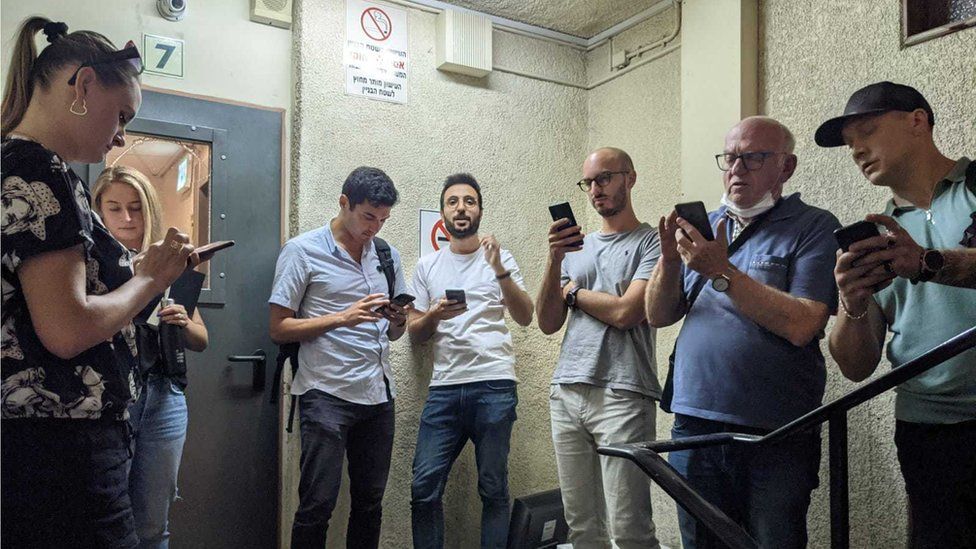
His work week is now based around the Jewish calendar and he's learning Hebrew like he always wanted to. But he is also aware that, at any time, a blaring siren could go off and he will have 90 seconds to find shelter.

Adam's Hebrew class
Adam C

On Thursday, he had to duck into a little pizza shop when he heard the sound.

"A rocket was intercepted by the Iron Dome [anti-missile system] directly overhead. We came out and saw the smoke trails in the air," he recounts.

"Simultaneously, I'm logging on to Instagram and seeing my American friends posting memes and slides without understanding the nuances of the situation."

He goes on: "It's deeply depressing to watch it happen in real time - a complex conflict boiled down into a few Instagram slides, terms like settler colonialism, genocide and ethnic cleansing thrown around, with total ignorance of the reality and the history here."

The 28-year-old is a registered Democrat in the US. He says Israel's "ugly right-wing" government has unjustly persecuted Palestinians and he is firmly pro-Palestinian statehood. But he fears "there isn't much space left to say you support Israel in the liberal camp".

Adam's Passover Seder
Adam C

People aren't willing to condemn the Hamas militants firing rockets into Israeli civilian population centres, he says, even as the terror group "welcomes the bloodshed and feeds off the terror" between the two sides.

"Accusing Israel multiple times of war crimes without, in the same breath, accusing Hamas of war crimes is baffling," says Adam. "Placing all the blame squarely on the shoulders of Israel is just wrong and I can't think of a place it would come from other than anti-Jewish bias."

He says Palestinian leaders repeatedly rejected credible two-state solutions on several occasions. He adds that current Palestinian President Mahmoud Abbas has remained in office indefinitely since his election to a four-year term 16 years ago.

And, irked by social media posts he has seen comparing Jews to European settlers, he points out that more than half of Israel's population has roots in North Africa and the Middle East, not Europe.

Adam considers himself to be pro-Black Lives Matter and marched in demonstrations in Chicago and Washington DC last year, but he warns that a binary narrative of oppression cannot neatly be applied outside of an American context.

"You're taking two parts of the world with infinitely different histories and contexts, and applying the same standards to them. It just doesn't work," he says.

"Innocent civilians are dying in Israel and in Gaza, and boiling it down to one side is an oppressor and the other is a victim is never the answer."

Short presentational grey line

'There's no power stronger than the people'

For some, the online conversations over the territorial dispute are significant not simply because they create awareness.

Leen credits the social media movement with "exposing" decades-long narratives about Palestinians perpetuated in the mainstream media and by foreign governments.

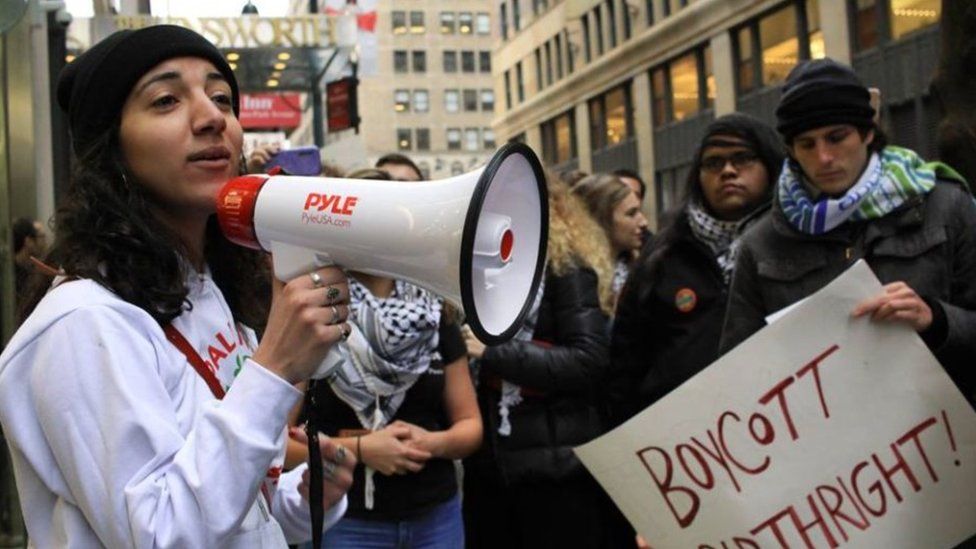
The 24-year-old activist says that when people post and share content from Gaza it dismantles the damaging "myth" that Israeli-Palestinian fighting is a "conflict".

"Gaza has been massacred time and time again," she tells the BBC. "This isn't a conflict; that implies an equation and it is not equal."

Leen at a protest in New York
Leen D

According to Leen, the most appropriate ways to describe the issue is as settler colonialism, apartheid and genocide, all terms that have been heavily featured in social media posts over the past two weeks, but vehemently rejected by Israel.

"There's no other way to frame trapping a population of two million people in an open-air prison and, every few years, bombing them for weeks and months at a time," she contends.

"When you're that densely populated in such a small area, there's no way to escape a full-scale bombing. That's absolutely nothing short of genocide."

Born in Jordan to parents with roots in the West Bank and Syria, Leen educated herself on the struggle for Palestinian liberation by reading dense historical texts from Palestinian and Jewish scholars before she started speaking out and organising in high school and college.

"We're expected to know every detail in order for our own calls for justice to be taken seriously and seen as not biased," she says.

But she adds: "I don't expect people to know the details the way I do because, when it comes down to it, the issue is very clear. You don't need a PhD in Middle Eastern Studies to know that what Israel is doing is wrong."

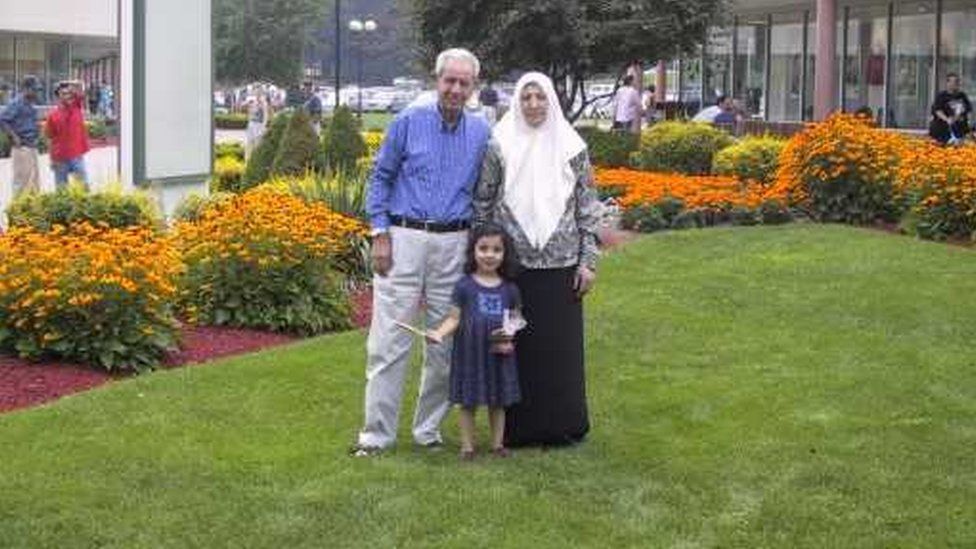
Leen with her grandparents
Leen D

She says people are no longer afraid to weigh in on the topic, a phenomenon she - like Leila - largely attributes to the potency of the Black Lives Matter movement.

"If black organisers and activists hadn't set that stage in the past year, I don't think we would be witnessing this moment for Palestinian activism online and through social media," she observes.

"You can't really separate struggles for justice," she goes on. "All struggles for justice are interconnected. One of us can't be free until all of us are."

That's why, despite what Leen describes as "extreme anger and frustration" over alleged pro-Israel bias, she also feels "the joy of solidarity".

Short presentational grey line

'Do they know what apartheid even means?'

An Ashkenazi Jew whose ancestorsimmigrated to the region in the 1930s, Eliana had no immediate ties to Israel until she lived there for all of 2017.

It was an experience that left her "emotionally and culturally connected" to the place, as she studied Judaism and grew to admire Israel's cuisine and its family-based culture.

She also explored as much of the region as she could - from Jerusalem to Tel Aviv, from Gaza to the West Bank. In her view, "unless people live there and know the nuances, or really know the history and where we came from, you don't know how this situation developed".

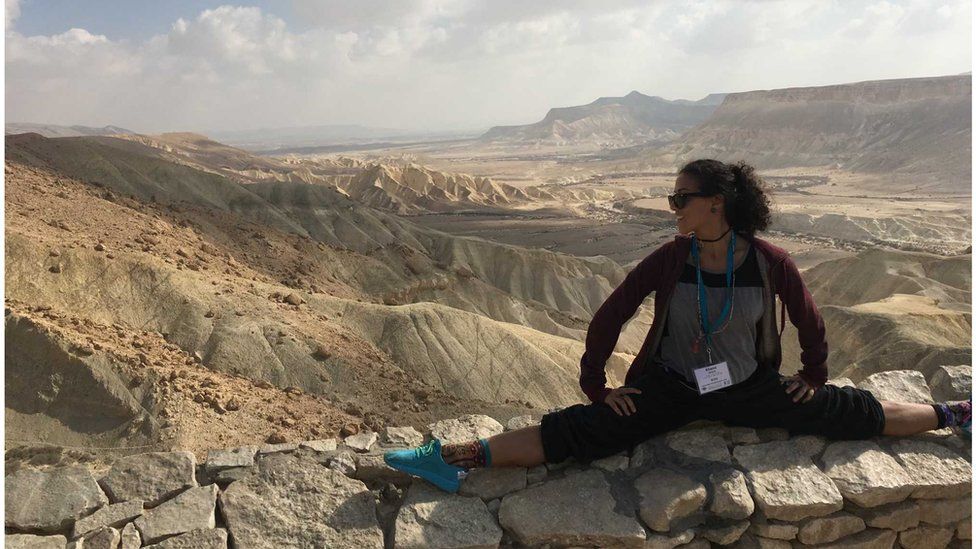
Eliana in Hebron
Eliana G

Describing herself as "absolutely pro-Israeli", Eliana says: "Everyone deserves a home and Jews have no place to call home except Israel."

She believes that Palestinians also have a legitimate right to live in the region, but a minority of Arabs are "volatile, radical and want to bomb us".

She points to the many Arabs who live in Israel, who she says are culturally Muslim but live harmoniously alongside Jews. Most of her friends there are Arabs too, she adds.

Recounting her travels through Gaza, she recalls the "heart-breaking" poverty of its residents and adds that they are the innocent victims of larger forces at play.

"They are manipulated," she opines. "Hamas and other terror organisations use the public as pawns on the frontlines, and by saying Israelis are responsible for their poor quality of life while taking money for their own agendas."

She says that, despite coverage that shows many more Palestinians have died than Israelis in the recent escalations, it is only because Israel has built up the military strength to defend itself from neighbours "like Syria and Iran that very much do not like us".

Eliana at Israeli-Jordan border
Eliana G

On a trip to the Israeli-occupied Syrian Golan Heights, for example, Eliana witnessed firsthand the might of Israel's Iron Dome during a missile attack.

It is absurd to her that terms like apartheid are being used in social media posts to describe the situation. "I don't know if people even know what that word means," she says.

"We're coming in like the British and trying to invade their territory?" she asks. "We are just trying to protect ourselves."

Adblock test (Why?)


https://news.google.com/__i/rss/rd/articles/CBMiM2h0dHBzOi8vd3d3LmJiYy5jby51ay9uZXdzL3dvcmxkLXVzLWNhbmFkYS01NzE2MTkyN9IBN2h0dHBzOi8vd3d3LmJiYy5jby51ay9uZXdzL3dvcmxkLXVzLWNhbmFkYS01NzE2MTkyNy5hbXA?oc=5

2021-05-18 22:03:32Z
52781577069323

People flee in panic as 300-metre-high skyscraper wobbles in China - Guardian News

Adblock test (Why?)


https://news.google.com/__i/rss/rd/articles/CBMiK2h0dHBzOi8vd3d3LnlvdXR1YmUuY29tL3dhdGNoP3Y9dTdUUXo1MlFtSDTSAQA?oc=5

2021-05-18 20:14:22Z
52781604807200

Violent clashes in West Bank as Palestinians protest over Israeli air strikes in Gaza - BBC News - BBC News

Adblock test (Why?)


https://news.google.com/__i/rss/rd/articles/CBMiK2h0dHBzOi8vd3d3LnlvdXR1YmUuY29tL3dhdGNoP3Y9Rzd0bXVhTEZHU1XSAQA?oc=5

2021-05-18 21:31:32Z
52781577069323

Migrants reach Spain's Ceuta enclave in record numbers – BBC News - BBC News

Adblock test (Why?)


https://news.google.com/__i/rss/rd/articles/CBMiK2h0dHBzOi8vd3d3LnlvdXR1YmUuY29tL3dhdGNoP3Y9UzdVOVhtcFJQUVXSAQA?oc=5

2021-05-18 18:00:09Z
52781602336291

Ceuta: Spain sends troops as 6,000 migrants enter enclave - BBC News

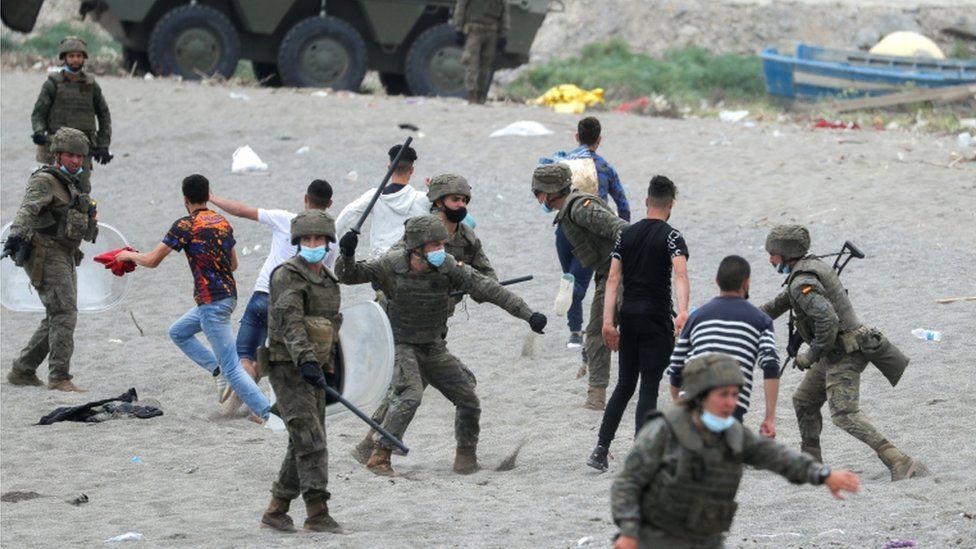
A Spanish legionnaire hits a Moroccan citizen at El Tarajal beach, near the fence between the Spanish-Moroccan border
Reuters

Spain has deployed troops after record numbers of migrants entered its enclave of Ceuta from neighbouring Morocco.

At least 6,000 people reached Ceuta in a single day, Spanish officials say.

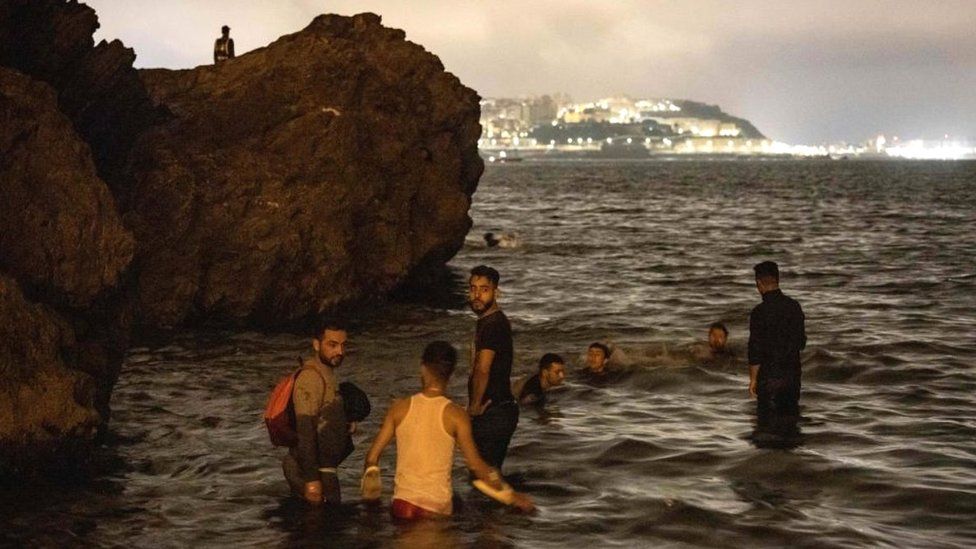
They say the migrants - who include about 1,500 minors - either swam around the border fences that jut out into the sea or walked across at low tide.

Spain's Prime Minister, Pedro Sánchez has vowed to restore order. Spain says it has already sent some 2,700 migrants back - but not the minors.

Most of the migrants are said to be from Morocco.

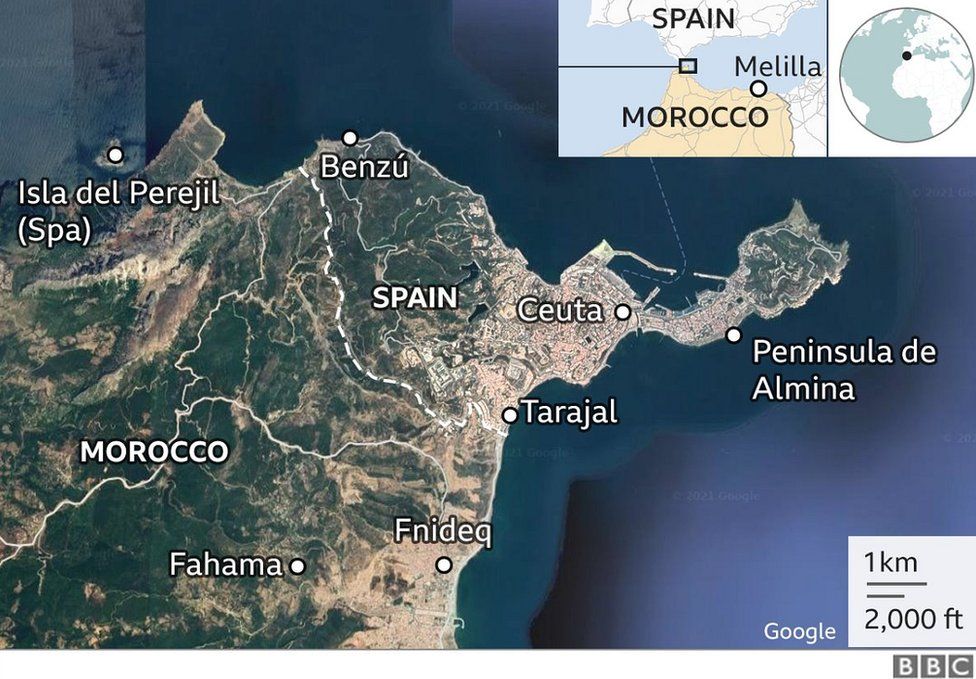
The Spanish forces troops have been deployed to the beach to help border police at Ceuta's main entry point - Tarajal, on the enclave's south side.

Interior Minister Fernando Grande-Marlaska said 200 troops, plus 200 extra police were going to assist Ceuta's normal 1,100-strong border force. The enclave has some 80,000 inhabitants.

Spain's Ceuta and Melilla enclaves have become magnets for African migrants.

On Tuesday, Moroccan security forces at Fnideq, the adjacent town to Ceuta, fired tear gas to disperse a large crowd of migrants at the border fence, AFP news agency reported.

Mr Sánchez has cancelled a trip to Paris - he was to attend a French-led summit on financial aid for Africa. Instead, he is focusing on the Ceuta crisis, and he promised "maximum firmness" in restoring normality to the enclave.

He has received support from senior EU officials, with European Council President Charles Michel tweeting: "Spain's borders are the European Union's borders."

EU Commissioner for Home Affairs Ylva Johansson described the number of arrivals in Ceuta as "unprecedented" and "worrying", noting that "a big number of them [are] children".

Ceuta map
1px transparent line

At the other enclave, Melilla, 86 sub-Saharan Africans entered on Tuesday via its southern jetty, which marks the border with Morocco.

Melilla has a formidable border fence, and several hundred more migrants were blocked by security forces, Spain's Efe news agency reports.

Spanish officials quoted by Efe said Moroccan guards had helped the Spanish forces in Melilla. Some migrants threw stones at the Spanish forces, they said.

Spanish media said it was different in Ceuta, where Moroccan border guards stood by and watched as migrants took to the sea to try to reach the enclave.

Most of the migrants were said to be young men, but there were also several families. Many had used inflatable rings and rubber dinghies.

They started arriving in Ceuta at 02:00 (midnight GMT) on Monday, but the number soared during the day. At least one died during the crossing.

Last month, more than 100 migrants arrived at Ceuta's Tarajal entry point. Most were sent back, except about 30 minors whose ages were confirmed by medical tests.

Migrants in water at Fnideq, 18 May 21
AFP

Since the 17th Century both Ceuta and Melilla have been under Spanish rule, though they are long claimed by Morocco. The port cities now form the EU's only land border with Africa. They have semi-autonomous status, like some regions of mainland Spain.

The influx comes amid renewed tension over Western Sahara, a territory occupied by Spain until 1975, when Morocco annexed it. Since then it has been disputed between Morocco and the indigenous Sahrawi people, led by the Polisario Front.

2px presentational grey line

Souring of ties over Western Sahara

Guy Hedgecoe

In April, Spain allowed Sahrawi leader Brahim Ghali, 73, to be treated in hospital for Covid-19, reportedly in Logroño. He leads the Polisario Front, fighting for Western Saharan sovereignty against the claims of Morocco. The Moroccan government responded angrily and warned Spain that harbouring Mr Ghali would bring "consequences".

Spanish Foreign Minister Arancha González said she was not aware of Morocco using the border issue to exert political pressure. But many see Monday's events, when Moroccan border guards appeared not to stop migrants from crossing, as evidence of a reprisal.

Such difficulties are likely to complicate the two neighbours' normally tight co-operation on the migrant issue. However, Spain says it has already repatriated about half of the migrants, following talks with Morocco.

The vast majority of those who reached Ceuta were Moroccan. Local police have clamped down on sub-Saharan migrants in northern Morocco in recent years, meaning they have sought other routes to Spain, such as across the Atlantic to the Canary Islands.

2px presentational grey line

The EU border force Frontex reports that illegal migration to Spain's Canary Islands - off the Moroccan coast - has surged this year.

In most cases sub-Saharan Africans make perilous journeys in rickety boats and drowning is common.

However, the overall number of undocumented migrants reaching Europe so far this year remains far below the levels seen in 2015-2016.

2px presentational grey line

Read more on migrants reaching Spain:

Adblock test (Why?)


https://news.google.com/__i/rss/rd/articles/CBMiMGh0dHBzOi8vd3d3LmJiYy5jby51ay9uZXdzL3dvcmxkLWV1cm9wZS01NzE1NjMyMNIBNGh0dHBzOi8vd3d3LmJiYy5jby51ay9uZXdzL3dvcmxkLWV1cm9wZS01NzE1NjMyMC5hbXA?oc=5

2021-05-18 16:16:57Z
52781602336291