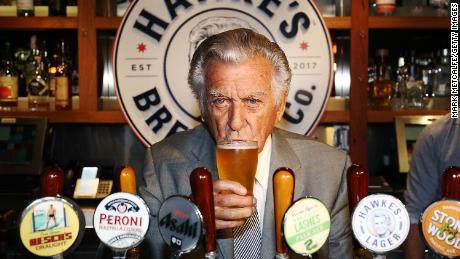
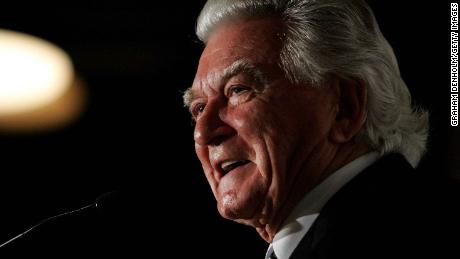
Known affectionately as "Hawkie," Hawke was Australia's prime minister from 1983 to 1991, winning four elections and becoming the country's third longest-serving leader.
His wife, Blanche D'Alpuget, released a statement on Thursday describing her husband as "the greatest Australian of the post-war era."
"Bob Hawke and Paul Keating and their governments modernised the Australian economy, paving the way for an unprecedented period of recession-free economic growth and job creation," her statement said.
A Rhodes scholar who graduated from Oxford University in 1956, Hawke quickly rose through the ranks of Australia's trade union movement to become the President of the Australian Council of Trade Unions in 1970, according to the Museum of Australian Democracy.
In 1983, after only being in parliament for three years, he became Australia's prime minister and would go on to serve for almost nine years in the country's top job.
Famous for his bouffant hair and cheeky sense of humor, Hawke reportedly held the world record for skolling a yard of beer in the quickest time when he was a student at Oxford.
When an Australian yacht won the America's Cup in September 1983, Hawke famously declared, "Any boss who sacks anyone for not turning up today is a bum."
But he was also a major economic reformer who with his then-treasurer Paul Keating liberalized the Australian economy, floating the Australian dollar and brought in universal healthcare for all citizens.
In the end, it was Keating who took his job as leader of the Labor Party in 1991 coup.
But even after he left office, Hawke remained one of Australia's most popular prime ministers, regularly invited to quickly drink beers at major sporting events by attendees to cheers and applause.
In a statement, opposition Labor leader Bill Shorten said that "the Australian people loved Bob Hawke because they knew Bob loved them."
"In Australian history, in Australian politics, there will always be B.H. and A.H: Before Hawke and After Hawke. After Hawke, we were a different country. A kinder, better, bigger and bolder country," he said.
China's Commerce Ministry warned Thursday that U.S. actions against companies such as Huawei could escalate trade tensions.
On Wednesday, U.S. President Donald Trump declared a national emergency over threats against American technology. The U.S. Department of Commerce subsequently announced the addition of Huawei Technologies and its affiliates to the Bureau of Industry and Security (BIS) Entity List. Now U.S. businesses will need a license to sell or transfer technology to Huawei, likely making it far more difficult for the Chinese telecom giant to conduct business with them.
We ask the U.S. to stop further actions, so Chinese companies can have a more normal environment to trade, to avoid further escalation of U.S.-China trade tensions, spokesperson Gao Feng said in Mandarin during a press conference Thursday, according to a CNBC translation.
He criticized the use of national security as a tool for protectionism, and emphasized that overseas operations of Chinese companies should respect local laws.
Trade tensions between the U.S. and China took a negative turn in the last two weeks, upsetting expectations that both sides would soon reach a deal. The U.S. raised tariffs on $200 billion worth of Chinese goods on Friday, and China retaliated Monday with plans for tariffs on $60 billion worth of U.S. goods set to take effect June 1.
Gao said Beijing has not received any details on a U.S. visit to China for further trade negotiations. Treasury Secretary Steven Mnuchin plans to visit Beijing in the near future, according to a Dow Jones report.
On the topic of a meeting between Trump and Chinese President Xi Jinping next month, the Ministry of Commerce referred CNBC to the Ministry of Foreign Affairs.
In an incendiary speech, Khamenei insisted the US will retreat from any further moves against the Islamic Republic due to the Iranian people’s resolve. Tensions between the two countries have been souring ever since Trump took office three years ago, especially since the US President withdrew from the nuclear deal with the Islamic Republic. Commenting on the current relations between the two countries, Khamenei said: “In this showdown America will be forced to retreat because our resolve is stronger.
“The definite decision of the Iranian nation is to resist against America.”
The Supreme Leader’s comments come as the UK’s Iranian ambassador, Hamid Baeidinejad, warned that Iranian forces would be “ready for any eventuality in the region”.
He added: “They should not try to test the determination of Iran to confront any escalation in the region.”
Amid the recent back and forth between the two countries, Trump has boldly stated he would send more troops to the region if necessary.
Moreover, the State Department announced it would be evacuating all non-emergency staff from neighbouring Iraq and would closing the US Embassy in Baghdad.
In response to those rumours, Trump stated: “Hopefully we’re not going to have to plan for that.
“And if we did that, we’d send a hell of a lot more troops than that.”
In response, Iranian Foreign Minister Mohammad Javad Zarif claimed Iran is not seeking conflict but “always defended” themselves.
On Wednesday, United States President Donald Trump signed an executive order escalating his administration's campaign against Chinese telecoms giant Huawei, raising pressure on allies to follow suit in banning the company from their 5G and other networks.
The US claims Huawei, one of China's most important companies, poses a spying risk to Western technology infrastructure. The latest move against the firm comes amid a worsening trade war between Beijing and Washington, after talks expected to bring a breakthrough fell apart, resulting in billions of dollars in further tariffs from both sides.
While some US allies -- notably Australia and New Zealand -- have followed Trump's lead on Huawei, others have been more reticent. Europe in particular is split over whether to ban the company, a market leader on 5G technology which is expected to be the lifeblood of the new economy.
The Huawei issue cuts to the heart of tensions between security and economic interests when it comes to China and Chinese influence. While many countries around the world share Washington's suspicion -- even hostility -- towards Beijing, they are unwilling to take the economic hit that openly standing apart from China would entail.
UK in chaos
Nowhere will Trump's order cause more chaos -- outside perhaps Huawei headquarters in Shenzhen -- than in the United Kingdom.
Earlier this month, British Prime Minister Theresa May fired her defense secretary, Gavin Williamson, after it was alleged he was the source of a news report that the UK was preparing to give Huawei access to parts of the country's 5G network.
May accused Williamson -- who had previously expressed "very deep concerns" about Huawei -- of leaking information from a meeting of the UK National Security Council, a claim he has "strenuously" denied. The council's discussions are normally strictly guarded and the publication of its discussions sparked an immediate furor in the UK.
The Huawei issue has exposed new tensions within May's Conservative Party, already riven over Brexit and shopping around for a new leader to takeover when the Prime Minster stands down in the wake of the UK eventually agreeing how to leave the European Union.
May and her allies are believed to favor limited involvement of Huawei in British network infrastructure, but not a full ban. This is based on the advice of GCHQ, the British intelligence agency responsible for communications surveillance, which has advised close monitoring of Huawei.
Others in the party strongly favor a complete ban, following Washington's lead. Last month, Tom Tugenhadt, Conservative chair of the parliamentary Foreign Affairs Committee, said in allowing Huawei to build parts of the country's 5G network "we will be nesting a dragon in the critical national infrastructure of the UK."
He accused May -- in ignoring US and Australian advice against Huawei -- of "putting in danger the 70 year intelligence sharing relationship that has underpinned the security of the UK is worth it, for Chinese commercial gain."
That sense of commercial gain is likely to come into sharp focus should the UK finally leave the EU. Brexit supporters have made it clear they hope better trade relations with China will help boost the British economy in the face of an unavoidable dip following a split with Europe.
Tugenhadt's committee is conducting an inquiry into "China and the international rules-based system." In the panel's most recent report, it said members "see considerable grounds for concern about Huawei's involvement in the UK's 5G infrastructure."
Bob Seely, another Conservative member of the committee, has argued that "Huawei -- by definition -- cannot be a trusted provider because it comes form a one-party state and is mandated to work with Chinese security services."
He has said he hopes Huawei will become an issue in the upcoming Tory leadership contest, and is one of several MPs within the party pressuring May to reverse her position.
The Chinese company has strenuously denied espionage claims, saying that agreeing to spy for Beijing would be equivalent to committing economy suicide.
Speaking during a visit to London this week, Huawei chairman Liang Hua said the company was "willing to sign a no-spy agreement with the UK government ... No spying, no back doors."
Germany uncertain
Another of Huawei's rotating chairmen, Ken Hu, is also in Europe this week. On Thursday, Hu will attend the annual Viva Tech conference in Paris, alongside French President Emmanuel Macron.
France is believed to be on the fence about Huawei, but is less likely to issue a full ban than the UK. However, Macron has been encouraging other European leaders to take a stronger stance on China, and he may seek to use Trump's latest move against Huawei as a means to push this agenda.
During a recent visit to the UK and Germany, US Secretary of State Mike Pompeo warned that allowing Huawei into those countries' telecoms infrastructure would make partnering with them "more difficult."
German Chancellor Angela Merkel has so far refused to bow to US pressure to ban Huawei, however, even as opposition to its involvement is reportedly growing among some sectors of the German security state.
"Security, particularly when it comes to the expansion of the 5G network, but also elsewhere in the digital area, is a very important concern for the German government, so we are defining our standards for ourselves," Merkel said in March, according to Reuters.
She said the German government would discuss any concerns with European partners, "as well as the appropriate offices in the United States."
That pressure could see Merkel change her position, as she seeks European agreement on this issue. In an interview with the Guardian this week, she said that China, Russia and the US "are forcing us, time and again, to find common positions. That is often difficult given our different interests. But we do get this done."
Trump's latest salvo against Huawei, and indications that more could follow if relations with Beijing do not improve, could juice those discussions. But in a Europe already riven over Brexit and struggling to come up with a coherent strategy on China, it's not clear a consensus is actually on the cards.
The U.S. military gave a top British general a public tongue-lashing Tuesday after he told reporters at the Pentagon that Iran does not pose a threat to coalition troops in the Middle East.
"There's been no increased threat from Iranian-backed forces in Iraq and Syria," British Army Maj. Gen. Chris Ghika, deputy commander of the U.S.-led anti-ISIS coalition, said Tuesday in a video press briefing from Baghdad. "We're aware of their presence, clearly, and we monitor them along with a whole range of others because that's the environment we're in." The Pentagon has increased U.S. military presence in the Persian Gulf over the last week, citing “troubling and escalatory” threats from Tehran.
Hours later, the top spokesman for the commander of U.S. forces in the Middle East issued a stark statement contradicting Ghika, saying the Pentagon has put U.S. forces in Syria and Iraq on heightened alert.
Ghika's comments "run counter to identified credible threats available to intelligence from U.S. and allies regarding Iranian-backed forces in the region," Capt. Bill Urban said.
U.S. Central Command, working with the anti-ISIS coalition, "has increased the force posture level for all service members" in Iraq and Syria, Urban added. The coalition "is now at a high level of alert as we continue to closely monitor credible and possibly imminent threats to U.S. forces in Iraq."
Ghika emphasized throughout his briefing that Iran was not in his wheelhouse. "I have no part of Iran in any of my orders, in any of my directives, or in any of my planning documents. Iran is no part of our mission," he told reporters who repeatedly asked about possible Iranian threats.
The Pentagon deployed the USS Abraham Lincoln carrier strike group and a task force of B-52 bombers to the Persian Gulf last week, followed by an additional ship and a Patriot missile defense battery. The New York Times reported Monday that U.S. officials reviewed a plan to send as many as 120,000 troops to the Gulf if Iran attacked U.S. forces, but President Trump denied the report Tuesday.
“I think it’s fake news," Trump said. "Hopefully, we’re not going to have to plan for that. And if we did that, we’d send a hell of a lot more troops than that.”
The State Department issued an order Wednesday requiring all nonemergency staff to leave Iraq, though specific details regarding the threat posed by Iran remain unclear. U.S. allies are skeptical of a potential threat, with U.K. Foreign Secretary Jeremy Hunt warning that Europe is "very worried about the risk of a conflict happening by accident, with an escalation that is unintended, really, on either side, but ends with some kind of conflict."
The Trump administration and European allies have been split on Iran since the president withdrew the United States from the 2015 nuclear agreement a year ago. Iran has threatened to increase its nuclear activities in breach of the deal unless the European signatories agree to new terms within the next two months.
The United States says it supports an international effort to find ways to stop social media from spreading hate — but won't take part in it.
In a statement issued Wednesday, the White House praised the call to action in the name of Christchurch being spearheaded by New Zealand Prime Minister Jacinda Ardern and French President Emmanuel Macron.
"The United States stands with the international community in condemning terrorist and violent extremist content online in the strongest terms," the White House said, but added that it is "not currently in a position to join the endorsement."
That makes the U.S. an outlier. Allies including the United Kingdom, Japan, Australia, Italy, India, Germany and Spain are all listed as signing on to the effort. Numerous technology giants are involved as well, including Amazon, Facebook, Google, Twitter and YouTube.
In its statement, the White House suggested that First Amendment concerns were stopping the Trump administration from joining in the agreement.
"We continue to be proactive in our efforts to counter terrorist content online while also continuing to respect freedom of expression and freedom of the press," the statement said.
In an op-ed in The New York Times this past weekend, Ardern said the "Christchurch Call" would be a voluntary framework that "commits signatories to counter the drivers of terrorism and put in place specific measures to prevent the uploading of terrorist content."
Just landed in Paris, with a busy few days ahead. First, the Christchurch Call to Action meeting, where world leaders & social media companies will meet to take action against violence & hate online. Then, I’ll speak at @VivaTech about restoring trust in the digital world.
It's named after the New Zealand city where a white supremacist attacked two mosques in a shooting spree that left 51 people dead. Parts of the March 15 attacks were livestreamed on Facebook.
The attacker's digital footprint along with his own claims about how the internet shaped his views led to renewed calls for social media platforms to do more to combat hate speech as well as foreign governments that said they were prepared to take matters into their own hands.
Ahead of the meeting with world leaders and other tech companies in Paris for a "Tech for Good" summit Wednesday, Facebook announced that it would be implementing new rules around the company's livestream tool in an effort to limit its use to "cause harm or spread hate."
Microsoft is proud to sign the Christchurch Call and commit to nine concrete steps to fight violent extremist content online. https://t.co/chba2JsmZL
In a rare joint statement, Facebook, Twitter, Google, Amazon and Microsoft said: "The terrorist attacks in Christchurch, New Zealand, in March were a horrifying tragedy. And so it is right that we come together, resolute in our commitment to ensure we are doing all we can to fight the hatred and extremism that lead to terrorist violence."
The companies said "we are sharing concrete steps we will take that address the abuse of technology to spread terrorist content, including continued investment in technology that improves our capability to detect and remove this content from our services, updates to our individual terms of use, and more transparency for content policies and removals."
U.S. officials are pointing the finger at elite Iranian military forces for the sabotage attacks on oil tankers near the Persian Gulf.
A week after claiming Iranian "preparations for possible attack" on U.S. forces in the region, the U.S. has ordered most State Department personnel out of neighboring Iraq.
U.S. and Iranian officials insist nobody wants a war, and President Trump has denied plans to send 120,000 troops to the region.
The U.S. military has refuted a senior British commander's assessment that there has been "no increased threat from Iranian-backed forces in Iraq and Syria."
U.S. officials have said they believe Iranian combat divers were behind the attacks on four oil tankers near the Persian Gulf over the weekend, and they tell CBS News senior national security correspondent David Martin there's still no sign Iran is backing off purported plans to attack Americans in the region.
On Wednesday the State Department ordered all non-emergency staff and their families to leave Iraq, a nation on Iran's southern border in which the Iranian government backs various militia groups which have fought U.S. troops before.
"U.S. citizens in Iraq are at high risk for violence and kidnapping. Numerous terrorist and insurgent groups are active in Iraq and regularly attack both Iraqi security forces and civilians. Anti-U.S. sectarian militias may also threaten U.S. citizens and Western companies throughout Iraq," the State Department said in its advisory.
Secretary of State Mike Pompeo renewed the Trump administration's warning on Tuesday that the U.S. would retaliate against Iran if it does attack American interests in the Middle East, but he declined to pin the blame for the tanker sabotage on Tehran.
U.S. officials believe Iran was involved in attacks on Persian Gulf oil tankers
He said he didn't have anything "concrete about the connection" between Tehran and the tanker attacks, adding: "I think in the coming hours and days we'll know the answer to that."
At a campaign rally on Tuesday evening, President Trump emphasized what is becoming one of the hallmarks of his hardline foreign policy, telling supporters that his administration was "holding dangerous regimes accountable by denying them oil revenue to fund their corruption, oppression and terror."
But as Martin reports, while the U.S. has put a stranglehold on Iran's economy, the country remains dangerous.
U.S. officials told Martin it was highly likely that Iran's Islamic Revolutionary Guards were responsible for Sunday's attacks that blew holes in the hulls of Saudi and Norwegian tankers anchored off the Emirati port of Fujairah, just outside the Persian Gulf.
Iranian combat divers are believed to have attached explosives to the ships' hulls, but a defense official told CBS News that further investigation was still needed.
Trump sending troops to Iran?
Mr. Trump, meanwhile, dismissed a New York Times report saying the administration was planning to send 120,000 American troops to the region to counter Iran. The U.S. has already sent an aircraft carrier strike group and four B-52 bombers to the Persian Gulf.
President Trump's denial of the Times report came with a caveat: "Would I do that? Absolutely," he said as he left the White House on Tuesday. "We have not planned for that… and if we did that, we'd send a hell of a lot more troops that."
On Capitol Hill, Virginia Democratic Senator Tim Kaine blasted the president's thinking.
"It would be the height of idiocy. It would be unconstitutional. There's no way this president should get us into a war with Iran," Kaine said.
Iran escalates nuclear threat
Iran has vehemently denied being involved in the attacks on the oil tankers and accused President Trump of playing a "very dangerous game, risking devastating war."
But on Wednesday, Iran's Supreme Leader Ayatollah Ali Khamenei said: "There is not going to be a war. Neither are we seeking war, nor is it to their (the United States') benefit to go after a war. They know this. We never start a war and have never started any wars. This is a confrontation of will-powers and our will-power is stronger than theirs."
He ruled out any negotiations with the current U.S. administration, saying they would be "poison" for Iran.
Iran's Revolutionary Guard rules out talks with U.S.
But while he downplayed the possibility of a conflict with the U.S., the ayatollah also dropped a loosely-veiled threat that Iran could take steps -- within a few months -- that would almost certainly draw a significant American response.
Iran announced a week ago that in response to President Trump pulling the U.S. out of the nuclear deal agreed in 2015 with world powers, it would partially withdraw from the terms of the agreement, too.
The Iranian regime said if the other parties to the agreement, which still want to keep it viable, couldn't figure out a way to work around new U.S. sanctions to keep doing business with Tehran within 60 days, it would resume enriching uranium to levels barred under the deal.
Iran is permitted under the terms of the nuclear deal to enrich uranium to just under 4% concentration -- a level at which it can be used for medical and scientific purposes, but not be easily refined to a level required to make nuclear weapons.
The regime said if no agreement was reached with Europe, Russia and the Chinese to keep the 2015 deal in play, it would resume enriching uranium to 20% -- which officials in the country have said could be done within four days. That benchmark is significant because once uranium is refined to 20%, it becomes much easier to enrich it to the 90% needed for weapons.
On Wednesday, the Ayatollah said "achieving 20% enrichment is the most difficult part. The next steps are easier than this step."
It was the first hint from the Iranian regime that it might try to obtain the highly-enriched uranium needed for an atomic bomb -- though Iranian officials have always denied any interest in obtaining one.
Both the U.S. and Israel have made it clear they will not allow the Islamic Republic to obtain a nuclear weapons capability.
U.S. and allies on same page?
There have been signs of frustration from European allies over the Trump administration's decision to not only bail on the nuclear deal, but to mount the new pressure on the Iranian regime.
The Trump administration and U.S. military officials said just over a week ago that they had detected, "a number of preparations for possible attack" on U.S. forces at sea and on land in the Middle East.
The U.S. has about 5,000 troops still in Iraq, on Iran's border, and while the State Department order on Wednesday for non-emergency personnel to leave the country did not specifically mention a threat from Iran, that was the implication.
Again without specifically citing Iran, a spokesperson at the U.S. Embassy in Iraq told CBS News on Wednesday that Pompeo ordered the non-emergency U.S. personnel out of the country because, "these threats are serious."
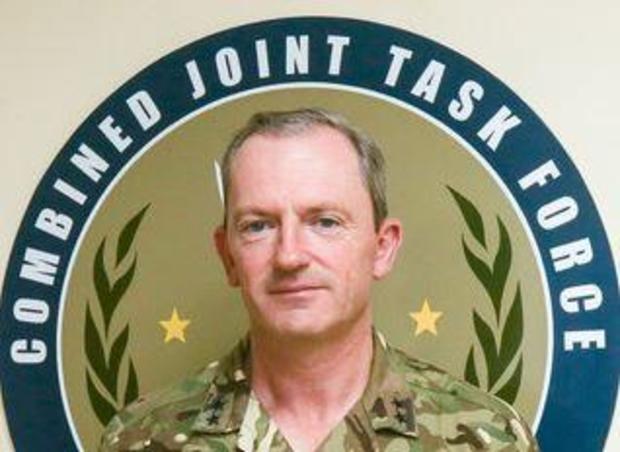
British Maj. Gen Christopher Ghika, Deputy Commander-Strategy and Information for the Combined Joint Task Force - Operation Inherent Resolve, the U.S.-led military operation in Iraq, is seen in a handout photo.
HANDOUT
On Tuesday, however, a British deputy commander of the U.S.-led joint military operation in Iraq disputed the claim of an elevated threat to allied forces in the region.
"There's been no increased threat from Iranian-backed forces in Iraq and Syria," Maj. Gen Christopher Ghika said in a video briefing from Baghdad to the Pentagon, according to The Guardian. "We're aware of that presence, clearly. And we monitor them along with a whole range of others because that's the environment we're in. We are monitoring the Shia militia groups I think you're referring to carefully, and if the threat level seems to go up then we'll raise our force protection measures accordingly."
But the U.S. military's Central Command, which oversees Operation Inherent Resolve (OIR) in Iraq and all other American operations in the region, directly refuted Ghika's statement later on Tuesday.
"Recent comments from OIR's deputy commander run counter to the identified credible threats available to intelligence from US and allies regarding Iranian-backed forces in the region," Central Command spokesman Capt. Bill Urban said in the statement.
Germany's military, meanwhile, announced a halt to its training operations in Iraq on Wednesday, but said it had no information about heightened threats to German troops in the country from Iran.
Defense Ministry spokesman Jens Flosdorff cited heightened regional tensions as he confirmed Germany's military was temporarily suspending training of Iraqi forces, "orienting itself toward our partner countries," but adding there were "no concrete warnings of attacks against German targets."