The vote came almost two years after the island's Constitutional Court ruled that the existing law -- which said marriage was between a man and a woman -- was unconstitutional. The panel of judges gave the island's parliament two years to amend or enact new laws.
On Friday -- only a week off the two-year deadline -- lawmakers in Taiwan's Legislative Yuan passed a bill making same-sex marriage a reality. It will go into effect on May 24.
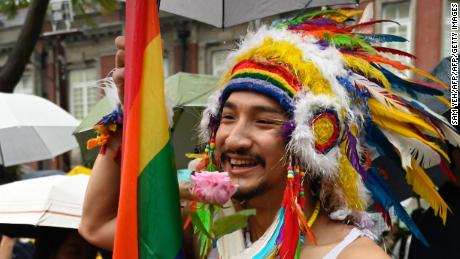
Tens of thousands of people braved pouring rain Friday to demonstrate in favor of same-sex marriage outside the parliament, where lawmakers were voting on three draft bills, one tabled by the country's Cabinet -- which would ultimately prove successful -- and two watered-down rival bills tabled by conservative groups.
The successful Cabinet bill was backed by LGBTQ groups, despite the fact it creates a law different to straight marriage. For instance, under Cabinet's bill, a Taiwanese person could not marry foreigners from countries where same-sex marriage is not legal.
Thousands turned of gay rights activists, many bearing umbrellas, rainbow flags and rainbow placards, gathered in heavy rain in the capital Taipei in support of marriage equality.
Ahead of the vote, Taiwan's President Tsai Ing-wen tweeted: "Today we have a chance to make history and show the world that progressive values can take root in an East Asian society."
Although the island has a large gay community and its annual gay pride parade is the biggest in Asia, the issue of marriage equality has divided Taiwanese society. In a controversial referendum in November last year, 67% voted to reject same-sex marriage.
In recent months conservative groups have campaigned against same-sex marriage reform, pushing for a law that would see gay marriage legislation redefined as same-sex unions.
LGBTQ rights in Asia
Taiwan's vote sets it apart from other parts of Asia where LGBTQ rights have regressed.
In mainland China, where homosexuality is legal but prejudices and discrimination against LGBT people persist under Communist Party rule, an author of same-sex erotic fiction was sent to jail for 10 years in November.
In April, the ruler of the tiny, oil-rich kingdom of Brunei announced he would introduce death by stoning for those convicted of gay sex. Sultan Hassanal Bolkiah has since said the death penalty will not be imposed, although he did not repeal the law.
In Indonesia, declining secularism has led to deepening discrimination against the country's gay, lesbian and transgender communities. Last year, two men accused of being gay received 87 lashes for gay sex in the country's conservative Aceh province.
More than two dozen countries around the world allow gay marriage, according to Pew Research.
U.S. and European prosecutors brought charges against an alleged multi-nation cybercriminal ring that sought to steal $100 million.
The scam used malware, known as GozNym, to steal people's online banking credentials via "phishing" attacks.
Emails infected with the virus allowed hackers operating from Europe to record the keystrokes from victims' computers, steal banking log-in info and siphon money from accounts.
A federal grand jury in Pittsburgh has charged 10 Eastern Europeans in connection with malware attacks that attempted to steal $100 million, U.S. and European authorities announced Thursday.
The U.S. Attorney for the Western District of Pennsylvania presented the charges, along with officials from Germany, Moldova, Ukraine, Bulgaria, Georgia, and the European Union law enforcement and justice agencies Europol and Eurojust. The charges include conspiracy to commit computer fraud, conspiracy to commit wire and bank fraud, and conspiracy to commit money laundering.
The malware, known as GozNym, automated the process of stealing people's online banking credentials. It infected 41,000 computers around the world using so-called phishing emails that were disguised as legitimate messages or invoices, officials said. Once opened, the emails allowed hackers operating from Europe to record the keystrokes from victims' computers, steal banking log-in credentials and siphon money from accounts.
Trending News
The leaders of the scam tried to steal $100 million, according to the indictment, although it's unclear how much money was actually stolen. In the U.S., the scam targeted a range of companies and other organizations, including a Washington law firm, a church in Texas, a furniture business in California and a casino in Mississippi.
Multi-nation bust
The 10 defendants include citizens of Russia, Ukraine, Moldova, Kazakhstan and Georgia. The accused ringleader of the network and his technical assistant are being prosecuted in Georgia, according to Europol. An 11th defendant in a related case was extradited to the U.S. from Bulgaria in 2016 and pleaded guilty last month in federal court in Pittsburgh, where Thursday's case was brought.
In cases of cyber crime, attribution—figuring out who's responsible—is often quite difficult, said CNET Senior Producer Dan Patterson. Thursday's indictment indicates that law enforcement has gotten better at pinpointing culprits and bringing prosecutions in such cases, he said.
What makes the case unique is that some of those other countries plan to undertake the actual criminal prosecutions, if and when the relevant suspects are apprehended.
Instead of seeking the immediate extradition of all 10 defendants, which can take years of negotiations, prosecutors will first bring charges against several of them in Ukraine, Moldova and Georgia. Scott Brady, the U.S. attorney in Pittsburgh, called it "a paradigm change in how we prosecute cybercrime."
Brady said that while prosecutors always look to recover stolen funds, that effort is especially challenging in international cybercrime cases. "Proceeds were converted to bitcoin and without the private key, it is really hard to identify and access, let alone seize, those accounts," he said.
-- The Associated Press contributed to this report.
Bob Hawke, Australia's longest-serving Labor Party prime minister, whose charisma and powers of persuasion earned him near-folk hero status among many Australians, died on Thursday, his wife said. He was 89.
The former union leader dedicated much of his political career to trade union issues, and he was widely regarded as a man of his people. He had a down-to-earth attitude, a passion for sports and legendary status among beer lovers — for once drinking himself into the record books.
He won four terms as prime minister, serving from 1983 to 1991 before being ousted by his own center-left party when the economy soured. Only two other prime ministers served Australia longer, and both were members of the conservative Liberal Party.
Trending News
He had been actively supporting Labor's campaign for elections on Saturday after six years in opposition. He also said he doubted he would survive to see the Labor victory predicted in opinion polling.
Opposition leader Bill Shorten said Hawke had transformed Australian society and protected the environment, a reference to his government preventing the damming of a wild river in Tasmania state to generate electricity in a major environmental conflict in 1983. "We have lost a favorite son. Bob Hawke loved Australia and Australia loved Bob Hawke," Shorten said.
Prime Minister Scott Morrison said Hawke had "defined the politics of his generation and beyond."
"Bob Hawke was a great Australian who led and served our country with passion, courage, and an intellectual horsepower that made our country stronger," Morrison said. Robert James Lee Hawke was born in the agricultural community of Bordertown, South Australia, to a Congregationalist minister father.
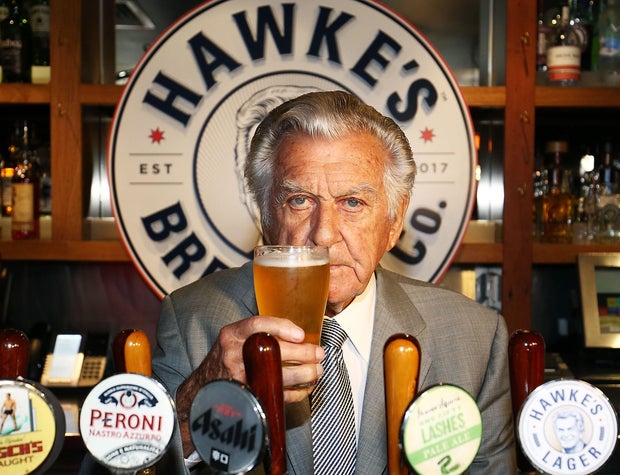
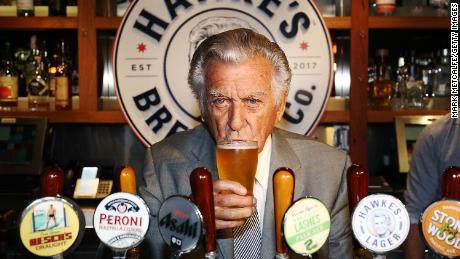
Bob Hawke toasts Hawke's Lager at the launch of Hawke's Lager at The Clock Hotel on April 6, 2017, in Sydney, Australia.
Mark Metcalfe/Getty Images
By the time he entered politics, Hawke had abandoned his religious upbringing and declared himself agnostic. His lifelong involvement with the labor movement began in 1958, when he joined the Australian Council of Trade Unions, first as a researcher and later as a union advocate.
After scoring several high-profile wins before the Arbitration Commission, Hawke rose through the ranks of the ACTU and was elected its president in 1969. Over the next decade, Hawke developed strong ties with both union representatives and their traditional rivals — employers and government agencies — winning him a reputation as an easy operator.
Negotiations over labor disputes were as likely to take place at the bar over copious beers as before the courts. His reputation as a tippler was cemented during his years as a Rhodes scholar at Oxford University in England, where he earned a Guinness world record by downing 2 1/2 pints of beer in 11 seconds.
"This feat was to endear me to some of my fellow Australians more than anything else I ever achieved," Hawke wrote of the 1955 stunt in his autobiography. In 1980, Hawke publicly swore off alcohol and was elected to Parliament, immediately taking up a high-profile role as the opposition's spokesman for industrial relations, employment and youth.
Still, he never shook his booze-loving reputation, and in his later years, did little to discourage it. A January 2012 video of a then-82-year-old Hawke chugging a beer at a cricket match as cheering and laughing fans shouted, "One for the country, Robert!" exceeds a million hits on YouTube.
Not everyone loved him, of course. Some viewed him as arrogant, sexist, even obnoxious.
Hawke was notorious for his short temper and womanizing ways; he admitted to repeatedly cheating on his first wife, Hazel Masterson, during their 39-year marriage and married his biographer and mistress, Blanche d'Alpuget, shortly after their divorce. "Today we lost Bob Hawke, a great Australian - many would say the greatest Australian of the post-war era," d'Alpuget said in a statement.
Prime Minister Hawke and his treasurer, then successor, Paul Keating "modernized the Australian economy, paving the way for an unprecedented period of recession-free economic growth and job creation," she said. Australians embraced Hawke as a larrikin, an Aussie term for someone considered endearingly mischievous.
On the strength of his personality and growing popularity with voters, Hawke was elected prime minister on March 5, 1983, after less than three years in Parliament and only one month as leader of the Labor Party. He came to power preaching consensus and, through his intimate knowledge of both the trade union and business communities, was able to forge a wage accord that helped to minimize industrial disputes.
On the back of his success, Hawke called an early election and was again swept to power in 1984. Hawke broke a 1984 campaign promise and called early elections again in 1987, after the Senate twice rejected a government proposal to introduce a national identity card, which Labor said was necessary to crack down on tax evaders and welfare cheats.
He was narrowly elected to a fourth term in 1990. But as Australia plunged into recession, Hawke's enormous popularity began to wane and his rule as prime minister finally ended on Dec. 20, 1991, when he was ousted by his own party.
He retired from Parliament the following year. Despite his background in the union movement, Hawke's approach to the economy was largely conservative.
In 1983, he oversaw the floating of Australia's currency and later set in motion the sale of several state-run industries — including airlines, banks and telecommunications companies — and curbed government subsidies to underperforming sectors. Like many Australians, Hawke was an avid sports fan, always ready to roll up his sleeves and place a bet.
In 1983, when Australia broke the United States' 132-year winning streak in the America's Cup yacht race, Hawke proclaimed the day a national holiday, famously saying, "Any boss who sacks anyone for not turning up today is a bum." D'Alpuge said she will hold a private funeral with his children Sue, Stephen, Rosslyn and stepson, Louis, and his grandchildren.
A memorial service will be held in Sydney in the coming weeks.
Beijing accused President Trump of engaging in industrial sabotage by using state security as "as a pretext for suppressing foreign business".
"We urge the US to stop this practice and instead create better conditions for business co-operation," Mr Lu said.
He did not give any details over how China planned to retaliate against the US sanctions.
What did the US sanctions order say?
According to a White House statement, Mr Trump's order aims to "protect America from foreign adversaries who are actively and increasingly creating and exploiting vulnerabilities in information and communications technology infrastructure and services".
It gives the secretary of commerce the power to "prohibit transactions posing an unacceptable risk to the national security", the statement adds.
The move was instantly welcomed by Federal Communications Commission Chairman Ajit Pai, who called it "a significant step toward securing America's networks".
The US had already restricted federal agencies from using Huawei products and has encouraged allies to shun them, while Australia and New Zealand have both blocked the use of Huawei gear in 5G networks.
Huawei has said its work does not pose any threats and that it is independent from the Chinese government.
"Restricting Huawei from doing business in the US will not make the US more secure or stronger," the company said in a statement.
"Instead, this will only serve to limit the US to inferior yet more expensive alternatives, leaving the US lagging behind in 5G deployment, and eventually harming the interests of US companies and consumers."
The company also said "unreasonable restrictions" on Huawei raised "other serious legal issues".
UK Prime Minister Theresa May last month provisionally approved Huawei technology for use in the nation's future 5G telecoms networks, but a leaked account of the meeting said five cabinet ministers raised concerns about the move.
France, Germany and Belgium have not banned Huawei technology, but Japan has from public contracts.
The US has pressured allies to shun Huawei in their next generation 5G mobile networks.
The confrontation over Huawei comes amid a broader trade war between the US and China.
The US has raised tariffs to 25% on $200 billion of Chinese imports and is threatening to tax an additional $300 billion worth.
The Hermit Kingdom is also apparently the barren kingdom.
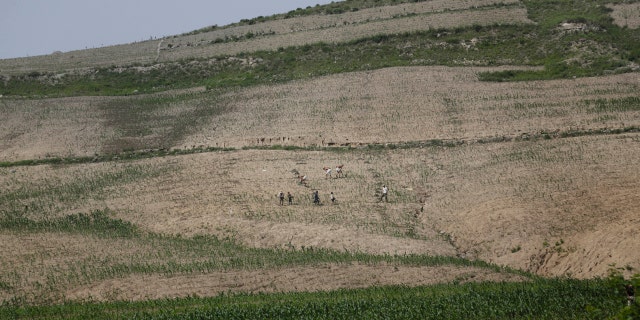
North Korea disclosed on Wednesday it is suffering its worst drought in nearly four decades, amid growing concerns the country is dangerously short on food.
The state-run Korean Central News Agency said that only 2.1 inches of rain fell throughout the country in the first five months of this year, the lowest amount since the same period in 1982 when 2 inches of rain on average fell.
The current conditions, described by KCNA as "extreme drought", are expected to continue at least until the end of May.
North Korean media outlets called on citizens on Thursday to find new sources of water, according to the Yonhap News Agency.
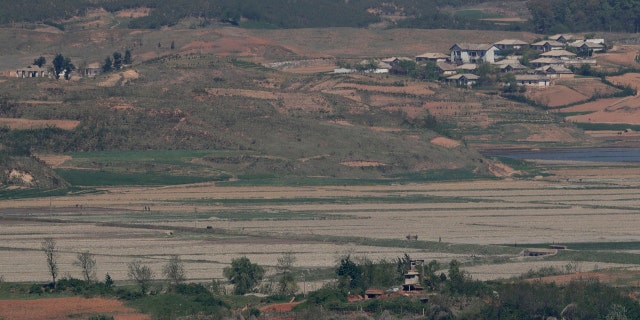
North Korea said it is suffering its worst drought in nearly four decades after only 2.1 inches of rain fell throughout the country in the first five months of this year.
(AP Photo/Lee Jin-man)
The country's Rodong Sinmun newspaper reported that workers are attempting to find new water sources and mobilize pumps and irrigation equipment to minimize the damage to agriculture.
Rodong Sinmun said the efforts are part of the "struggle to prevent damage from drought is a fierce battle against the nature to protect socialism."
The ongoing drought is expected to add to an already perilous situation facing the North.
Earlier this month, United Nations food agencies said in a joint assessment about 10 million people in North Korea, about 40 percent of the population, were facing "severe food shortages" after the country had one of the worst harvests in a decade.
"The situation could further deteriorate during the lean season from May to September, if no proper and urgent humanitarian actions are taken," the report said.
North Korean officials have blamed the food shortage on bad weather and international economic sanctions that were toughened after the country conducted a series of high-profile nuclear and missile tests in recent years.
The official Korean Central News Agency said Wednesday, May 15, that an average of 2.1 inches of rain fell throughout the country in the first five months of this year, the lowest level since 1982.
(AP Photo/Wong Maye-E, File)
In February, North Korea's ambassador to the United Nations, Kim Song, issued a rare appeal for urgent food assistance, saying the sanctions were "barbaric and inhuman," according to Sky News.
"There is a dreadful restriction by sanctions on imports of all sorts of metal farming facilities, such as tractors, harvesters... as well as chemical fertilizer, pesticide and herbicide," he wrote.
In February, President Trump and North Korean leader Kim Jong Un met in Vietnam for their second summit, but negotiations fizzled. The North requested sanctions relief in exchange for partial denuclearization measures. The U.S. balked at the request, insisting sanctions would not be relaxed until complete denuclearization.
United Nations food agencies have warned about 10 million people in North Korea, about 40 percent of the population, are facing "severe food shortages" after the country had one of the worst harvests in a decade.
(AP Photo/Wong Maye-E, File)
North Korea suffered a devastating famine in the mid-1990s that is estimated to have killed hundreds of thousands of people.
Known affectionately as "Hawkie," Hawke was Australia's Prime Minister from 1983 to 1991, winning four elections and becoming the country's third longest-serving leader.
His wife, Blanche D'Alpuget, released a statement on Thursday describing her husband as "the greatest Australian of the post-war era."
"Bob Hawke and Paul Keating and their governments modernised the Australian economy, paving the way for an unprecedented period of recession-free economic growth and job creation," her statement said.
A Rhodes scholar who graduated from Oxford University in 1956, Hawke quickly rose through the ranks of Australia's trade union movement to become the President of the Australian Council of Trade Unions in 1970, according to the Museum of Australian Democracy.
In 1983, after serving in parliament for just three years, he became Australia's Prime Minister in a landslide election victory.
That success revived Hawke's Labor Party, ushering in a sustained period of rule that lasted until 1996.
Hawke served as Prime Minister for almost nine of those 13 years, winning three more polls in the process and cementing his legacy as the party's longest-serving and most electorally successful leader.
In a political landscape that sees regular elections and frequent leadership contests, Hawke's longevity can be matched only by Liberal Prime Ministers Robert Menzies and John Howard.
But Hawke was as famous for his colorful character as his political achievements, his bouffant hair and cheeky sense of humor ensuring that he has endured in the country's affections long after his career came to a close.
He reportedly held the world record for skulling a yard of beer in the quickest time when he was a student at Oxford.
And when an Australian yacht won the America's Cup in September 1983, Hawke famously declared, "Any boss who sacks anyone for not turning up today is a bum" -- a comment that has forever been affectionately associated with the leader.
"Bob Hawke was a great Australian who led and served our country with passion, courage, and an intellectual horsepower that made our country stronger," the country's current Prime Minister Scott Morrison said.
"He was true to his beliefs in the Labor tradition and defined the politics of his generation and beyond," Morrison added. "He had a unique ability to speak to all Australians and will be greatly missed."
Hawke was a major economic reformer who, alongside his then-treasurer Paul Keating, liberalized the Australian economy and made the landmark decision to float the Australian dollar.
He also brought in universal healthcare for all Australian citizens, establishing the Medicare system in 1984.
Hawke placed an emphasis on Aboriginal affairs during his years in office, and briefly re-entered the political fray in 2008 to witness a long-awaited apology to the Aboriginal community, made by then-Prime Minister Kevin Rudd, for years of mistreatment.
Keating, Hawke's right-hand man through nine years of economic reform, ultimately took his job as leader of the Labor Party in a 1991 coup.
But Hawke remained one of Australia's most popular Prime Ministers. He was regularly invited to quickly drink beers at major sporting events by attendees, invariably to huge cheers and applause.
In a statement, current opposition Labor leader Bill Shorten -- gearing up to contest an election on Saturday -- said that "the Australian people loved Bob Hawke because they knew Bob loved them."
"In Australian history, in Australian politics, there will always be B.H. and A.H: Before Hawke and After Hawke. After Hawke, we were a different country. A kinder, better, bigger and bolder country," he said.
Known affectionately as "Hawkie," Hawke was Australia's prime minister from 1983 to 1991, winning four elections and becoming the country's third longest-serving leader.
His wife, Blanche D'Alpuget, released a statement on Thursday describing her husband as "the greatest Australian of the post-war era."
"Bob Hawke and Paul Keating and their governments modernised the Australian economy, paving the way for an unprecedented period of recession-free economic growth and job creation," her statement said.
A Rhodes scholar who graduated from Oxford University in 1956, Hawke quickly rose through the ranks of Australia's trade union movement to become the President of the Australian Council of Trade Unions in 1970, according to the Museum of Australian Democracy.
In 1983, after only being in parliament for three years, he became Australia's prime minister and would go on to serve for almost nine years in the country's top job.
Famous for his bouffant hair and cheeky sense of humor, Hawke reportedly held the world record for skolling a yard of beer in the quickest time when he was a student at Oxford.
When an Australian yacht won the America's Cup in September 1983, Hawke famously declared, "Any boss who sacks anyone for not turning up today is a bum."
But he was also a major economic reformer who with his then-treasurer Paul Keating liberalized the Australian economy, floating the Australian dollar and brought in universal healthcare for all citizens.
In the end, it was Keating who took his job as leader of the Labor Party in 1991 coup.
But even after he left office, Hawke remained one of Australia's most popular prime ministers, regularly invited to quickly drink beers at major sporting events by attendees to cheers and applause.
In a statement, opposition Labor leader Bill Shorten said that "the Australian people loved Bob Hawke because they knew Bob loved them."
"In Australian history, in Australian politics, there will always be B.H. and A.H: Before Hawke and After Hawke. After Hawke, we were a different country. A kinder, better, bigger and bolder country," he said.