In May, US national security adviser John Bolton met with one of Taiwan's top defense officials, National Security Council Secretary-General David Lee, who was visiting the US. Taiwan's official news agency CNA said it was the first meeting between the top security advisers of both governments since 1979, when Washington severed formal ties with Taipei.
Chinese Foreign Ministry spokesman Lu Kang said Monday that Beijing "deplored and strongly objected" to the meeting and urgedthe US to stop "having official exchanges or upgrading substantive relations with Taiwan."
Taiwan and China were separated at the end of a bloody civil war in 1949 and officially the US only has official diplomatic relations with Beijing.
"The one-China principle is the political basis for China-US relations," Lu said. "We are firmly against the US engaging in any official contact with Taiwan in whatever form and under whatever pretext.
"We also stand resolutely against any attempt to create 'two Chinas' or 'one China, one Taiwan.' This is our clear and consistent position."
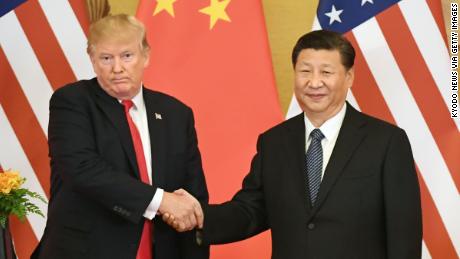
As the China and US engage in a tense trade war, however, Washington has been building closer ties with Taiwan, the island that China views as a renegade province.
On Saturday, Taiwan announced it had renamed its unofficial embassy in Washington from the Coordination Council for North American Affairs to the Taiwan Council for US Affairs, after discussions with Washington. That marked the first time a Taiwan government organization had been renamed to include the words "Taiwan" and "US."
And in March, Taiwan President Tsai Ing-wen announced she wanted to purchase advanced new weapons from US President Donald Trump's administration.
Beijing's comments came asTaiwan began its annual Han Kuang Exercise on Tuesday. The military drills are aimed at ensuring the island's readiness for an invasion by communist China's People's Liberation Army (PLA).
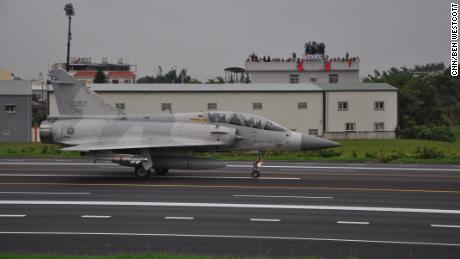
President Tsai watched as the air force landed F-16V aircraft on a highway in eastern Changhua county, an exercise designed to test the military's refueling and rearming capacity if major airfields on the island were occupied or destroyed by the PLA.
Hundreds of Taiwanese flocked to the roadside to watch the drill, waving flags and displaying banners showing their support for the island's airforce.
When asked about the future of US-Taiwan defense relations -- and whether the Bolton meeting was the new normal -- Taiwan military spokesman Maj. Gen. Chen Chung-Chi said the two governments would continue to work together.
"In the Asia Pacific region, we are just like the US, who share common core values including freedom of democracy and human rights (with)," he said.
"We also hope that we can play the role of defender of peace in the region. This is to serve the common interests of Taiwan and the US."
According to reports, the attacker stabbed at least 15 children at a bus station near a park in Kawasaki. A suspect has been arrested following the attack local media have reported. The attack took place at 07.44am local time (10.44pm BST).
As of yet, it is unclear as to the motive of the attacker on Tuesday morning.
A witness told Nippon Hōsō Kyōkai (NHK): "I heard screaming, then I saw a man standing with a knife in each hand
"Then he crumbled to the ground."
According to local news outlet NHK, the attacker stabbed himself in the shoulder before being detained and subsequently died at the scene.
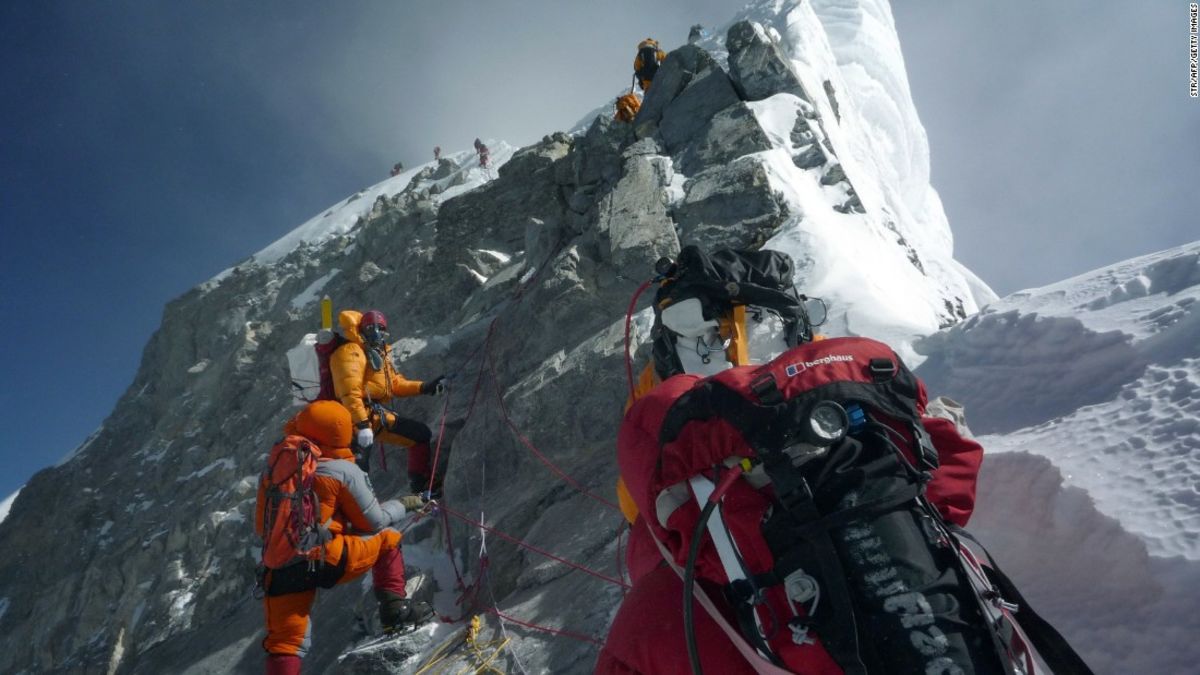
It seems like a record number of climbers are attempting to do so this year. That's led to traffic jams at the summit, with hundreds of people waiting in line to reach Everest's top.
So far, at least 11 people have died during this spring's climbing season. Last year, five climbers died, while six died in both 2017 and 2016.
People are still drawn to try to climb the mountain. However, Everest's mystique, while a huge lure for climbers, is based on a number of myths.
MYTH: It's the tallest mountain in the world
Yes, we've all been taught that Mount Everest, standing at an elevation of 29,035 feet, is the highest above sea level. But actually the world's tallest mountain is half a world away, in the middle of the Pacific Ocean. That's where you'll find Mauna Kea, on the island of Hawaii. Mauna Kea, a dormant volcano, rises 13,796 feet above sea level, but if you measure it from ocean floor to its summit, its total height is nearly 33,500 feet.
And Everest isn't even the highest point above Earth's center. That honor belongs to Mount Chimborazo in Ecuador. Chimborazo's summit is 20,564 feet above sea level, but because the planet is a little thicker at the equator (thanks to centrifugal force caused by Earth's constant rotation) Chimborazo's peak is more than 6,800 feet farther from the center of the Earth than Everest's summit.
MYTH: Only a select few get to climb
Climbing Everest is no walk in the park. Icy temperatures, fierce winds and limited oxygen make it a dangerous climb. More than 200 people have died on the mountain since 1922, when the first climbers' deaths on Everest were recorded. The success rate of Mount Everest climbers is only 29%.
Despite all that, hundreds of people get permission to climb Everest every year. Would-be climbers must obtain a permit, which cost about $11,000. For this year's spring climbing season, Nepal's tourism board has issued 381 permits so far.
There were about 11,000 attempts to reach the summit between 1922 and 2006, the website Adventurestats.com reports. And the age range of climbers is wider that you'd expect. The oldest person to successfully reach Everest's peak was 80-year-old Yuichiro Miura of Japan in 2013. The youngest? A 13-year-old American teen named Jordan Romero. He conquered Everest, accompanied by his father and stepmother, in 2010.
MYTH: You're required to endure years of preparation
Not true. The Nepalese government doesn't require a certain number of training hours that climbers must complete before attempting to summit Everest.
Several of the trekking agencies in Nepal that help facilitate adventurers' climb to the top will charge thousands of dollars for training to prepare climbers. The kinds of training offered by the different trekking agencies varies.
And even before going to Nepal, people who want to climb Everest are encouraged to commit to a heightened exercise schedule several months before their climb to try to achieve optimum fitness.
One of the first steps for anyone considering an Everest trek should be consulting with a physician to evaluate physical health. It's also a way to discover any pre-existing conditions that might be amplified by high altitude, Jon Kedrowski, a geographer and climber who summited Mount Everest in 2012, told CNN in 2016.
If Kedrowski is leading a peak expedition, he screens his clients and designs training programs to help them prepare for the journey. When altitude is a consideration, cardio is the emphasis, rather than strength, he said.
MYTH: It's a way to be one with nature
That may have been the case once. But the enormous increase in visitors in recent decades has had a severe impact on the mountain's sensitive environment, the Everest Summiteers Association says. A clean-up effort last month collected more than 6,613 pounds garbage in just the first two weeks: empty cans, bottles, plastic and discarded climbing gear.
CNN's Ashley Strickland and Rob Picheta contributed to this report.
A woman exits a voting booth with curtains depicting the European Union flag in Baleni, Romania, on Sunday.
Andreea Alexandru/AP
hide caption
toggle caption
Andreea Alexandru/AP
Europe's traditional centrist coalition lost its majority in the European Union's parliamentary elections Sunday, with far-right populist parties and liberal, pro-European Union parties both gaining ground. The results suggest a complicated future for the EU, as voters look for new ways forward.
More than 50 percent of European voters turned out last week to vote in the parliamentary elections, the highest turnout in two decades and a sharp increase from the last election in 2014.
Here's what you need to know from the results.
The center-left, center-right coalition lost its majority
The center-right group known as the European People's Party (EPP) and the center-left Progressive Alliance of Socialists and Democrats (S&D) held 54 percent of the seats before the vote. Now they're down to 43 percent, according to Sunday's results. The two blocs together lost more than 70 seats, along with the majority they held for decades, according to NPR's Sylvia Poggioli.
The results suggest that European centrists will have to reach out to and unite more broadly with liberal coalitions in order to affect change — and maintain authority — in the EU.
The far-right gained ground — but not as much as expected
Matteo Salvini, Italy's Deputy Prime Minister and leader of the right-wing League party, speaks at a news conference following the European Parliament election results on Monday in Milan.
Emanuele Cremaschi/Getty Images
hide caption
toggle caption
Emanuele Cremaschi/Getty Images
Populist, euroskeptic parties across Europe saw gains, but less than what some pre-election polls had predicted — and what pro-EU forces had feared. And the various nationalist parties' differences over issues like migration and attitudes toward Russia could cloud prospects for a united right.
"What happened was not really what a lot of people were fearing, that there would be a surge of the far-right populists," former Swedish Prime Minister and now co-chair of the European Council on Foreign Relations Carl Bildt told NPR on Monday. "There was an increase by the far-right, but fairly marginal and far less than what people had predicted."
Because the gains were smaller than expected, the far-right likely won't be able to reshape the future of Europe by itself, says NPR's Poggioli, but it may be able to obstruct the legislative process. Many attribute the victories on the far-right to high unemployment rates, security concerns after several terrorist attacks and tensions over migration.
In France, the far-right National Rally party of Marine Le Pen narrowly beat French President Emmanuel Macron's party coalition. Though Le Pen's party won by less than 1 percent, with 23 percent of the vote, she dubbed it a "victory for the people" on Twitter.
The League, Italy's far-right populist party led by Deputy Prime Minister Matteo Salvini, saw a sweeping victory, garnering more than 34 percent of the country's vote.
"Not only is the League the top party in Italy, Marine Le Pen is the top party in France, Nigel Farage is the top party in the U.K. So Italy, France, the U.K., it's a sign of a Europe that's changing," Salvini said at a press conference after the victory.
In Hungary, the nationalist Fidesz party of Prime Minister Viktor Orbán took more than 52 percent of the vote.
In Austria, conservative Chancellor Sebastian Kurz's Austrian People's Party won the election Sunday, but Kurz was ousted Monday when he lost a no-confidence vote stemming from a scandal that erupted last week over its coalition partner, the far-right Freedom Party. That party fared worse than it had in the previous European election.
Though many of the far-right parties of Europe share the goal of weakening the European Union, they clash on other pressing issues. In Italy, for instance, Salvini, though anti-immigration, has advocated for the relocation of asylum seekers across the EU. Hungary's Orbán has pushed to close borders.
"We reject migration; and we would like to see leaders in position in the European Union who reject migration, who would like to stop it and not manage it," Orbán wrote in a statement after casting his vote Sunday.
Europeans are concerned about the environment
The Greens, a party coalition focusing on environmental issues, went from 52 seats in the European Parliament in 2014 to 69 in 2019, making them the fourth largest voting bloc in the EU.
Members and supporters of the Greens coalition celebrate in Berlin after the announcement of the first forecast for the European elections.
Kay Nietfeld/Picture Alliance Via Getty Images
hide caption
toggle caption
Kay Nietfeld/Picture Alliance Via Getty Images
The results, the strongest ever for the Greens, indicate that many Europeans are growing increasingly concerned about climate change and the environment. Recently, across northern Europe, young people have been protesting what they see as governmental inaction on combating climate change.
In Germany, the Greens took 21 percent of the vote, second only to German Chancellor Angela Merkel's Christian Democrats, part of the center-right EPP European parliamentary bloc. Since the last election in 2014, Merkel's party lost 6 percentage points, while the Greens gained nearly 10 points.
The Greens also saw gains in France, the Netherlands, Ireland, Finland, Denmark and Belgium, among others.
"The Greens and the Liberals were the winners of the day," Sweden's Carl Bildt told NPR.
Brexit Party leader Nigel Farage arrives at a Brexit party on Monday in London.
Peter Summers/Getty Images
hide caption
toggle caption
Peter Summers/Getty Images
Voters in the United Kingdom weren't initially even supposed to participate in this election; they were supposed to have left the EU by the end of March. But with several delays — and plans for leaving now set for October — U.K. voters had to take part, and gave the new Brexit Party, led by populist Nigel Farage, more than 30 percent of the vote.
In contrast, Prime Minister Theresa May's Conservative Party ended up in fifth place, with 8.7 percent of the vote. "This is the worst showing by the Conservative Party since the 1830s," says NPR's Frank Langfitt.
The Labour Party also fared poorly, down 10 percentage points since 2014. Both the Labour and Conservative parties wavered on finding a clear position on Brexit, and the vote seems to indicate, Langfitt says, that voters rewarded clarity on the issue of leaving the EU. Liberal Democrats and other pro-EU parties did well.
"Never before in British politics has a new party, launched just six weeks ago, topped the polls in a national election," Farage said after his election as a member of the European Parliament. "There's a huge message here, a massive message here."
President Trump and Japanese Prime Minister Shinzo Abe at Akasaka Palace in Tokyo on Monday.
Evan Vucci/AP
hide caption
toggle caption
Evan Vucci/AP
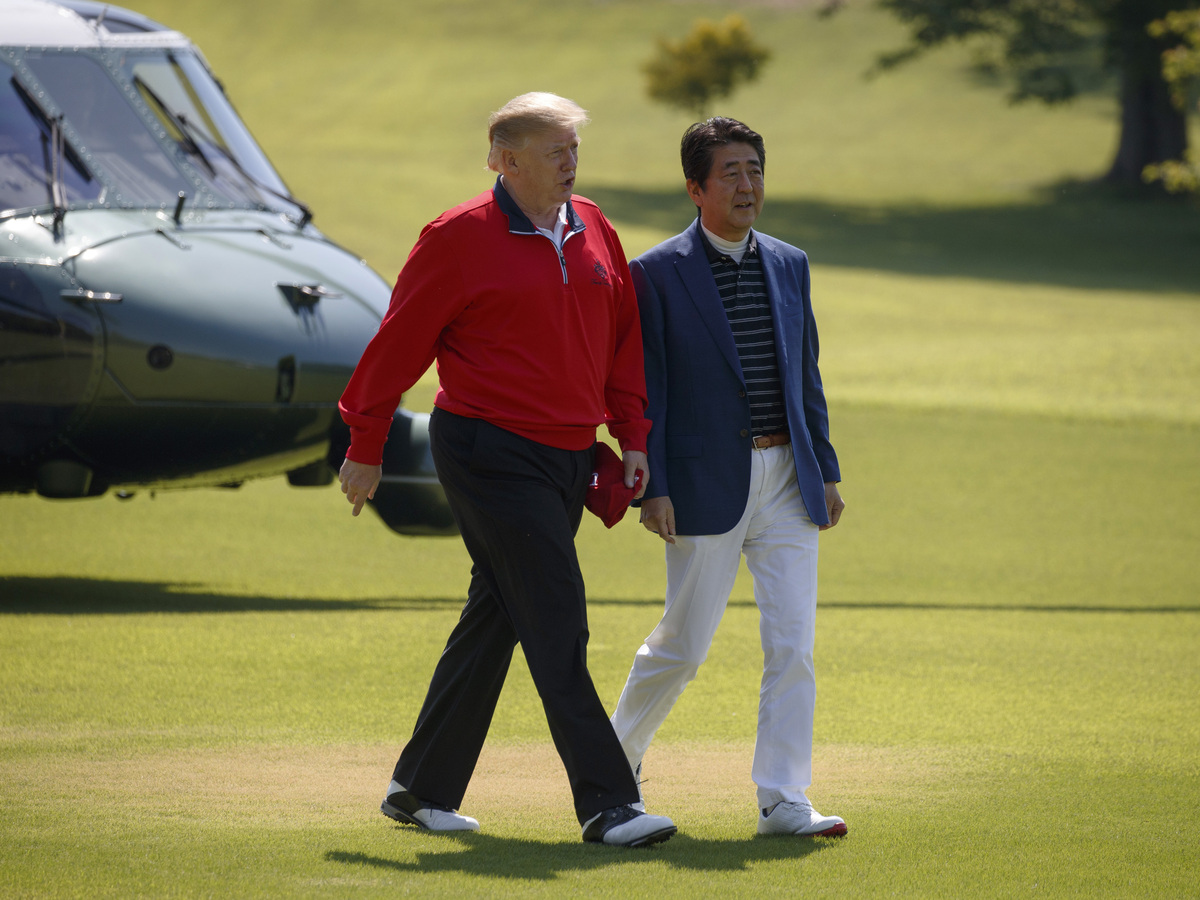
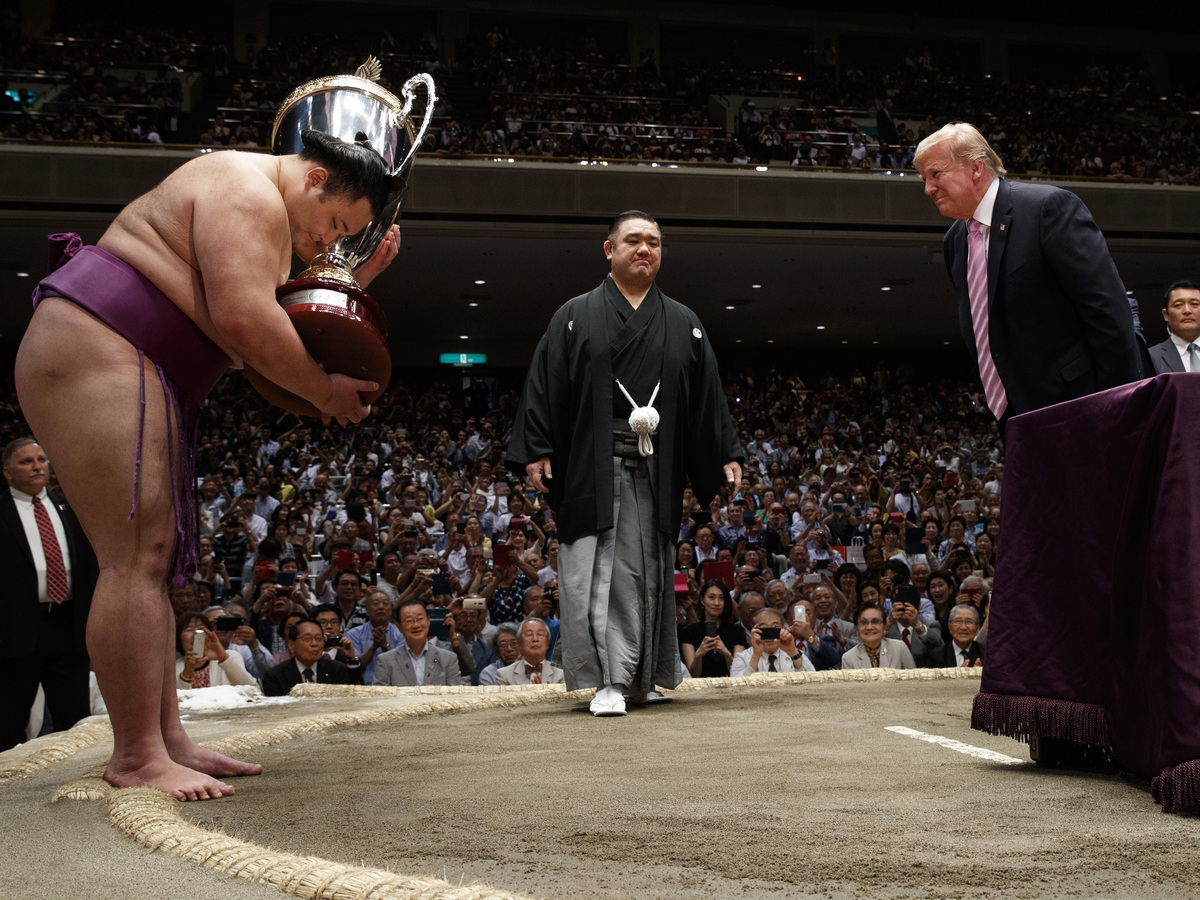
The optics and the rhetoric of President Trump's state visit to Japan aimed to show two allies at their closest in history, at the start of a new Japanese emperor's reign. Trump is the first state guest to visit since Emperor Naruhito ascended the Chrysanthemum Throne on May 1. On Sunday, he and Japanese Prime Minister Shinzo Abe shared a round of golf, attended a sumo wrestling match and had a barbecue dinner.
But on Monday, a joint press conference with the two leaders revealed the two countries struggling to manage differences over a raft of policy issues — in particular, bilateral trade, North Korea and Iran.
President Trump walks with Japanese Prime Minister Shinzo Abe before playing a round of golf on Sunday in Shiba, Japan.
Evan Vucci/AP
hide caption
toggle caption
Evan Vucci/AP
One of Japan's top concerns is that the U.S. is threatening tariffs on Japanese car exports to the U.S. if a deal is not reached in six months. Those exports are a mainstay of the Japanese economy, and Tokyo is unnerved to hear that its chief ally classifies Japan's trade surplus as a security threat.
"When I talk about a security threat, I talk about a balance sheet," Trump said at Monday's press conference at the Akasaka Palace in Tokyo.
In its defense, Japan points out that it produces more cars in the U.S. than it exports there, and that investment has surged under the Trump administration, creating tens of thousands of U.S. jobs.
President Trump acknowledged that Japan has lowered its trade surplus, with plans to purchase more than 100 U.S. F-35 warplanes, more than any other ally.
Trump is expected to highlight that purchase on Tuesday, when he plans to visit the port of Yokosuka, home to both U.S. and Japanese warships. Japan's legislature has approved plans to convert helicopter carriers to accommodate F-35s, giving it its first aircraft carriers since World War II.
President Trump presents the President's Cup to the Tokyo Grand Sumo Tournament winner Asanoyama on Sunday.
Evan Vucci/AP
hide caption
toggle caption
Evan Vucci/AP
Trump suggested that any trade deal would have to wait until after Japan's parliamentary elections in July. Washington has its hands full with an ongoing trade war with China, and Abe could lose votes if he makes big concessions to the U.S. before the poll.
Analysts say Abe seeks to cement a two-thirds majority in Japan's parliament to achieve his long-held goal of rewriting Japan's U.S.-drafted postwar constitution, which limits the role of Japan's emperor and its military.
"I think he thinks of this as unfinished family business," says Jeff Kingston, director of Asian studies at Temple University's Japan campus in Tokyo. "This is something that his grandfather Kishi Nobusuke had wanted to do. So I think that he feels that this would bring completion to his political career."
Nobusuke served as Japan's prime minister from 1957 to 1960.
President Trump and First Lady Melania Trump attend a state banquet with Japanese Emperor Naruhito (second from right), and Empress Masako (left) on Monday in Tokyo.
Evan Vucci/AP
hide caption
toggle caption
Evan Vucci/AP
Washington is still eager to strike a trade deal, though, because Japan has signed trade agreements with big agricultural producers, including Australia and Canada, allowing their farmers and ranchers to grab market share from their U.S. competitors. The Trump administration has criticized Japan's move as unfriendly.
"What you're looking at is a U.S. government that is demanding what it could have had, and is unfortunately not in a position to acknowledge that," says Brad Glosserman, deputy director of the Center for Rule-making Strategies at Tama University in Tokyo.
Previously, the U.S. had proposed and then negotiated a trade deal known as the Trans-Pacific Partnership, Glosserman points out, but Trump walked out on it.
"I'm not bound by anything that anybody else signs, with respect to the United States," Trump said at Monday's press briefing. The TPP, he said, "would have destroyed our automobile industry and many of our manufacturers."
Trump reiterated his indifference to North Korea's short-range missile tests this month, despite criticism of the launches from his own national security adviser, John Bolton. The tests also worry South Korea and Japan, both of which are within the missiles' striking range. So are some U.S. military bases in these countries.
But Trump pointed to the lack of nuclear and long-range missile tests as signs of his diplomatic success with North Korea. "I am very happy with the way it's going, and intelligent people agree with me," he said.
Abe is the only regional leader who has not met with North Korean leader Kim Jong Un, and therefore has less to offer the U.S. as a mediator.
This is not the case with Iran, with which Japan has long had friendly ties. Japan has also been highly reliant on Iranian oil, but has had to cut that reliance due to U.S. sanctions. Prime Minister Abe is considering traveling to Iran next month, and at Monday's briefing, he pledged to do whatever he could to mediate.
Japanese media have reported that Tehran would like Tokyo to mediate with the U.S. on its behalf.
Japan has supported the 2015 Iran nuclear deal, which President Trump pulled the U.S. out of.
"This is one of the few issues on which Japan very clearly takes a position that is contrary to the U.S. government. And usually, Abe's pretty good about positioning himself to be the faithful ally" of the U.S., says Daniel Sneider, a Japan expert at Stanford University.
All the policy talk on the second full day of Trump's visit stood in sharp contrast to the first day, which was centered around golf, sumo wrestling, burgers and steak. The schedule was clearly calculated to please Trump and highlight the closeness of the two leaders.
Trump and Abe "are good friends, it seems, but that is not the issue," says Kunihiko Miyake, a former diplomat and now research director at the Canon Institute for Global Studies in Tokyo.
"This is not just for Mr. Trump," he says, "this is for the president of the United States." And once the ceremonies are finished, the U.S. and Japanese leaders must cooperate on facing urgent strategic challenges, including the rise of Iran and China.
LONDON — The dust has settled on the world's second largest democratic exercise, a continent-wide vote that has left Europe's political landscape reshaped.
Last week, some 373 million citizens across 28 countries took part in elections for the European Parliament, which makes laws that bind the political and economic bloc. The results rolled in on Sunday night.
Far-right populists had some wins, but it wasn't quite the dramatic, widespread surge seen in recent elections at the national and local level across the continent.
What is clear is that the mainstream parties from the center-left and center-right hemorrhaged votes, with much of their support going to a fragmented collection of environmentalists and pro-European Union liberals.
Steve Bannon, the former adviser to President Donald Trump, called for these elections to be a referendum endorsing his right-wing populist vision for Europe. But while there were some victories for this camp, the full-blown tsunami that some predicted failed to materialize.
Right-wing populists fell short of expectations in Austria, the Netherlands and Denmark, while Germany's AfD party made only slight gains.
Even in France, where Marine le Pen's National Rally came first, beating President Emmanuel Macron's En Marche party, its provisional vote share was down on the last European Parliament elections in 2014.
"The big story is that the nationalist populists have not managed to turn this into a referendum on the E.U.," said Jose Ignacio Torreblanca, a senior policy fellow at the European Council on Foreign Relations, a Brussels-based think tank. "People like Bannon have failed."
That said, while the gains might not have been as dramatic as some forecast, the election arguably cemented far-right populism as a European force that isn't going away soon. Such parties are often anti-migrant, anti-Muslim and anti-E.U., or at least wish to radically reshape the bloc from within.
There were clear victories for the right in Poland, Hungary and Italy. "The rules are changing in Europe," said Matteo Salvini, the leader of Italy's far-right League party which got around 34 percent of the vote there. "A new Europe is born."
Britain's Brexit Party was also victorious, securing around one-third of the vote and relegating the ruling Conservatives to fifth place at a dismal 9 percent. However, the U.K. should perhaps be seen as a special case due to the country's protracted and messy attempts to leave the European Union.
For the first time, the traditional center-left and center-right parties will not have a majority in the European Parliament's 751-seat chamber.
The Social Democrats and the European People's Party, groupings which have dominated for years, lost 39 and 36 seats respectively, according to provisional results.
"This is a profound change," said Janis A. Emmanouilidis, director of studies at the European Policy Centre, another Brussels-based think tank. "The two biggest parties have lost a significant number of seats."
March 14, 201901:51
However, voters often use the E.U. elections to give major parties a bloody nose, secure in the knowledge that it will not cause upheaval in their own national parliaments.
Even so, Sunday's results represented a seismic rejection of the traditional ruling parties across the continent.
"We are facing a shrinking center of the European Union parliament," Manfred Weber, chairman of the European People's Party said. "From now on, those who want to have a strong European Union have to join forces."
The one exception was in Spain, where the Socialists looked set to gain 20 of the country's 54 seats. The Socialists belong to the wider Social Democrats group, however, for whom the general outlook was far more bleak.
"If you lose an election, if you lose seats, you have to be modest," added Frans Timmermans, the lead candidate for the Social Democrats. "We have lost seats and this means that we have to be humble."
Riding something of an environmentalist wave washing over Europe, the continent's Green group made big gains.
This was most evident in Germany, where the Greens doubled their provisional vote share to 21 percent and overtook the country's traditional center-left Social Democrats in the process.
In France and Britain, the Greens also did well, placing third and fourth respectively. More subtly, environmental issues were given increased prominence in the manifestos of other parties, too.
Another group that mopped up support from the traditional parties was the pro-Europe, pro-business liberal centrists.
Parties allied with the Alliance of Liberals and Democrats for Europe — known as ALDE — looked set to increase their number of seats from 68 to 109, although this was largely thanks to Macron's En Marche party joining them.
ALDE is led by Guy Verhofstadt, one of the E.U.'s most ardent defenders against populist forces that wish to dismantle or disrupt the union.
The boost in support suggests that voters, especially young people, came out to back their side of the argument.
"When Europe is threatened, you have seen the youth mobilizing to defend it," said Torreblanca at the European Council on Foreign Relations.
The BBC also reported that turnout in the U.K. surged in areas that supported the country staying in the E.U. in the 2016 Brexit referendum. Britain's Liberal Democrats came second with 20 percent of the vote. They were one of the parties to explicitly oppose Brexit, and gained huge support in Remain-backing areas, including beating Labour in that party's erstwhile stronghold of London.
This was the first time in Europe's history that turnout for these elections has risen, climbing from 43 percent to an encouraging 51 percent.
"This is noteworthy," said Emmanouilidis at the European Policy Centre, calling the leap "remarkably higher."
Yet the results spell a European Parliament that is going to be far more fragmented than it has been in recent years.
The two centrist giants bled support and will be unable to form the kind of "grand coalition" that they had before. Instead they might need another coalition partner or two, meaning more compromise and room for disagreement on key issues.
Timmermans, of the Social Democrats, has already ruled out attempting to build a coalition with the far-right, calling instead for a "progressive" grouping to be formed.
"It will become quite messy," said Emmanouilidis, describing attempts to find consensus in Brussels "an uphill struggle" at the best of times.
Alexander Smith
Alexander Smith is a London-based senior reporter for NBC News Digital.