Minggu, 23 Mei 2021

Israel-Gaza: A conflict on pause as both sides claim victory - BBC News

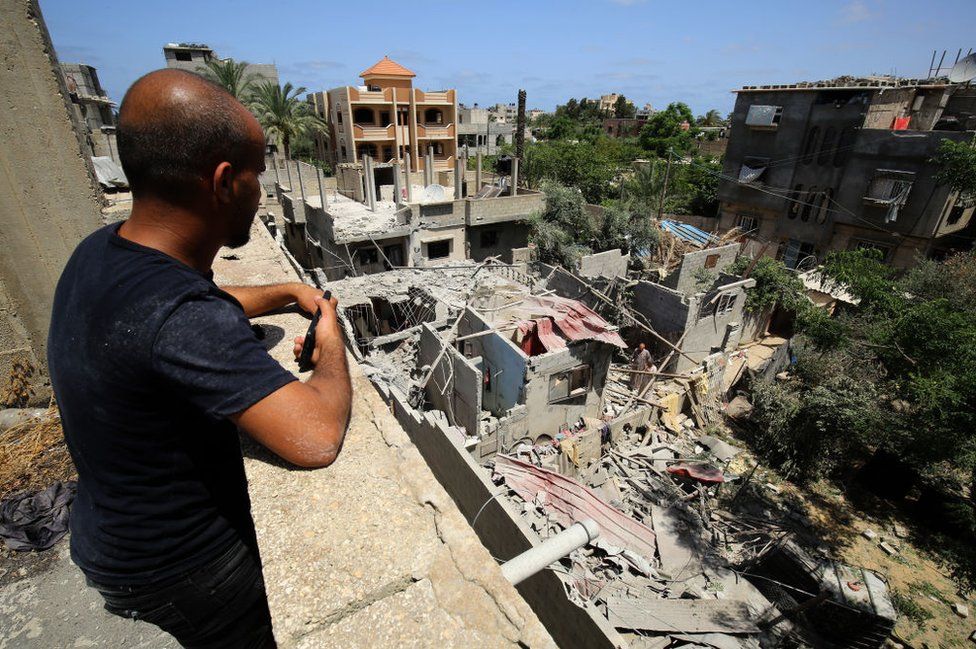
A man looks at the debris of a building in Khan Yunis, Gaza, on May 20, 2021
Anadolu Agency via Getty Images

After the ceasefire, Palestinians in Gaza, who had stayed inside as much as they could while there was a chance of getting killed outside, walked round their neighbourhoods to get a better idea of what Israel had done.

People stopped to inspect huge piles of concrete rubble from the tower blocks that Israel had toppled. In some places the streets were blocked by rubble. Bulldozer operators were working overtime. Nothing they found was surprising. What has happened has been covered exhaustively on TV. But human beings like to see for themselves.

In Khan Younis, one of Gaza's towns, I went to the funeral of nine fighters who were killed in part of the tunnel network that Israel has targeted.

Israeli politicians and commanders have claimed that they have done serious damage to what they describe as an infrastructure of terror, run by Hamas and the smaller factions in Gaza. The damage to buildings is obvious. I have not been able to see underground military installations, but the talk here is that Hamas was shocked that Israel was able to kill its men when they believed they were safe underground.

Morale among supporters of the armed groups in Gaza is another matter. It seems intact, even enhanced by the 11-day war.

Khan Younis stopped for the funerals. Several thousand men prayed on a sports field and followed the stretchers carrying bodies wrapped in Palestinian flags, chanting their support on the way to the cemetery.
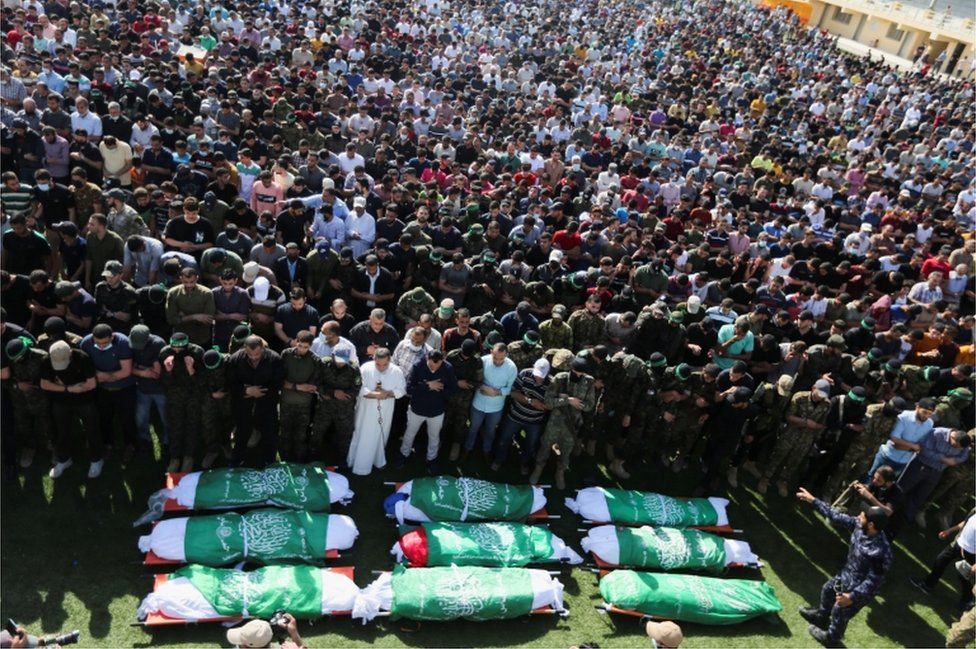
Thousands of people in Khan Younis attend a funeral for Palestinians killed during Israeli-Palestinian fighting, held on 21 May
Reuters

Israel and Hamas both claimed victory.

Israeli leaders listed buildings destroyed, Hamas commanders and fighters targeted and killed, and the remarkable success of the Iron Dome anti-missile system.

Hamas defines victory first of all as survival. Its leader in Gaza, Yahya Sinwar, emerged triumphantly from hiding the day after the ceasefire. But Hamas will also look at the political scorecard with some satisfaction.

Hamas slogans have been chanted after prayers 60 miles (96km) inland from Gaza, at the Al-Aqsa mosque in Jerusalem. Hamas has driven home a message to Palestinians that it is prepared to fight and accept sacrifices for their rights in Jerusalem. Israel insists that all of Jerusalem is its eternal and indivisible capital. Palestinians have other ideas.

The Palestinian President Mahmoud Abbas is recognised internationally as the representative voice of his people through his leadership of the PLO and the Palestinian Authority, which administers parts of the occupied territories and was intended in the now moribund Oslo agreements of the 1990s to develop into the government of an independent state.

But Palestinians are deeply dissatisfied with the president's performance. He cancelled elections due for May that he looked likely to lose. Palestinians have not been able to vote for a president or a legislature since 2006.

In contrast, a simple message from Hamas that it would fight to the death for Jerusalem resonated with Palestinians who despair at the inability of President Abbas to slow down, let alone stop, the steady increase of Jewish settlement, illegal under international law, on occupied land they want for a state.
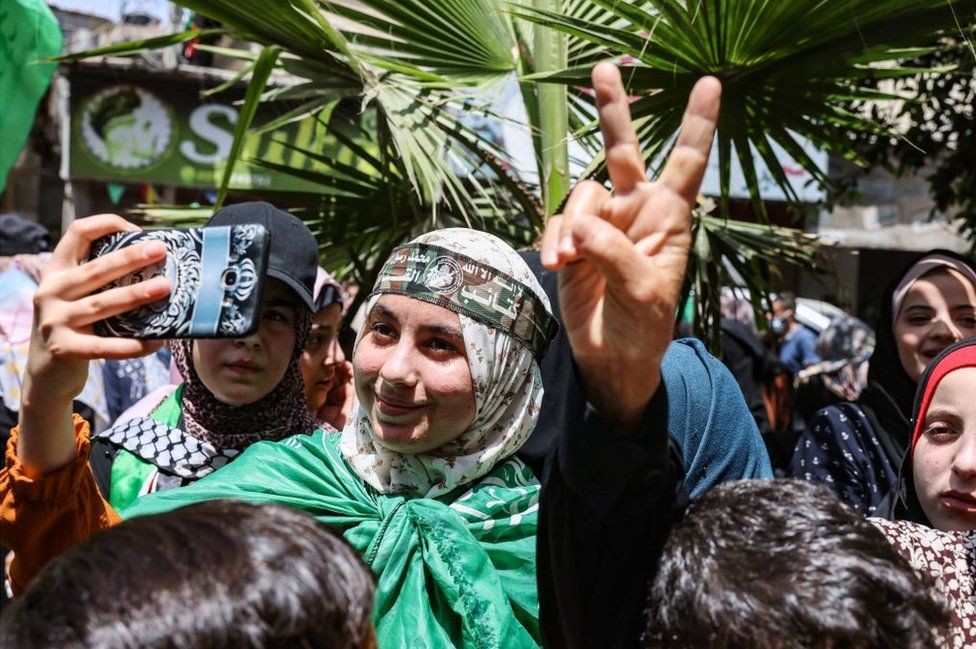
Palestinian supporters of Hamas celebrate the ceasefire between Hamas and Israel, in Khan Younis, in the southern Gaza Strip, on May 21, 2021.
AFP via Getty Images

In Israel, Prime Minister Benjamin Netanyahu will now return to the battle for political survival he was fighting before the 11 days of conflict with Hamas.

Mr Netanyahu is on trial on charges so serious that he could end up in jail for corruption, like his predecessor Ehud Olmert. On 10 May, the day Hamas dramatically escalated the conflict by firing missiles at Jerusalem, the prime minister was close to losing his job.

He has been a caretaker since the fourth inconclusive election in two years. In a month of trying, Mr Netanyahu failed to form a coalition that commanded the necessary 61 votes in parliament for a majority.

His main opponent, Yair Lapid, was taking his turn and looked to be days, even hours, away from announcing he had the votes to form a government. Mr Lapid's plans fell apart during the fighting. He still has time to rebuild them, though a fifth election might be a more likely outcome.

Israel also has to deal with the collapse of co-existence between its Jewish majority and Palestinian Arab minority, which makes up around 20 per cent of the population. Mr Netanyahu's polarising rhetoric and embrace of extreme Jewish nationalists have made a bad situation worse.
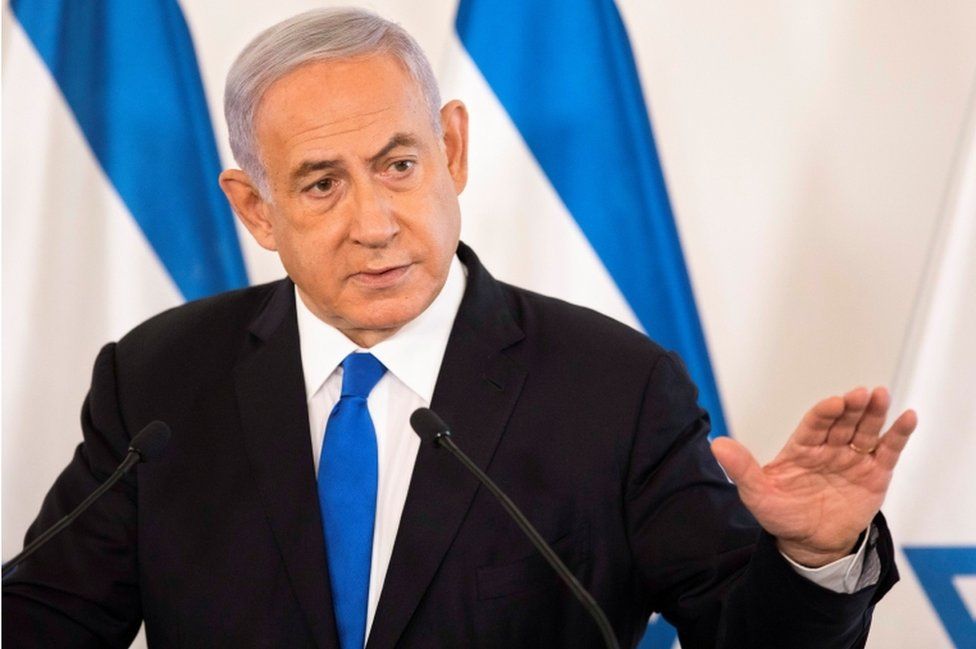
Israeli Prime Minister Benjamin Netanyahu pictured during a briefing to ambassadors to Israel in Tel Aviv on May 19, 2021.
Reuters

Like the previous rounds of fighting between Israel and Hamas, the ceasefire is just a pause. The conflict is not just unresolved. It is not even frozen. The ceasefire will hold until it is tested by a crisis. That could be a rocket fired out of Gaza, or more Israeli police violence towards Palestinians in Jerusalem.

Or it could be the lawsuit brought by Jewish settler groups to evict Palestinians from their homes in Sheikh Jarrah, a leafy district on the occupied eastern side of Jerusalem. The prospect of evicted Palestinian families being replaced by more Jewish settlers was a major reason why tension in Jerusalem turned violent.

The judgement in the case was postponed in a belated attempt to calm matters. But the case was not dropped, and the judgement will eventually be issued. Israel's legal timetable could deliver the ceasefire's first big challenge.

Adblock test (Why?)


https://news.google.com/__i/rss/rd/articles/CBMiNWh0dHBzOi8vd3d3LmJiYy5jby51ay9uZXdzL3dvcmxkLW1pZGRsZS1lYXN0LTU3MjE4NDI40gE5aHR0cHM6Ly93d3cuYmJjLmNvLnVrL25ld3Mvd29ybGQtbWlkZGxlLWVhc3QtNTcyMTg0MjguYW1w?oc=5

2021-05-23 11:07:36Z
52781577069323

Italy cable car fall: Nine dead after accident near Lake Maggiore - BBC News

Nine people have been killed after a cable car fell on a mountain near Lake Maggiore in northern Italy on Sunday.

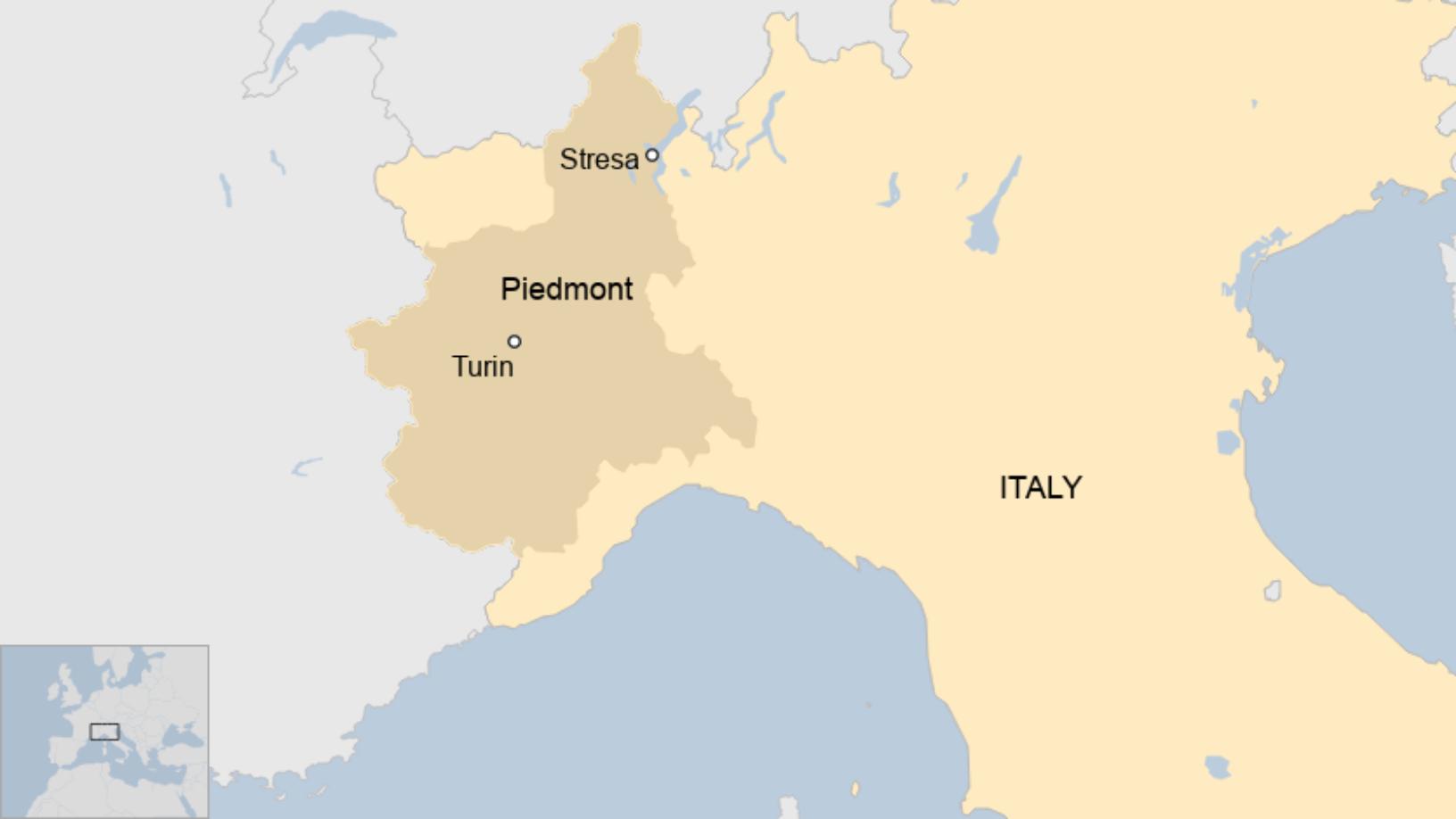
The accident happened on a service transporting passengers from the resort town of Stresa up the nearby Mottarone mountain in the region of Piedmont.

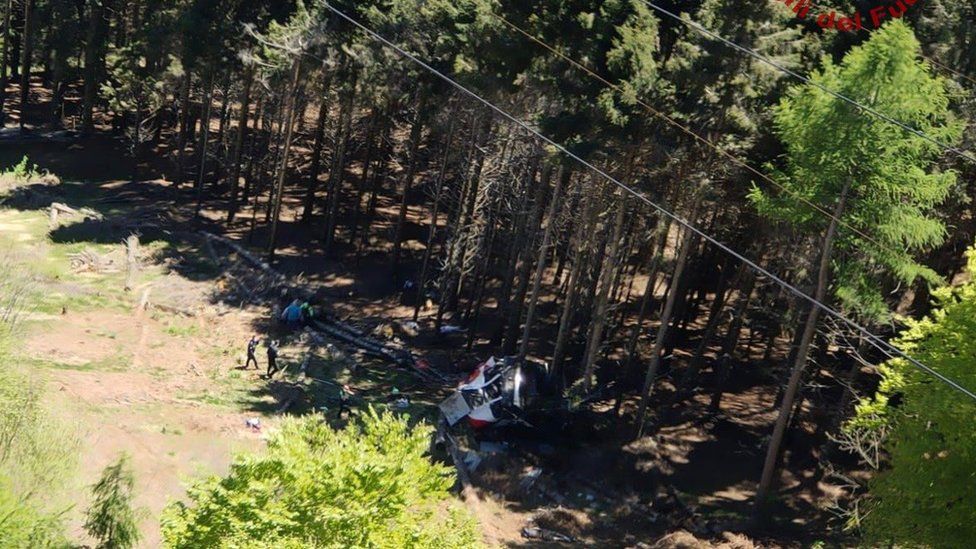
An image posted on social media by emergency services showed the wreckage of the car lying in a wooded area.

Officials say two children, aged five and nine, were taken from the scene by helicopter to a Turin hospital.

They are the only survivors of 11 passengers who had been on board when the cable car crashed, a spokesman for Italy's alpine rescue service confirmed to the Reuters news agency.

Officials said a call to emergency services came just after 12:00 local time (11:00 BST) on Sunday.

Walter Milan, another alpine rescue spokesman, told RaiNews24 television that the cable car was left "crumpled" after falling from a high height.

The cause of the incident remains unclear, but local reports suggest the cable carrying it may have failed about 300m (984ft) from the top of the mountain.

Social media image showing wreckage of cable car posted by emergency services
@emergenzavvf
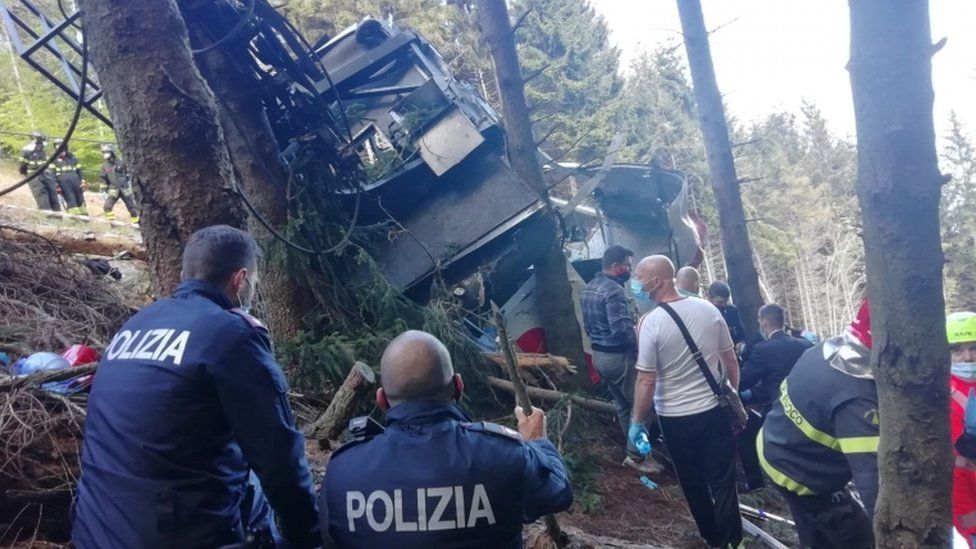
Police and other rescuers photographed at the scene of the wreckage
Handout Via Reuters

The website for the Stresa-Alpine-Mottarone cable car said it usually takes 20 minutes to transport passengers 1,491m above sea level.

Mottarone is situated between Lake Maggiore and Lake Orta, offering scenic views of the region for tourists.

Map

The cable car service had recently reopened following the lifting of coronavirus restrictions, Reuters news agency reported.

Banner saying 'Get in touch'

Are you in the area? If it is safe to do so, share your experiences. Email haveyoursay@bbc.co.uk.

Please include a contact number if you are willing to speak to a BBC journalist. You can also get in touch in the following ways:

If you are reading this page and can't see the form you will need to visit the mobile version of the BBC website to submit your question or comment or you can email us at HaveYourSay@bbc.co.uk. Please include your name, age and location with any submission.

Adblock test (Why?)


https://news.google.com/__i/rss/rd/articles/CBMiMGh0dHBzOi8vd3d3LmJiYy5jby51ay9uZXdzL3dvcmxkLWV1cm9wZS01NzIxOTczN9IBNGh0dHBzOi8vd3d3LmJiYy5jby51ay9uZXdzL3dvcmxkLWV1cm9wZS01NzIxOTczNy5hbXA?oc=5

2021-05-23 14:00:59Z
52781616213184

The hardline Israelis stoking violence in East Jerusalem - Al Jazeera English

Sheikh Jarrah, Occupied East Jerusalem – A surreal, and almost bucolic, atmosphere encompassed the occupied East Jerusalem suburb of Sheikh Jarrah on a recent morning as an Israeli settler and a Palestinian sat on armchairs under an old fig tree surrounded by picturesque stone houses, discussing the ongoing violence in the presence of an Israeli TV crew.

For several weeks the Sheikh Jarrah neighbourhood was a pivotal point in an ongoing battle in which dozens of Palestinian families are fighting to remain in the homes they lived in for generations as they face possible forced expulsion by Israeli authorities to make way for Israeli settlers, a move illegal under international law.

On an almost nightly basis, the families, and hundreds of their supporters, came out to protest, facing off with Israeli security forces, leading to the assault and arrest of dozens of Palestinians as well as the destruction of both Palestinian and settler property.

The debate between the Palestinian and the Israeli settler outside the home of the al-Kurd family – one of the families threatened with expulsion – was civil as they answered questions from the TV crew between sips of coffee.

However, the gaping chasm between the lives of Palestinians on the ground and the ideology of the settler movement was glaringly obvious.

“There was peace here for a long time until ‘trouble-makers’ from the Israeli-Arab cities came here,” Israeli settler Eric – who lives in the illegal settlement of Givat Ze’ev and studies at the nearby Simon Tzadak yeshiva in Sheikh Jarrah, but who was afraid to give his full name – told Al Jazeera.

“I have Palestinians from the West Bank working for me and we got on fine before Palestinians started attacking Jews here.”

When asked about the repeated raids on Al-Aqsa Mosque by Israeli security forces, Eric said he did not believe that Palestinian fears over the possible division of the Al-Aqsa Mosque were grounded in reality.

“The two sides will be kept apart because the government knows that if they share places of worship there will always be confrontations,” he said.

Third Jewish Temple

There are several Israeli settler movements involved in pushing for Jewish worshippers to be allowed to pray at Al-Aqsa, reinforcing Palestinian fears that Islam’s third-holiest site could follow the route of the Ibrahimi Mosque in Hebron in the southern West Bank.

Following the 1994 massacre of dozens of Palestinians after an Israeli settler opened fire as they worshipped, the Ibrahimi Mosque was divided into days allowing Jewish prayer and days allowing Muslim prayer, as streets in the Old City were restricted for Palestinian families and businesses and reserved for settlers.

One of the most hardline settler movements is the Temple Mount and Land of Israel Faithful Movement, an Orthodox Jewish group. Its goal is to rebuild the Third Jewish Temple on the grounds of Al-Aqsa Mosque and reinstitute the practice of ritual sacrifice, according to their website.

The movement was founded in 1967 by former Israeli military officer and Middle Eastern studies lecturer Gershon Salomon.

In the 1980s, there were two attempts by Jewish hardliners to blow up the Islamic sites in the Al-Aqsa compound.

In 1990, 17 Palestinians were killed and more than 100 others wounded by Israeli’s paramilitary border police after riots erupted following the announcement by the Temple Mount Faithful that they intended to lay a cornerstone for the Third Jewish Temple on the grounds of the Al-Aqsa compound.

Following the clashes, Israeli police banned members of the movement from entering the compound.

But the Israeli government, which has always supported the settler movement, has moved further right over the years.

Members of Temple Mount Faithful in the Old City [File: Eliana Aponte/Reuters]
‘On the fringe’

The Temple Institute in Jerusalem’s Old City is partly funded by the Israeli government.

It produces ritual objects for the Temple, in anticipation of its reconstruction, while performances of simulated ritual sacrifices by priests in white robes are held annually before the Jewish Passover in close proximity to Al-Aqsa Mosque.

“Twenty to 30 years ago, Israel’s settler extremists were on the fringe of society but today we live in a reality where right-wing extremist Itamar Ben-Gvir is a member of the Knesset,” Lod-based Palestinian journalist Rami Younis told Al Jazeera.

Ben-Gvir, a supporter of the Kahanist movement, which advocates for the expulsions of Palestinians, was blamed for provoking some of the unrest in Sheikh Jarrah by establishing a temporary office near the illegal Shimon Tzadak settlement, before being asked by Israeli Prime Minister Benjamin Netanyahu to leave to avoid further violence.

Violence erupted last month during the Muslim holy month of Ramadan when far-right Israelis marched in the Old City, harassing Palestinians and chanting “death to Arabs”.

Younis said he also believes the Israeli media is enabling the settlers by giving their viewpoints extensive coverage.

“Israeli TV has given Ben-Gvir 509 minutes of airtime over the last two weeks while I was given nine minutes,” said Younis.

He also accused the Israeli police of legitimising the behaviour of violent settlers during the recent attacks, saying the lines between the occupied West Bank and Jerusalem and Israel within the Green Line were becoming increasingly blurred.

“The Israeli police escorted busloads of armed settlers from the West Bank into Lod, allowing them to break curfew saying they had come to the ‘defence of Israelis there’,” Younis said.

The Israeli government has repeatedly said it would protect the right of all religions to pray in occupied East Jerusalem at their holy sites.

Protecting settlers

However, Halima Abu Haneya, who specialises in social sciences, said the Israeli government had encouraged settlers to pray in the Al-Aqsa compound and repeatedly protected them when disturbances broke out by arresting Palestinians but not Israeli settlers when they carried out acts of violence.

“Furthermore, when Israeli settlers shot at and seriously wounded two Palestinians during clashes in Shu’afat, in East Jerusalem recently, the police never arrived nor were any settlers arrested,” Abu Haneya told Al Jazeera.

Palestinian fears over the division of Al-Aqsa are part of what they say is an Israeli process of “Judaising” the city in favour of a Jewish majority, with the Israeli government repeating that Jerusalem will be united and under its control permanently.

“Throughout its occupation, Israel has significantly restricted Palestinian development in East Jerusalem,” said the UN Office for the Coordination of Humanitarian Affairs (OCHA).

“Over one-third of East Jerusalem has been expropriated for the construction of Israeli settlements, despite international humanitarian law prohibiting the transfer of civilians to the occupied territory.

“Only 13 percent of the annexed area is currently zoned by the Israeli authorities for Palestinian construction, within which Palestinians have the possibility of obtaining building permits, which are expensive and difficult to obtain.”

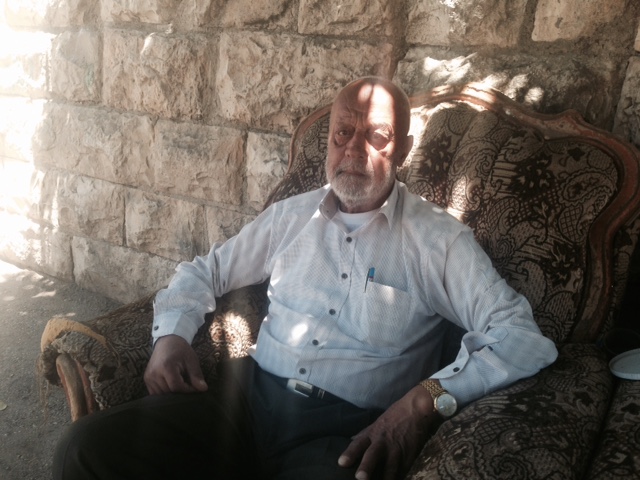
Sitting outside the al-Kurd’s home, and looking directly at the Shimon Tzadak settlement across the road, Muhammad Sabbah told Al Jazeera his family was one of eight that were facing possible expulsion from Sheikh Jarrah.

“There have been several expulsions over the years. It’s an ongoing process. But if the Israeli court rules in favour of the expulsions we will not move – under any circumstances.”

Muhammad Sabbagh’s family faces forced expulsion from the occupied East Jerusalem neighbourhood of Sheikh Jarrah [Mel Frykberg/Al Jazeera]
Adblock test (Why?)


https://news.google.com/__i/rss/rd/articles/CBMiYWh0dHBzOi8vd3d3LmFsamF6ZWVyYS5jb20vbmV3cy8yMDIxLzUvMjMvdGhlLWhhcmRsaW5lLWlzcmFlbGlzLXN0b2tpbmctdmlvbGVuY2UtaW4tZWFzdC1qZXJ1c2FsZW3SAWVodHRwczovL3d3dy5hbGphemVlcmEuY29tL2FtcC9uZXdzLzIwMjEvNS8yMy90aGUtaGFyZGxpbmUtaXNyYWVsaXMtc3Rva2luZy12aW9sZW5jZS1pbi1lYXN0LWplcnVzYWxlbQ?oc=5

2021-05-23 08:32:31Z
52781577069323

Mount Nyiragongo: DR Congo city of Goma empties as thousands flee erupting volcano - Sky News

DR Congo's Mount Nyiragongo has erupted for the first time in nearly two decades.

Many thousands of people have fled the city of Goma, some heading for its highest point Mount Goma.

Others headed for the nearby Rwandan border, with authorities there saying that around 3,000 people had already crossed over on Saturday night.

Goma resident Zacharie Paluku told The Associated Press: "Everyone is afraid, people are running away. We really don't know what to do."

There was a government evacuation plan but it came hours after the sky had turned a fiery red and power had been cut to the city.

Lava from the eruption flowed on to a major road on Saturday as it reached the airport on the city's edge, according to a volcanologist based there.

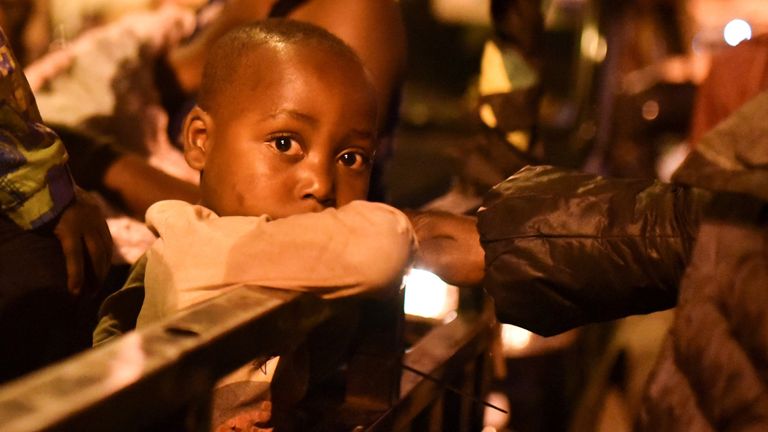
A child looks on as people gather with their belongings following a volcanic activities at Mount Nyiragongo near Goma, in the Democratic Republic of Congo May 22, 2021. REUTERS/Olivia Acland
Image: Thousands of people have fled the city of Goma, many heading for the Rwandan border
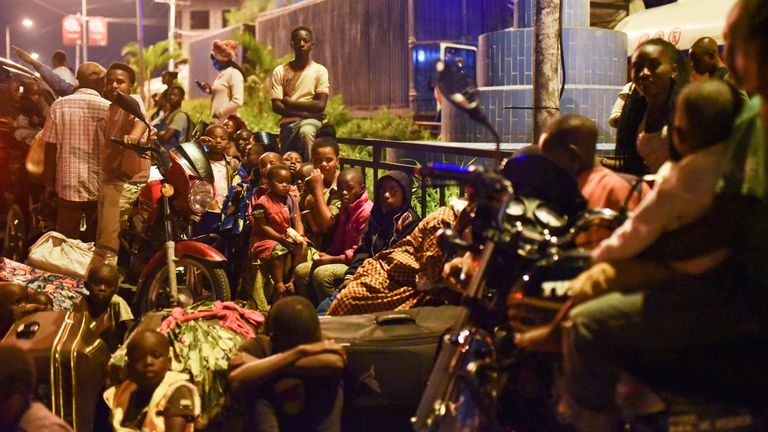
Civilians watch smoke and flames as they gather with their belongings following a volcanic activities at Mount Nyiragongo near Goma, in the Democratic Republic of Congo May 22, 2021. REUTERS/Olivia Acland
Image: Many people fled the city before the government activated its evacuation plan, worried by the bright red the sky

Dario Tedesco told Reuters that new fractures were opening in Nyiragongo, allowing the lava to flow southward towards Goma after initially flowing east toward Rwanda.

More on Democratic Republic Of Congo

"Now Goma is the target," Mr Tedesco said, adding: "It's similar to 2002."

Another Gomo resident told Sky News that the "situation is serious".

"The fire is becoming complicated. The houses are burnt, the people are suffering and the problems are huge," he said.

Nyiragongo's last eruption was in 2002 and it left hundreds of people dead, and coated airport runways with lava.

"I think that the lava is going towards the city centre," Mr Tedesco said.

"It might stop before or go on. It's difficult to forecast."

No casualties have been confirmed as a result of the eruption so far.

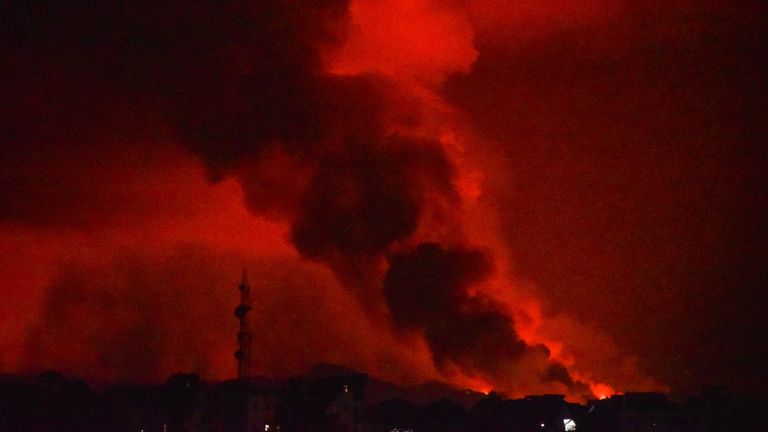
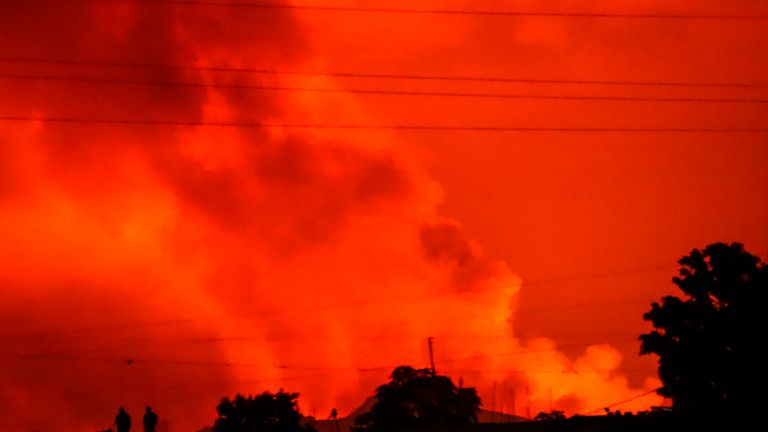
Two people are seen silhouetted against a night sky turned red by the eruption of Mount Nyiragongo, in Goma, Congo Saturday, May 22, 2021. Congo's Mount Nyiragongo erupted for the first time in nearly two decades Saturday, turning the night sky a fiery red and sending lava onto a major highway as panicked residents tried to flee Goma, a city of nearly 2 million. (AP Photo/Justin Kabumba)
Image: The sky over Goma in Congo has turned a fiery red due to the eruption of Mount Nyiragongo
A general view shows smoke and flames at the volcanic eruption of Mount Nyiragongo near Goma, in the Democratic Republic of Congo May 22, 2021. REUTERS/Olivia Acland
Image: The volcanic eruption has sent lava into the air and across at least one major road

"We are doing our best to give you factual information, unfortunately, a part of Gomo is in the dark but I want to assure you your government is doing something," a government spokesman said.

Goma is a base for UN peacekeeping mission MONUSCO and it was reported that the organisation's aircraft had been moved to nearby cities.

Nyiragongo is one of the world's most active volcanoes and is considered among the most dangerous.

There had been concern about the amount of volcanic activity observed in the last five years at Nyiragongo but experts at Goma Volcano Observatory have not been able to check things regularly due to funding issues.

Adblock test (Why?)


https://news.google.com/__i/rss/rd/articles/CBMidWh0dHBzOi8vbmV3cy5za3kuY29tL3N0b3J5L2RyLWNvbmdvLWNpdHktb2YtZ29tYS1lbXB0aWVzLWFzLXRob3VzYW5kcy1mbGVlLWVydXB0aW5nLXZvbGNhbm8tbW91bnQtbnlpcmFnb25nby0xMjMxNDI3NtIBeWh0dHBzOi8vbmV3cy5za3kuY29tL3N0b3J5L2FtcC9kci1jb25nby1jaXR5LW9mLWdvbWEtZW1wdGllcy1hcy10aG91c2FuZHMtZmxlZS1lcnVwdGluZy12b2xjYW5vLW1vdW50LW55aXJhZ29uZ28tMTIzMTQyNzY?oc=5

2021-05-23 01:31:35Z
52781614785032

Sabtu, 22 Mei 2021

Mount Nyiragongo: DR Congo city of Goma empties as thousands flee erupting volcano - Sky News

DR Congo's Mount Nyiragongo has erupted for the first time in nearly two decades.

Many thousands of people have fled the city of Goma, some heading for its highest point Mount Goma.

Others headed for the nearby Rwandan border, with authorities there saying that around 3,000 people had already crossed over on Saturday night.

Goma resident Zacharie Paluku told The Associated Press: "Everyone is afraid, people are running away. We really don't know what to do."

There was a government evacuation plan but it came hours after the sky had turned a fiery red and power had been cut to the city.

Lava from the eruption flowed onto a major road on Saturday as it reached the airport on the city's edge, according to a volcanologist based there.

A child looks on as people gather with their belongings following a volcanic activities at Mount Nyiragongo near Goma, in the Democratic Republic of Congo May 22, 2021. REUTERS/Olivia Acland
Image: Thousands of people have fled the city of Goma, many heading for the Rwandan border
Civilians watch smoke and flames as they gather with their belongings following a volcanic activities at Mount Nyiragongo near Goma, in the Democratic Republic of Congo May 22, 2021. REUTERS/Olivia Acland
Image: Many people fled the city before the government activated its evacuation plan, worried by the bright red the sky

Dario Tedesco told Reuters that new fractures were opening in Nyiragongo, allowing the lava to flow southward towards Goma after initially flowing east toward Rwanda.

More on Democratic Republic Of Congo

"Now Goma is the target," Mr Tedesco said, adding: "It's similar to 2002."

Nyiragongo's last eruption was in 2002 and it left hundreds of people dead, and coated airport runways with lava.

"I think that the lava is going towards the city centre," Mr Tedesco said.

"It might stop before or go on. It's difficult to forecast."

No casualties have been confirmed as a result of the eruption so far.

Two people are seen silhouetted against a night sky turned red by the eruption of Mount Nyiragongo, in Goma, Congo Saturday, May 22, 2021. Congo's Mount Nyiragongo erupted for the first time in nearly two decades Saturday, turning the night sky a fiery red and sending lava onto a major highway as panicked residents tried to flee Goma, a city of nearly 2 million. (AP Photo/Justin Kabumba)
Image: The sky over Goma in Congo has turned a fiery red due to the eruption of Mount Nyiragongo
A general view shows smoke and flames at the volcanic eruption of Mount Nyiragongo near Goma, in the Democratic Republic of Congo May 22, 2021. REUTERS/Olivia Acland
Image: The volcanic eruption has sent lava into the air and across at least one major road

Goma is a base for UN peacekeeping mission MONUSCO and it was reported that the organisation's aircraft had been moved to nearby cities.

Nyiragongo is one of the world's most active volcanoes and is considered among the most dangerous.

There had been concern about the amount of volcanic activity observed in the last five years at Nyiragongo but experts at Goma Volcano Observatory have not been able to check things regularly due to funding issues.

Adblock test (Why?)


https://news.google.com/__i/rss/rd/articles/CBMidWh0dHBzOi8vbmV3cy5za3kuY29tL3N0b3J5L2RyLWNvbmdvLWNpdHktb2YtZ29tYS1lbXB0aWVzLWFzLXRob3VzYW5kcy1mbGVlLWVydXB0aW5nLXZvbGNhbm8tbW91bnQtbnlpcmFnb25nby0xMjMxNDI3NtIBeWh0dHBzOi8vbmV3cy5za3kuY29tL3N0b3J5L2FtcC9kci1jb25nby1jaXR5LW9mLWdvbWEtZW1wdGllcy1hcy10aG91c2FuZHMtZmxlZS1lcnVwdGluZy12b2xjYW5vLW1vdW50LW55aXJhZ29uZ28tMTIzMTQyNzY?oc=5

2021-05-23 01:18:45Z
52781614785032

Israeli - Palestinian ceasefire: 'There is no future in Gaza' - Sky News

Adblock test (Why?)


https://news.google.com/__i/rss/rd/articles/CBMiK2h0dHBzOi8vd3d3LnlvdXR1YmUuY29tL3dhdGNoP3Y9UFZBd3ZOTm5CSlXSAQA?oc=5

2021-05-22 20:07:35Z
52781577069323

COVID: ‘Black fungus’ adds to India’s woes, 4,194 deaths reported - Al Jazeera English

India’s coronavirus outbreak has stabilised in parts of the country, a government official said, but deaths rose by 4,194 on Saturday and infections were spreading in rural areas. A new infection, called black fungus, is also complicating matters further.

Earlier this month, India reported more than 400,000 new daily infections but the numbers have gradually eased. On Saturday, government data showed 257,299 new cases.

Active cases in the Maharashtra and Karnataka states and the coastal state of Kerala had fallen in the last two weeks, health ministry official Lav Agarwal told reporters on Saturday.

Daily numbers in states, including West Bengal, which recently concluded state elections, and the southern states of Andhra Pradesh and Tamil Nadu were on the rise, he said.

With hospitals overflowing, the health system overwhelmed in the cities and a shortage of vaccines, experts have warned India could face a third wave of infections in the coming months.

“While it [spread of coronavirus] has stabilised in many parts of the country, and overall the burden has been lessened, we have a long way to go with this wave,” Dr VK Paul, part of a federal government panel on COVID-19 management, told a news conference.

“For the first time, we have seen that rural areas have been affected in this pandemic.”

Total infections in the country stood at 26.3 million, the second-highest in the world after the United States, while the country’s total death toll was 295,525.

A woman with breathing difficulty receives treatment at a clinic set up by a local villager in Parsaul village in Greater Noida, in the northern state of Uttar Pradesh, India [Adnan Abidi/Reuters]
Prime Minister Narendra Modi and state authorities have faced widespread criticism for failing to counter the pandemic as many officials gear up for another surge.

The slow pace of vaccination in the country is another big concern.

Delhi’s chief minister said authorities had been forced to halt vaccinations for those aged between 18 and 44 as supplies had run out.

Black fungus scare

The Indian government has asked states to report cases of mucormycosis, also known as black fungus – a deadly infection that has been appearing in patients who have had the coronavirus.

The condition causes discolouration of the eyes and nose, blurred vision, chest pain, and breathing difficulties. In some cases, doctors have had to remove one or both eyes, or part of the jaw to stop the disease from spreading.

States across India have also ordered emergency measures to counter a surge in the rare infection among coronavirus patients.

According to medical professionals, diabetic patients were more likely to have the ailment.

Gujarat and Telangana states on Thursday became the latest to declare black fungus epidemics, a day after Rajasthan.

Maharashtra state has reported more than 2,000 cases. Gujarat, the home state of PM Modi, has about 1,200 cases, officials said.

“Doctors say coronavirus patients with diabetes and a weakened immune system, are particularly prone to infection,” Al Jazeera’s Elizabeth Puranam reported from New Delhi.

“They believe the use of steroids to treat severe COVID-19 could be contributing to the condition of the pre-diabetic population.”

Adblock test (Why?)


https://news.google.com/__i/rss/rd/articles/CBMiZWh0dHBzOi8vd3d3LmFsamF6ZWVyYS5jb20vbmV3cy8yMDIxLzUvMjIvY292aWQtc3ByZWFkcy10by1ydXJhbC1pbmRpYS1hcy1kZWF0aHMtYWdhaW4tcmlzZS1hYm92ZS00MDAw0gFpaHR0cHM6Ly93d3cuYWxqYXplZXJhLmNvbS9hbXAvbmV3cy8yMDIxLzUvMjIvY292aWQtc3ByZWFkcy10by1ydXJhbC1pbmRpYS1hcy1kZWF0aHMtYWdhaW4tcmlzZS1hYm92ZS00MDAw?oc=5

2021-05-22 17:03:58Z
52781613725070