NATO - the North Atlantic Treaty Organisation - is a political and military alliance made up of 30 countries. Member states consult and make decisions together in the interest of shared values, and as a group, NATO possesses the military power to undertake crisis management operations where diplomacy fails. NATO defence spending is seen as a key factor in budgeting for all members states - and the US is leading the way.
During his time as US president, Donald Trump was fiercely critical of NATO members in Europe for not spending enough to support the alliance. But at the G7 Summit, President Joe Biden reaffirmed US support for the group.
However, Mr Biden may want to look further at spending on defence, with the graph below showing the staggering disparity between how much the USA contributes in comparison to its Brussels bloc allies.
In terms of the proportion of its GDP (the total value of goods produced and services) allocated to defence expenditure, the United States spends more than any of the other 29 NATO countries.
In 2020, it's estimated that the US spent just over 3.7 percent of its GDP on defence, while the average for NATO's European members (and Canada) was 1.77 percent of GDP. In fact, the US is estimated to spend a total of $811,140 million on NATO defence in 2021 - some $362,798 million more than the spend of all other countries combined.
For the same period, the UK spent nearly 2.3 percent of its GDP on defence. But many EU nations seem to be lagging behind the current agreed target for European Nato members of two percent of GDP on defence by 2024.
In fact, the following EU nations are estimated to have failed to reach the target so far by 2021:
Germany - 1.53 percent
Italy - 1.41 percent
Spain 1.02 percent
Netherlands - .45 percent
Belgium - 1.12 percent
Denmark 1.41 percent
Czech Republic - 1.42 percent
Portugal 1.54 percent
Hungary - 1.60 percent
Slovak Republic - 1.73 percent
Bulgaria - 1.56 percent
Slovenia 1.28 percent
Luxembourg 0.57 percent
The country contributing the least in 2020 was Luxembourg, with 0.56 percent.
There are obvious reasons why spending would differ like this - the US accounted for more than half of the combined GDP of all NATO members in 2020, for example, and has military commitments around the world, so a high NATO spend makes sense.
Defence spending by European NATO members and Canada has been increasing in recent years.
Despite the impact of the pandemic, countries increased spending on defence in 2020 for the sixth year running.
The current agreed target for European NATO members is two percent of GDP on defence by 2024.
President Trump had urged the other countries in the alliance to increase that to four percent of GDP.
In 2020, 10 NATO countries (in addition to the US) reached or exceeded the two percent target - two more than in 2019 including for the first time, France and Norway.
The rest, including Germany, Italy and Spain, spent below that in 2020, even though they've all increased their spending as a percentage of GDP since 2014 when the two percent target was agreed.
Germany indicated in 2019 that it wouldn't reach the two percent target until 2031.
NATO members also pledged that by 2024 at least 20 percent of their defence expenditure should go on acquiring and developing equipment.
The US used to pay more than 22 percent of these running costs, but a new payment formula was agreed in 2019 to address complaints by the Trump administration about the burden to the US of supporting the alliance.
There are also thousands of American active-duty military personnel deployed around the world.
Germany currently hosts by far the largest number of US forces in Europe, followed by Italy and the UK.
And US forces have also worked with their NATO counterparts outside of Europe as well, for example in Afghanistan.
China has warned Britain, the United States and the rest of the NATO alliance that it will not "sit by and do nothing" if challenges approach.
A senior diplomat also accused the 30 allies of slander after they agreed for the first time that Beijing posed "systemic challenges" to international rules and values.
At a summit on Monday in Brussels, the alliance expressed concern about what it called China's "coercive policies", how the country is rapidly expanding its nuclear arsenal with more warheads and its military cooperation with Russia.
A spokesperson for the Chinese Mission to the European Union, responding to the comments, called on NATO to be more rational about China and "stop hyping up in any forum the so-called 'China threat'".
Please use Chrome browser for a more accessible video player
Prime Minister Boris Johnson spoke ahead of the NATO summit
The allies had stressed they did not view China as a threat but a challenge.
Advertisement
Still, they only mentioned China in relatively mild terms for the first time in 2019. The language used in a communique released after their gathering in the Belgian capital on Monday was a lot stronger.
The Chinese spokesperson said: "NATO is slandering China's peaceful development and misjudging the international situation and its own role. It represents a continuation of the Cold War mentality and bloc politics".
More on China
The spokesperson said China's defence policy is "defensive in nature", claiming that the military budget is just a fraction of total military expenditure by the alliance - $209bn compared with a collective sum of $1.12trn.
"We will follow very closely NATO's strategic adjustment and its policy adjustment towards China. China will not present 'systemic challenges' to anyone, but we will not sit by and do nothing if 'systemic challenges' come closer to us," the spokesperson said in a statement.
The remarks come after China earlier accused the G7 of slander and "political manipulation" after the group of industrialised nations criticised Beijing following a summit in Cornwall.
The homepage of Global Research, a Canadian website that bills itself as an independent research and media organisation, is universally bleak about the prospects of western-made Covid-19 vaccines.
“Covid-19 Vaccines lead to new Infections and Mortality: The evidence is overwhelming,” runs one headline from May. “Alarming casualty rates for mRNA vaccines warrant urgent action,” says another.
According to the US state department, the Montreal-based non-profit is anything but independent. Instead, it said in a report published last year, the organisation is “deeply enmeshed in Russia’s broader disinformation and propaganda ecosystem”.
Global Research was a partner of another website, Strategic Culture Foundation, that is directed by Russia’s Foreign Intelligence Service (SVR), the report said. The Canada-based group has also published content from SouthFront, which the US Department of Justice designated in April — alongside SCF and two others — as a “disinformation outlet” of Russia’s intelligence services, in this case the FSB.
As Joe Biden prepares to meet Vladimir Putin at a summit in Geneva on Wednesday — their first meeting since the US president took office — the efforts by Russia-linked groups to sour opinion on Covid-19 vaccines are part of what the US sees as an intensified disinformation campaign by Moscow.
In the past, the US has sought to use summits with Russia to resolve disputes over nuclear warhead numbers or to criticise Moscow’s invasion of Ukraine. In Geneva, the Biden administration will be focused on what it sees as Russia’s “harmful activities” in cybersphere.
For the US, the disinformation operations follow a series of cyber attacks and hacking incidents which all appear to have some level of Russian involvement. US officials and experts believe they amount to an accelerated policy of sowing discontent and mistrust among the American public, aimed at undermining institutions and faith in democracy, at a time when fierce political polarisation in the US is exposing those same fissures.
“They are constantly exploring, looking, poking, prodding — not just systems but also the American public — looking for ways to cast doubt, to divide us along racial lines, along political lines, along whatever societal divisions we already have in existence,” says Matthew Masterson, former senior cyber security adviser at the Department of Homeland Security now at Stanford Internet Observatory. “That’s hybrid warfare in the 21st century.”
US officials and monitoring groups say Moscow’s efforts to disrupt and undermine US democracy have adapted fast to the arrival of a new administration. Misinformation about Covid-19 vaccines is just one part of that effort, they say.
“Clearly there is a more direct campaign against the Biden administration than there was against Trump,” says Bret Schafer, a propaganda expert at the Alliance for Securing Democracy, part of the German Marshall Fund think-tank which was set up to track disinformation.
Schafer has developed a tracker that collects data from 350 Twitter accounts, 27 websites and two YouTube channels that are affiliated with the Russian government or Russian state-funded media outlets. “I couldn’t pick out a single positive story in the past six months,” he says.
Biden is seeking to use the Geneva summit to help stabilise relations and resolve what he said on Sunday were “actions which we think are inconsistent with international norms”.
The US president also said he agreed with a proposal from Putin that could allow the US and Russia to exchange cybercriminals wanted by each other’s governments.
But few US experts on Russia believe Moscow is likely to back off in any significant way in its cyber activities. “The Russians have effectively already declared war quite a long time ago in the information sphere,” says Fiona Hill, former senior Russia director on the National Security Council during the Trump administration.
“They’ve been trying to prove that they are a major cyber force — they want to create a wartime scenario so then they can sit down and agree some kind of truce with us.”
The notion of disinformation wars, though long in existence, came into its own in the wake of the 2016 US presidential elections that brought Trump to power. US investigators found co-ordinated efforts by a Russian “troll farm”, the Internet Research Agency, to influence the polls.
Yevgeny Prigozhin, the alleged caterer-turned-warlord known as “Putin’s chef” who US officials say funds the troll farm, has denied its existence and Moscow says it was not behind such efforts. But the US indicted 13 IRA employees for their involvement in the campaign and since then, Russia has remained one of the most active nations conducting clandestine influence operations, according to Facebook.
US officials and researchers believe some of the recent forays into the information space have been more subtle, relying on real sources rather than inventing negative stories. One example has been the number of stories in recent weeks flagging concerns over Biden’s health. In this case, the prompt was a May letter signed by 124 retired US generals who questioned the outcome of the 2020 presidential election and “the mental and physical condition of the commander-in-chief”, which was also widely covered by mainstream US media outlets.
For experts, this is part of an effort from Russia to shift away from fake bots and personas amid a crackdown by social media platforms on inauthentic activity. Instead, they say, Russian output is citing facts found in western sources and amplifying existing voices.
“When it comes to US domestic narratives, they’re almost always piggybacking on something that exists,” says Schafer. “From the official sources we very rarely see something that you would categorise as being invented”. Instead, Russia is now focused on “wildly misleading” context rather than making up facts: Schafer says he prefers the term “malinformation” to outright disinformation in such cases.
The aim, say experts, is to prey on US domestic division, such as that over race relations and claims of election fraud, or to stoke culture wars on both the right and the left. Covid-19 has proved a particularly fertile area.
“It is very clear that Russia is up to its old tricks,” said Ned Price, a state department spokesman, in March. “And in doing so is potentially putting people at risk by spreading disinformation about vaccines that we know to be saving lives every day.” He added that the state department’s Global Engagement Center, which has previously analysed Russia’s “propaganda ecosystem”, had identified four Russian online platforms that were directed by Moscow’s intelligence services and which spread disinformation about vaccines being used in the US.
“We have seen Russia certainly amplifying superspreaders of counter-vaccine disinformation or just Covid conspiracy theories,” says Nina Jankowicz, an expert in Russian disinformation at the Wilson Centre. “Russia doesn’t create this stuff . . . but they latch on to pre-existing narratives, societal distrust, and amplify that.”
Sometimes Russia targets “prominent US individuals” to push influence narratives to the domestic US audience, according to a March report from the US intelligence community. It said Putin had authorised such information operations for the 2020 polls rather than repeating persistent efforts to hack election infrastructure in 2016.
US lawmakers are among American citizens accused of spreading Russian propaganda. Last month, Republican senator Ted Cruz was criticised after he shared on social media a video montage that unfavourably compared a US military recruitment advert to a Russian one.
“Whenever there’s something useful out there in the information ecosystem that makes it look like there’s mud on America’s face, then they’ll use that,” says Graham Brookie, a former Obama administration official who is now director of the Atlantic Council’s Digital Forensic Research Lab, which tracks open-source foreign disinformation. “It’s a clever engagement strategy, and it shows how divided we are.”
Researchers at social media intelligence group Graphika last week revealed that the people behind a fake rightwing outlet which had been taken down in October by social media platforms including Facebook, Twitter and YouTube have begun targeting more niche rightwing social media platforms such as Gab, Parler and patriots.win, which are only lightly moderated.
Graphika said that the campaign, which was “still active”, focused on spreading narratives of voter fraud, as well as “highly offensive” cartoons accusing Biden of “senility, sexual harassment and paedophilia”.
Camille François, chief innovation officer at Graphika, says these alternative platforms were enabling Russian operatives because a “lack of policies” . . . “means that campaigns are not being taken down, and can be more successful in their hyper-targeting of specific far-right communities”.
Russia’s cyber efforts go far beyond polarising influence campaigns, however. Officials say that direct cyber attacks are now successfully targeting the US government on a grand scale and that indirect attacks risk critical infrastructure.
In April, the Biden administration blamed Moscow for a months’ long hack that affected nine federal agencies and more than 100 private companies. The operatives — widely believed by the US government to be part of Russia’s Foreign Intelligence Service (SVR) — hacked software from the US company SolarWinds in order to breach government and company email systems.
The breach was first detected in December, but Moscow appears to have continued its campaign. In May, Microsoft said it had evidence the same group hijacked an email system to pose as the USAID development agency and carry out a phishing campaign targeting more than 150 government agencies, human rights groups and non-governmental organisations worldwide.
Ransomware attacks attributed by the US to Russian cyber criminals also forced temporary closure of a commercial pipeline and meatpacking company in May. The US has not directly blamed the Kremlin, but the US Treasury earlier this year accused Russia’s FSB, of “cultivating and co-opting” one ransomware group, known as Evil Corp. The White House said it told Moscow “responsible states do not harbour ransomware criminals”.
Andrei Soldatov, a Russian security expert at the Center for European Policy Analysis, says ransomware attacks by Russian criminals were “extremely convenient” for the Kremlin as US investigators are forced to ask Moscow for assistance in tracing them. “You are not only dealing with a political issue but the added problem of needing to request co-operation with Russian security services,” he adds. “It’s very smart.”
Andrea Kendall-Taylor, former senior US intelligence official who Biden appointed Russia director on the National Security Council before she turned it down for personal reasons, says Putin could prevent such attacks if he wanted. “It’s becoming more brazen and [they are] going after bigger targets.” she says of Russia’s disruptive cyber attacks.
The Biden administration is also investigating a host of suspected “directed” radio frequency attacks on US officials known as Havana syndrome after US officials stationed in Cuba first reported it in 2016. Similar symptoms have been reported in China and elsewhere since 2018.
Although US secretary of state Antony Blinken said last week “we still simply do not know” the cause of the incidents, suspicion has fallen on Moscow. Two people briefed by US intelligence officials say Russia was the most likely culprit if they were confirmed as attacks. One said there was a possibility it was a prototype intelligence-collection technique gone wrong in which the Russians might be attempting to steal data from computers and phones by “pulsing” radiofrequency energy towards devices that ended up also affecting people in the immediate vicinity.
“One of the theories is they tried it in Havana, they tweaked it and they tried it again in China,” says the person.
Hill says the Havana attacks, if proven to be perpetrated by Moscow, would fall into a pattern of Russian disregard for collateral damage in intelligence collection.
“The Russians take great pride in their novel ways of getting at you . . . in many respects it’s a continuation of the Cold War,” says Hill, who suspects Russians have previously exfiltrated data from her phones, hacked her work laptop at the time she was writing a 2015 book about Putin and regularly tailed her. “They don’t really care about the harm they could cause.”
She adds that when Russia’s previous use of polonium, a radioactive poison, and novichok, a nerve agent, to target opponents came to light, the revelations were not wholly unwelcome in Moscow because it signalled to Russia’s own citizens the dangers of spying or dissent. “It’s softening up the enemy, making them feel that they’re going to be defeated.”
Attempting to stop Russian information operations and cyber hacks is an uphill task. “It’s like whack-a-mole,” says James Lewis, cyber security expert at the Center for Strategic and International Studies. “I think that’s why the Russians enjoy this so much; it’s constitutionally hard for us to take action,” he adds.
Russia has for years sought to lay down some form of global peace treaty for cyber space, but the US has been wary of entering any form of talks that presuppose both sides are equal, or bear equal responsibility for past cybercrimes.
The Biden administration has signalled that it is actively seeking to discuss cyber attacks to establish limits and signal heavy responses if breached.
“It is a good thing that they have stopped this silly policy of refusing to talk with us about cyber issues,” a senior Russian government official told the Financial Times. “Now that is on the [Geneva] agenda we can at least discuss it, but we are far from co-operation.”
As one first step, the Biden administration wants to expose Russia’s information operations but without resorting to militarised language about cyber “warfare”.
Biden’s approach indicates he wants to solicit support from Nato, harden the resilience of critical US infrastructure and take steps to defend democracy at home and abroad. His national security adviser Jake Sullivan has promised to respond in ways “seen and unseen”, suggesting the US could take increasing covert cyber actions of its own.
In the propaganda sphere, Todd Helmus, a disinformation expert at Rand Corporation, a US think-tank, argues that although fact-checking was helpful for certain audiences, it will not resolve the issue. “There’s no single policy that addresses this problem; it’s very complex,” he says.
Others caution that the impact of Russian information operations is hard to assess. “We still really lack an understanding of the effects of what Russia is doing,” says Kendall-Taylor, who said rules of the road would help.
But even if the Geneva summit provides some clarity, the direction of travel seems clear.
“This invisible war is becoming more and more real, and is becoming one of the principal tools in this hybrid war, [this] confrontation between the United States and Russia,” says Dmitri Trenin, director of the Carnegie Moscow Center. “I see no real let-up in this confrontation. I think it will intensify . . . I’m afraid, before we find a new normal.”
The EU and US are poised to resolve a 17-year dispute over aircraft subsidies, lifting the threat of billions of dollars in punitive tariffs on their economies in a boost to transatlantic relations.
Diplomats and officials confirmed on Monday night that two days of intensive negotiations in Brussels had left the EU and the Biden administration on the cusp of confirming a deal on subsidy rules for Airbus and Boeing. The breakthrough is set to be finalised on Tuesday at US president Joe Biden’s first EU-US summit meeting in Brussels.
People close to the talks said that the governments of Airbus’s three home countries in the EU — Germany, France, and Spain — were being consulted on an agreement that could be confirmed on Tuesday morning if there were no last-minute obstacles.
The deal, which could fall apart, was likely to take the form of a multiyear accord on subsidy limits, people briefed on the talks said.
A breakthrough would lift a cloud of uncertainty hanging over the airline sector while also removing the threat that EU and US consumer goods could once again be hit with punitive tariffs because of the dispute.
Those duties — on a wide range of products, from French wine to US spirits and sugarcane molasses — were suspended after the EU and US agreed in March to lift them for four months and to start negotiations on a solution.
$7.5bn
Extra tariffs imposed by the US on European goods in October 2019
The Airbus-Boeing dispute is one of the longest running battles in the history of the World Trade Organization — a disagreement both sides have acknowledged they could increasingly ill-afford as they seek to forge closer co-operation in dealing with China’s model of state capitalism.
EU trade commissioner Valdis Dombrovskis held talks with US trade representative Katherine Tai and commerce secretary Gina Raimondo in the days leading up the summit as the sides strove to get an agreement over the line.
Tai’s office declined to comment.
Companies on both sides of the Atlantic have long called for a solution. The matter took on greater urgency after the US targeted European exports worth $7.5bn with extra tariffs in October 2019, while the EU imposed additional duties on $4bn of US exports last year. Both sets of measures were in line with WTO rulings in favour of each side.
But both the US and EU have been found over the years to have failed to properly implement WTO panel rulings on illegal subsidies for their aircraft manufacturing champions.
EU and US trade officials emphasised the complexity of the dispute, with each side taking issue with the other’s claim to have complied with WTO decisions. The nature of subsidies on each side of the Atlantic is also very different, with EU officials pointing to sizeable US defence contracts as one example.
The end of the Airbus-Boeing dispute would remove one important irritant in trade relations, but others remain.
Brussels last month held back from increasing tariffs on US goods as a goodwill gesture in a disagreement over Trump-era tariffs on European steel and aluminium.
The two economies are also yet to fully bury their differences over digital taxes, with the issue now tied up with broader international talks.
NATO leaders have expanded their mutual defence clause to include a collective response to attacks in space.
A statement said attacks "from, or within space" could be a challenge that threatens "national and Euro-Atlantic prosperity, security and stability, and could be as harmful to modern societies as a conventional attack".
Article 5 of the military alliance's treaty states that an attack on any one of the 30 allies would be considered an attack on them all.
Until now, it has only applied to attacks on land, sea, air or cyberspace.
The statement following their Brussels summit said attacks in space could lead to the invocation of Article 5, but a decision as to when such attacks would warrant a response would be "taken by the North Atlantic Council on a case-by-case basis".
Advertisement
Around 2,000 satellites orbit Earth, over half operated by NATO countries, ensuring the functioning of everything from mobile phone and banking services to weather forecasts.
Military commanders also use some of them to navigate, communicate, share intelligence and detect missile launches.
More on Boris Johnson
Shortly after arriving at the alliance's headquarters for the first NATO summit of his presidency, Joe Biden sat down with Secretary-General Jens Stoltenberg and reaffirmed the US commitment to Article 5.
Mr Biden said: "Article 5 we take as a sacred obligation. I want NATO to know America is there."
The past four years saw Donald Trump call the alliance "obsolete" and complain that it allowed for "freeloading" countries to spend less on military defence at the expense of the US.
Many member countries are concerned about what they say is increasingly aggressive behaviour in space by China and Russia.
Prime Minister Boris Johnson said NATO does not want to "descend into a new Cold War" with China.
Speaking ahead of the summit, the prime minister said the East Asian nation had become a "new strategic consideration" for NATO but he also said there would be "opportunities" to engage.
"I don't think anybody around the table today wants to descend into a new Cold War with China," he told a news conference.
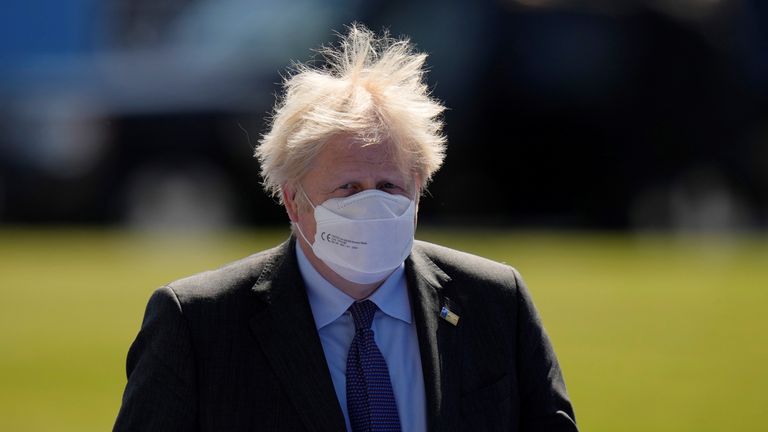
Image:Boris Johnson arrives at the NATO summit in Brussels
His comments echoed those by NATO secretary-general Jens Stoltenberg, who said the alliance would need to "engage" with China on issues including climate change and arms control.
"China's military build-up, growing influence and coercive behaviour poses some challenges to our security," Mr Stoltenberg said.
However, he also said "we are not entering a new Cold War" and China is "not our adversary, not our enemy" - although it has become a "systemic" challenge to Western security.
On Sunday, White House national security adviser Jake Sullivan said China would "feature in the (NATO) communique in a more robust way than we've ever seen before" as the alliance begins to look more seriously at any potential threat from the country.
NATO is also taking a stronger line on Russia, with Mr Stoltenberg saying their relationship is "at its lowest point since the end of the Cold War".
Mr Johnson said he remained "hopeful" things could improve with Russia but the situation was currently "pretty disappointing" from a UK point of view.
Image:Joe Biden says the US is 'not seeking conflict with Russia'
Over the weekend, Russian President Vladimir Putin told NBC News that the relationship between his country and the US was at its "lowest point in recent years".
It comes ahead of a meeting between Joe Biden and Mr Putin on Wednesday, which will take place after the US president has met with NATO leaders.
Mr Biden previously said the US was "not seeking conflict with Russia" and wanted a "stable and predictable relationship".
However, he said America would "respond in a robust and meaningful way if the Russian government engages in harmful activities".
Analysis: Getting tough with Beijing and Moscow as Biden's impact is felt
By Deborah Haynes, foreign affairs editor
The toughest language yet on China, calling out Russia over its nuclear arsenal and a pledge for the first time to make tackling climate change a security priority.
The NATO alliance set out an increasingly diverse array of dangers and priorities in a hefty communique that betrayed the brevity of what was in reality a half-day summit of leaders in Brussels.
Spread across 79 paragraphs - covering nuclear, cyber and even space threats as well as the need to embrace emerging technologies like artificial intelligence - the plan is far more ambitious than anything attempted when Donald Trump was in the White House.
It provides evidence of how the new president is enabling NATO to return to focusing on external threats and the need to adapt instead of worrying about its own survival - a concern that was at times speculated during the four years of the previous US administration.
Mr Trump, who was never a fan of multilateral organisations and in particular NATO, spent much of his time berating allies for failing to pay their fair share towards collective defence (he had a good point) and even threatening to pull the US out of the club.
It meant getting through a summit without an unmanageable disaster was deemed a success.
And yet, the Trump approach did at least prompt many allies, in particular Germany, to boost their efforts to edge towards the NATO spending target of 2% of national income.
This time around though, the alliance once again has a fan in charge of its most important member state.
President Joe Biden has made clear his commitment to NATO and the importance he places on the alliance for collective security.
He also knows that he needs all the allies he can muster to deal with what he sees as the challenge of his time - tackling the rise of authoritarianism led by China, which does not respect the same values as the world's democracies.
The NATO communique said: "China's stated ambitions and assertive behaviour present systemic challenges to the rules-based international order and to areas relevant to alliance security."
It flags up Beijing's "coercive policies" and how it is "rapidly expanding its nuclear arsenal with more warheads and a larger number of sophisticated delivery systems to establish a nuclear triad".
There is also concern about China's cooperation with NATO's old rival - Russia.
It is important to remember that China only featured in a NATO communique for the first time in December 2019.
Yet the ruling Communist Party is not considered such a problem for allies to agree unanimously that it is a security threat - a conclusion certain member states may perhaps disagree with.