Ottawa police have warned that "volatile" and "determined" protesters remain in Canada's capital after nearly two weeks of a trucker-led anti-vaccine mandate protest.
Ottawa is under a state of emergency as police have tried to contain the chaos.
Up to a quarter of so-called Freedom Convoy vehicles have children in them who could be at risk during operations, authorities said on Tuesday.
Nearly 80 criminal investigations have been opened relating to the protests.
Some two dozen arrests have been made so far.
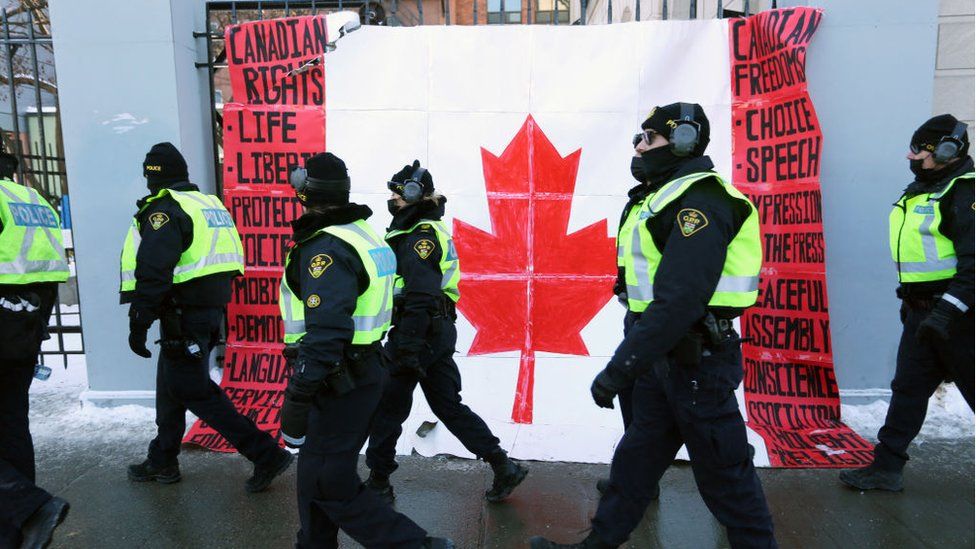
While most of the protest has been peaceful, police have been concerned about the extremist rhetoric coming from far-right groups at the rally. As well as reported racial and homophobic abuse, Nazi symbols have been displayed and protesters danced on the Tomb of the Unknown Soldier at the National War Memorial.
Officers have issued tickets and warned people away, but have been met with protesters determined to stay, and even a fake bomb threat which authorities said was intended to "deceive and distract" police.
One officer was reportedly attacked while attempting to seize fuel from a protest truck.
Speaking to press on Tuesday, deputy police chief Steve Bell said: "Our message to the demonstrators remains the same: Don't come. If you do, there will be consequences."
Incidents under police investigation include alleged hate crimes and property damage.
Mr Bell also disclosed on Tuesday that police had found about 100 trucks with children in them and contacted Children Aid Society overs concerns with noise, fumes and hygiene.
EPA
Some 740 miles (1,190 km) away from Ottawa, Canada's busiest border crossing was partially reopened on Tuesday after protesting truckers ground traffic to a standstill.
Truckers rallying in solidarity with those in Ottawa had blocked the Ambassador Bridge on Monday night, forcing vehicles to take long detours.
The bridge over the Detroit River is a vital trade link between it and the US, with more than 40,000 people and $323m (£238m) worth of goods cross it daily.
According to police in Michigan and Windsor, protesters had forced authorities to close it shortly before 21:00 local time on Monday - just hours after Canadian Prime Minister Justin Trudeau had accused the demonstrators of attempting to "blockade our economy".
Hundreds of vehicles were backed up for miles as travellers were warned by Canadian police to reroute.
While now open for travel from Canada to the US, across the other side, the Michigan Department of Transportation said the bridge remained closed and advised drivers to divert to nearby Port Huron to head into Canada. Business groups in the US and Canada called the blockade "an attack on the well-being of our citizens and the businesses that employ them", and demanded a full reopening.
As traffic continued to ensnare the area, demonstrators in Ottawa faced anger from local residents even as many insisted that they were protesting peacefully and with righteousness.
"There's been nothing but love, unity and peace out here," said John Van Vleet, a trucker from Ontario. "It's important for me to come down here to fight for my freedoms," he said.
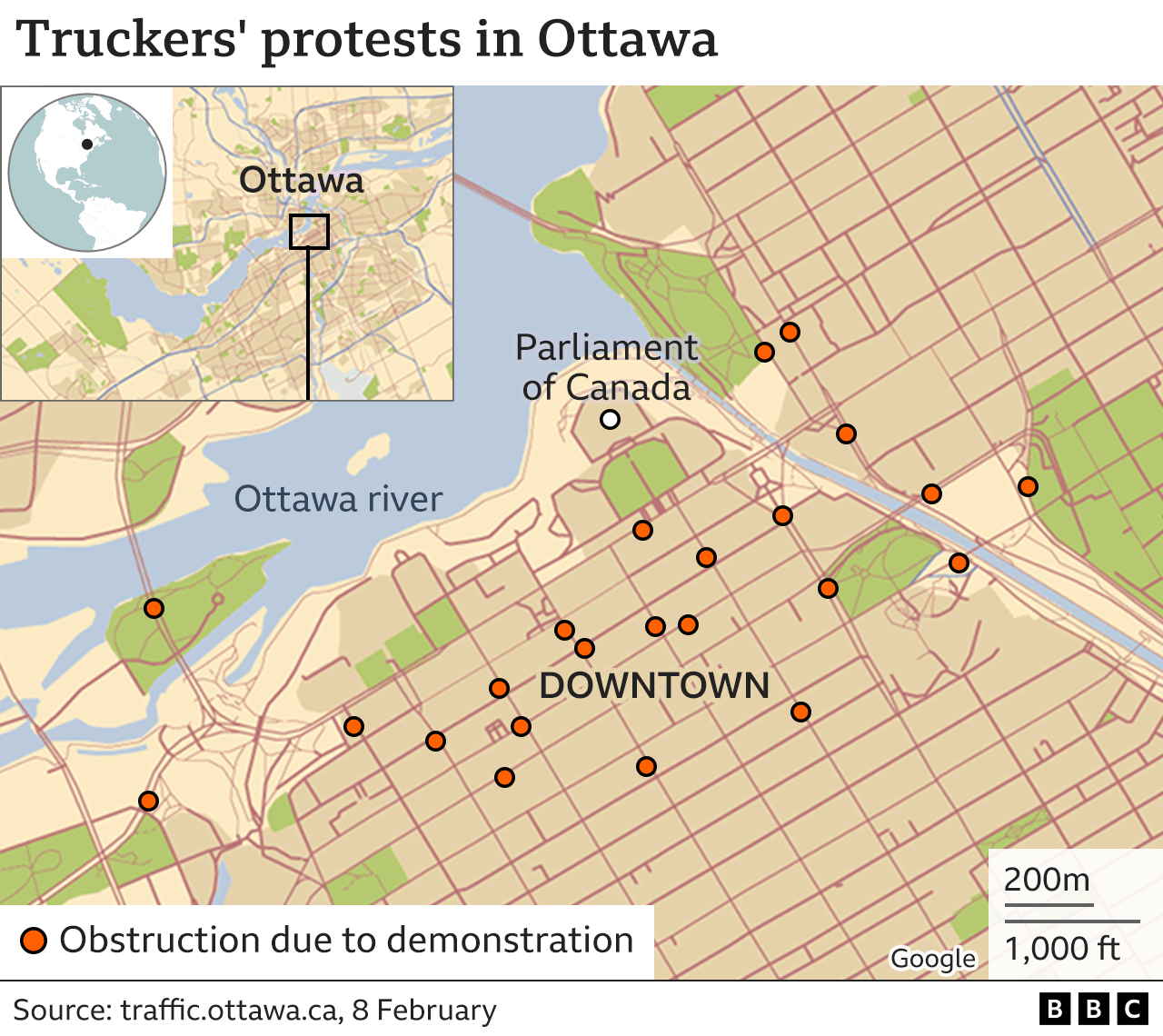
However, Ottawans have said the atmosphere has been tense, especially on weekends when thousands of protesters have descended upon the city's downtown core, spilling into nearby streets.
"We're all fed up," said Marika Morris, a resident. "They don't have a right to take us hostage".
Ottawa has been under a state of emergency since Sunday.
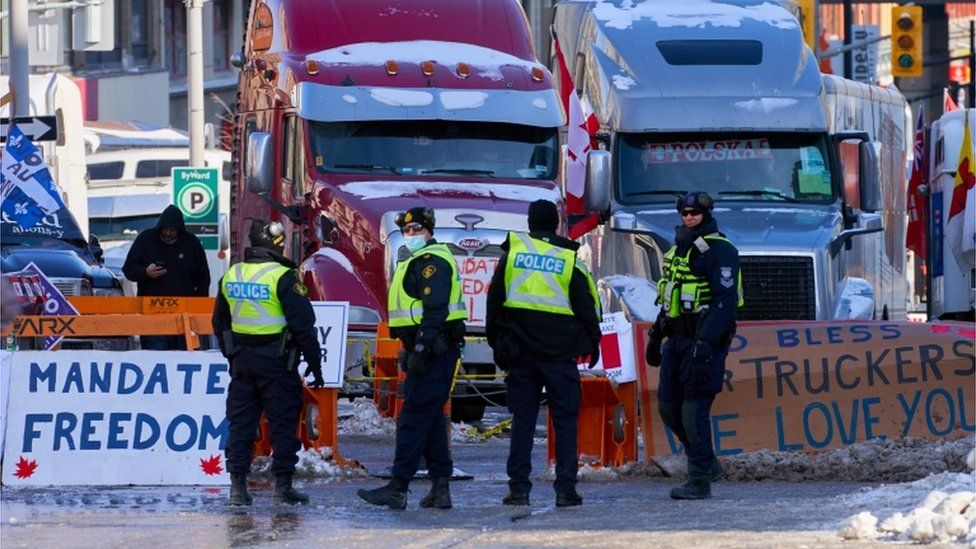
Even before that, the city centre had been paralysed for a week as hundreds of lorries parked downtown and gatherings of protesters had forced businesses to close.
The so-called Freedom Convoy began on 9 January in western Canada as truckers protested against a rule that requires them to be vaccinated against Covid-19 to cross the US-Canada border. The demonstrations have morphed to include anger at a raft of Covid-19 restrictions and at Mr Trudeau's government generally.
Demonstrations have also spread to other Canadian cities, including Toronto and Vancouver. Internationally, there have been rallies of support in New Zealand's capital Wellington and Canberra in Australia.
This video can not be played
To play this video you need to enable JavaScript in your browser.
A divided city
Jessica Murphy, BBC News, Ottawa
For city blocks, in the centre of the national capital, massive trucks are parked, many decorated with signs calling for an end to vaccine mandates - or simply "Freedom".
Up to 500 such trucks are estimated to be in Ottawa's downtown right now and many have been there for going on 12 days.
The fences in front of the parliament building are covered in hundreds of handwritten protest signs expressing support for their cause.
The protesters say that theirs is a cause all Canadians should applaud - but after nearly a fortnight of blaring horns and streets shut by blockaders and police, many residents of Ottawa see it differently.
"They've done their protest and should have been sent home a long time ago," David, a local business owner said.
Holding a sign opposing the protests, he said he has got some supportive honks and thumbs up from passers-by. But he's also been yelled at by protesters, or bumped into and pushed, and they've tried to take his sign.
China is targeting Uyghurs and critics abroad, pressuring other countries to detain and deport them, an investigation by Sky News has found, with high-ranking Chinese officials even conducting interrogations at "black sites" abroad.
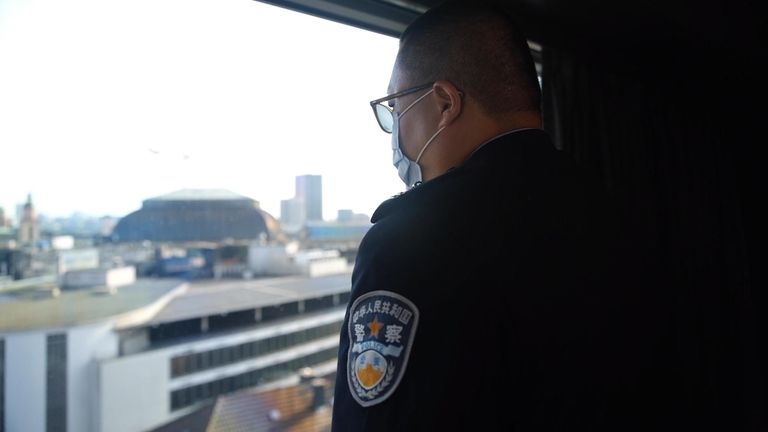
Chinese agents and police routinely operate abroad, attempting to identify Uyghurs who have fled China. Some are coerced into spying for the Chinese government. Others, once detained in a third country, simply vanish.
China's campaign of repression against Uyghurs and other minorities in Xinjiang, with evidence of mass detention, forced labour, family separations and forced sterilisation, has provoked international condemnation.
It denies the allegations and says its policies in the region are to fight extremism.
Interviews with seven people suggest that China's campaign of repression is not simply confined to Xinjiang, but fully international.
Advertisement
And one country in particular has become a happy hunting ground for Chinese security services: the United Arab Emirates.
Chinese agent tells man to spy on his ex-wife
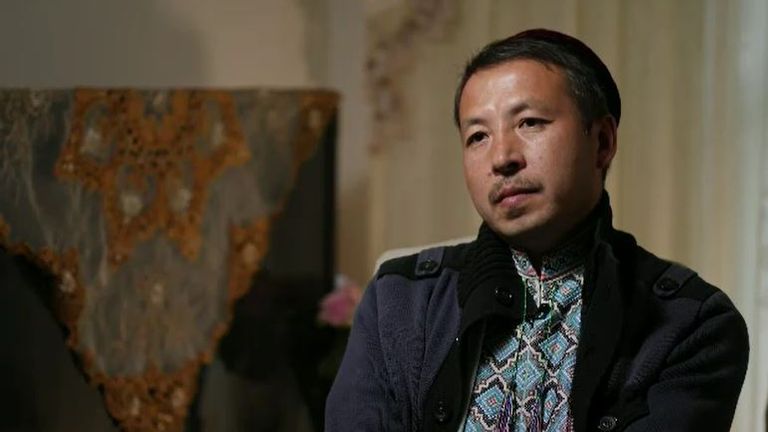
Jesure Burunqi is a Uyghur man, originally from Urumqi in Xinjiang, where he worked for a local Chinese Communist Party committee. He left China in 2009 and settled in the Netherlands.
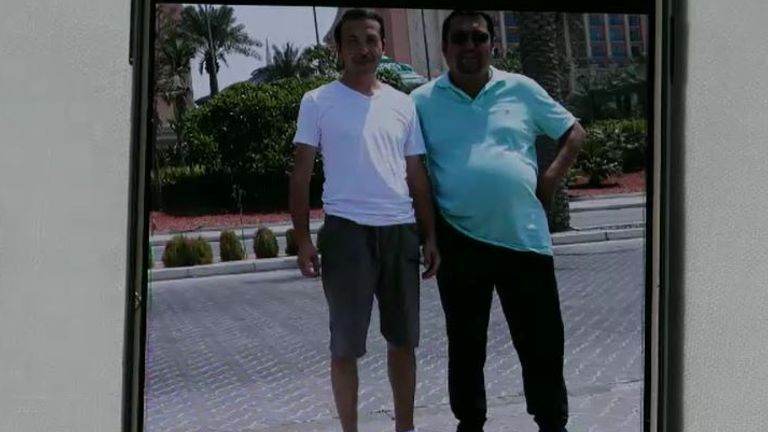
In August 2019, he got a message out of the blue - an old friend from Xinjiang who said he wanted to meet in Dubai to discuss something important.
What Jesure didn't know was that his ex-wife, who also lived in the Netherlands, was a whistleblower, with important information on the repression in Xinjiang.
"Before departure, I went to my ex-wife's home, to tell her that I'd go to Dubai," he told Sky News.
"My ex-wife told me that she had a very important document and asked me why I must go now. She told me it's too coincidental.
"In Kashgar (a city in Xinjiang), there was a camp," he explained. "The document is about the list of over 800 people's names, birth dates and home addresses who were kept in the camp."
Image:Jesure Burunqi was told to spy on his ex-wife who had information on the repression in Xinjiang
Despite his wife's concerns, Jesure accepted the offer of a ticket to go to Dubai.
At the airport, he was met by his friend and some other men. They later said they worked for Chinese national security.
"He knew that I went to my ex-wife's home to see my children," Jesure said.
"In her computer, there was a document that we want, if you co-operate with us, it's very easy, you wouldn't work very hard in future, we could give you a very good commission.
"He told me later that he gave me a USB key and I just input it with my ex-wife's computer so that they could catch the blower.
"When I left Dubai, I asked them any problem if I pass through the security check with the USB key. They said, no problems, they did it a lot."
Image:Jusereye met with the man on right when he arrived in Dubai
Jesure took the key back to the Netherlands - and handed it over to the Dutch security services.
The Chinese men kept calling but Jesure ignored them. One call was impossible to ignore though - a video of his mother, still in China. The man who worked for national security said "your mum is so not very healthy - if you co-operate with us, you could meet her very soon".
He said: "My sister, my brother and my mom are all in their hands."
Uyghur man detained at Dubai airport
Wang Jingyu was a teenager when he voiced his support for protestors in Hong Kong in 2019, before he criticised the Chinese People's Liberation Army in 2020. In China it is a crime to criticise "martyrs".
First, his parents were detained in his hometown of Chongqing, in China. Wang was living in Turkey at the time - but then they came for him, in April last year.
"I'm staying in a hotel in Istanbul," Wang told Sky News.
"In the first hotel, while I was sleeping, a Chinese man made phone call to hotel reception and the hotel reception transferred the call to my room. And he told me, 'you are criminal, I will kill you'. I changed hotel, but the same thing happened again."
Wang was scared and made plans to go to the US. His flight transited through Dubai. On his way to the departure gate for the US leg, two officers pulled him aside and told him to go with them.
In the detention centre, he was allowed to make a call. He phoned his girlfriend, Wu Huan.
He said: "I asked her to come to Dubai to pay the lawyer, do something, help me."
Please use Chrome browser for a more accessible video player
3:57
Whistleblower describes torture of Uyghurs
Wu arrived the next day - only to be detained herself. First at a Dubai police station, then a detention centre and then somewhere else entirely.
She said: "On May 30th, probably, two Chinese came. They took me to a questioning room."
They handcuffed her, she told Sky News, and put her in a car.
"They took me to a normal-looking villa. But inside, it was separated into many small single rooms and the rooms were locked by iron doors, like a prison."
And Wu said that she saws Uyghurs inside the same black site, which she said she thought was somewhere on the outskirts of the city.
"One day, when it was time to eat, I saw a girl shouting," she told Sky News. "She said, 'why have you locked me up? I want to return to Turkey'. That's the first time I saw someone else besides me inside. The girl looked like she was from Xinjiang."
Please use Chrome browser for a more accessible video player
1:12
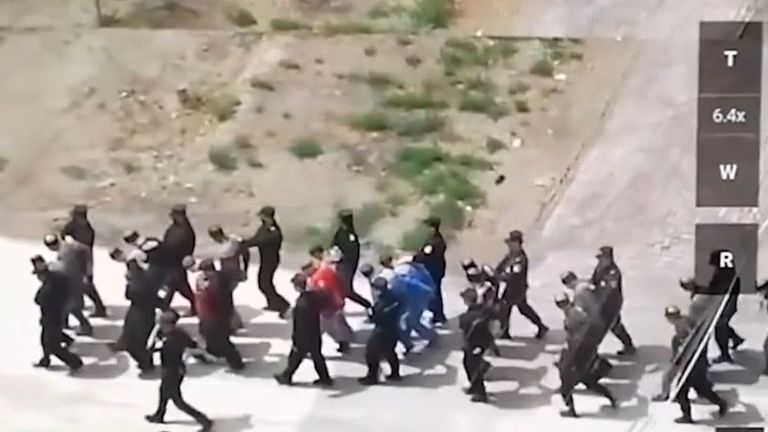
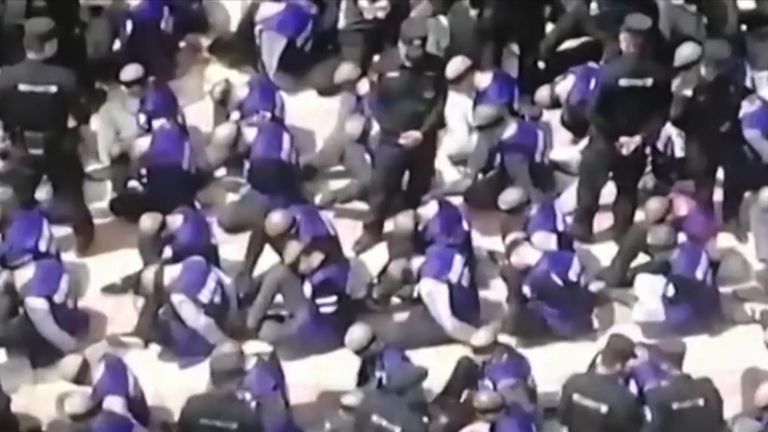
Drone video of alleged Uighur prisoners
Both Wang Jingyu and Wu Huan say there were questioned by Chinese officials on UAE soil.
"In my opinion, they came from China's consulate, at least, most of them," Wu Huan said. "At present, I know only one person, he was the consul general of the consulate. His name is Li Xuhang."
Wang also identified the Chinese consul general.
"One time, I think on the third visit, the Consul General Li Xuhang, he told me, 'If you sign this document, on the 1 May we will send you to Guangzhou.'"
Who are the Uyghur people and why do they face oppression by China?
The Uyghurs are a group of people - mostly Muslim - who live mainly in the Xinjiang area of China.
They have been living there for at least several hundred years.
China has been accused of interning up to one million Uyghurs in "re-education" centres in Xinjiang and increasing the number of non-Uyghurs in the region, so the proportion of Uyghurs there is declining.
In April, MPs in the UK declared that Uyghurs and other ethnic and religious minorities in China's Xinjiang region are being subjected to genocide.
China denies all allegations of human rights abuses.
After going public with their ordeal, and intervention from US activists, both were released.
"It's so frightening," Wu Huan told Sky News.
"But to make it public - I thought I get out of this, I need to make it public.
"I need to tear away their hypocritical faces and tell these things to the whole world. Let the whole world know their ugly faces."
Image:Wu Huan was questioned by Chinese officials at a black site in the UAE
China and UAE have strong trading relationship
The United Arab Emirates is at the centre of all of the stories of the people who have spoken to us.
In recent years, China has been hugging the tiny Middle Eastern state tight.
In 2018, Xi Jinping himself visited - the first visit by a Chinese leader in three decades. His plane was even given an Emirati fighter escort as it landed.
Image:Nigare Yusup has not seen her husband Hussein, pictured, since 2017
The UAE has also signed up to China's belt and road investment initiative, and China is now one of its largest trading partners.
And, crucially, the two countries have an extradition treaty.
The UAE and China are the strongest trade partners," Radha Stirling, the founder of Detained in Dubai, which helps foreign victims of injustice in the UAE, told Sky News.
"China has more than 6,000 businesses operating in the UAE. And they are the strongest ally to the UAE in the financial sense.
"Not only that, they both are authoritarian states, they both engage in censorship and they are sharing security.
"Of course, when China says we want to partner with you in these certain unlawful activities, the UAE knows that the United States and other allies are not going to do much to stop that, which is a huge concern for the advancement of Chinese interests in the Middle East and Northern Africa."
Amannisa Abdula and Nigare Yusup are Uyghurs, originally from Xinjiang.
Both moved to Turkey as China's campaign of repression intensified. But even there, their families were not safe.
It was in Istanbul that Nigare met her husband, Hussein.
"They talk about love at first sight," she told Sky News. "That is exactly what happened."
After they were married, Hussein was detained by Turkish authorities, who said he did not have the right to reside in the country. He was sent to a repatriation centre in the east of the country.
A month later, he called his wife, saying that that two Chinese police officers had visited him.
They "offered him to either be sent back to China or work for them to spy on the Uyghur community in Turkey," Nigare told Sky News.
"'You are going to be our eyes and ears and tell us what the Uyghurs are doing.'"
Image:Nigare Yusup moved to Turkey due to China's oppression of Uyghur muslims
Mother doesn't know whether husband is dead or alive
Hussein asked Turkey to deport him to the UAE instead, with a plan to go to from there to Europe.
Nigare would go and meet him in Dubai.
She said: "I last heard my husband's voice on October 12th 2017.
"He called me, not via WhatsApp because calling on that platform is forbidden in Dubai, he can only send voice messages.
"He told me, 'the Chinese police is looking for me. Maybe I will be caught. I do not know what my fate is.
"'I entrust my children with you. I am ashamed of the situation and for leaving you unprotected.'
"You can mourn someone when they die, the pain passes but a man, husband father of two disappears all of a sudden. Did he die, is he alive? Where is he? I know nothing."
Please use Chrome browser for a more accessible video player
2:34
Chinese Muslims get 'beaten to death'
A year later, Amannisa, her husband Ahmad and their son also travelled to Dubai, shopping for clothes for the baby they were expecting.
Ahmad was quickly detained in a police station, then moved.
"My husband called me," Amannisa told Sky News. "His voice, he was crying, he said 'they took me to another place, another station. They took urine and DNA. Bring my passport they want to deport me to China'."
A lawyer helped Amannisa, telling her that her husband was being detained by Interpol in Abu Dhabi.
She went to their offices.
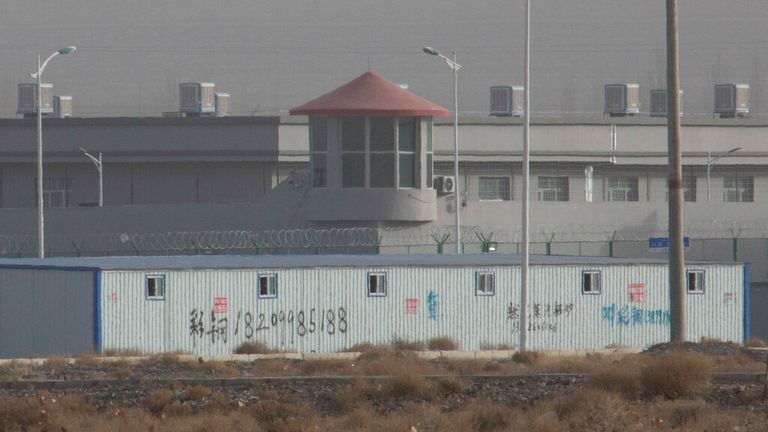
Image:One of a number of internment camps in the Xinjiang region where Uyghur Muslims are being detained
She said: "I explain these are the court papers. They did not even look at it and they said your husband has to go we will deport him. Because China wants him."
Her last contact from her husband was in February 2018, a phone call.
"He asked to talk to Musa, my son, and told him 'take care of your mom. She is pregnant. You are my son, you have to stay strong until I come back'. Then the phone was cut and I was never able to talk to him again."
Sky News asked Turkey, the United Arab Emirates and Interpol for comment but received no response.
Xu Guixiang, a spokesperson for the Xinjiang government, told Sky News: "China always respects other countries' sovereignty. It's impossible for China to set up black sites overseas. It's not true, as some Western media report, that China set up black sites in Dubai. It's a total lie and smear.
"Regarding the issue that people were menaced and their relatives were forced to return to China - please trust us, China is a socialist country ruled by law. All levels of government act in accordance with relevant laws and regulations."
He also questioned Wu Huan's reliability as a witness, alleging she had made more than 30 calls to the police in China with false claims.
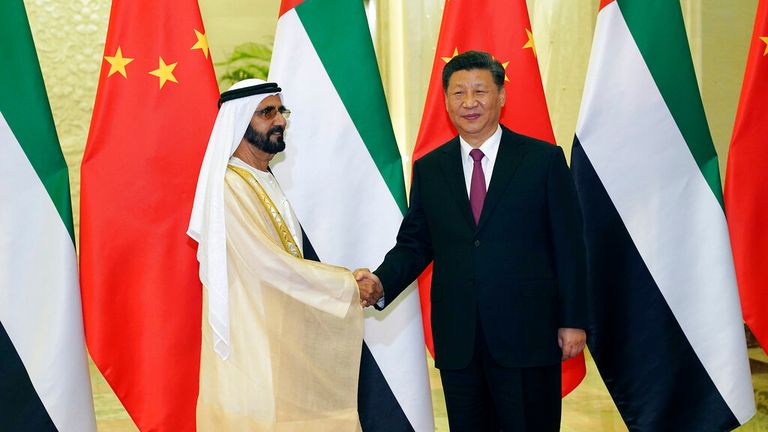
Image:Chinan's president Xi Jinping shakes hands with UAE prime minister Sheik Mohammed bin Rashid al Maktoum in 2019. Pic: AP
Wu denied this, telling Sky News that the complaints she made were about police harassment.
Mr Xu offered no information on Nigare's and Amannisa's husbands.
They have disappeared, into a world of shadows.
This is where China will continue to operate. And as its power and economic might develop, its reach will only grow longer.
"Their ambitions go further," Wu Huan said.
"Their henchmen have spread out further and further."
At least six states of the Arab world - Egypt, Morocco, Qatar, Saudi Arabia, Syria, and the United Arab Emirates (UAE) - have participated in China's transnational repression campaign that has reached 28 countries worldwide.
According to the dataset, an upper estimate of 292 Uyghurs have been detained or deported from Arab world countries at China's behest since 2001.
The UK "will not flinch" over Ukraine and sanctions will be ready if Russia invades, the prime minister has said.
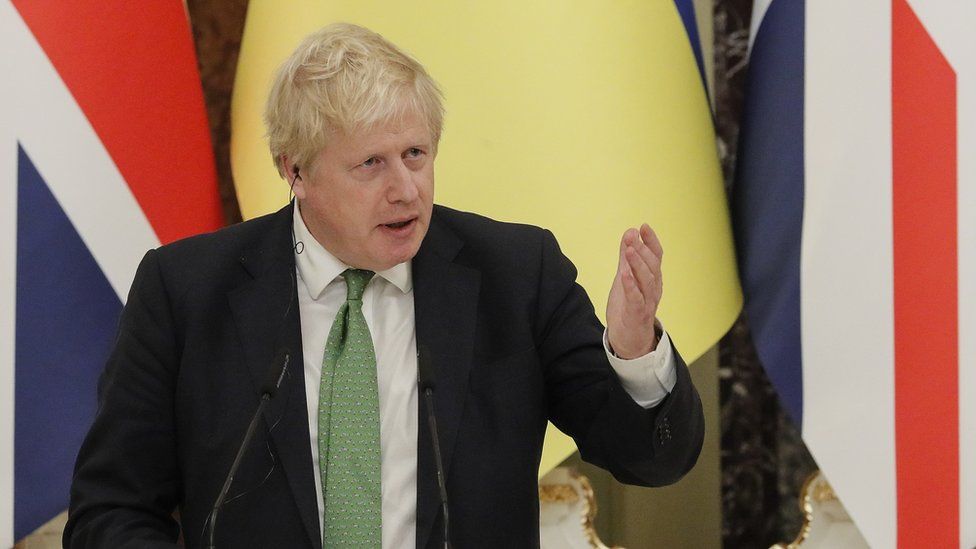
Boris Johnson told Moscow that support to Europe and Nato "will remain unconditional and immovable".
Writing in the Times, he said the government would ask for new powers to target "individuals and entities" linked to the Russian state.
Talks aimed at de-escalating the crisis are continuing in Kyiv, where Emmanuel Macron is meeting Ukraine's president.
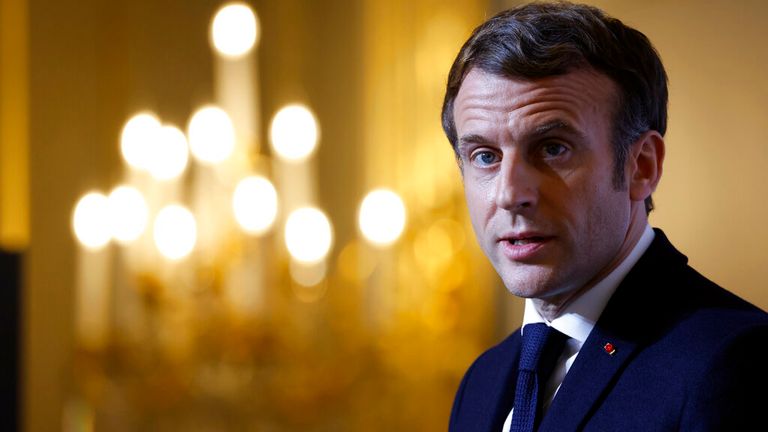
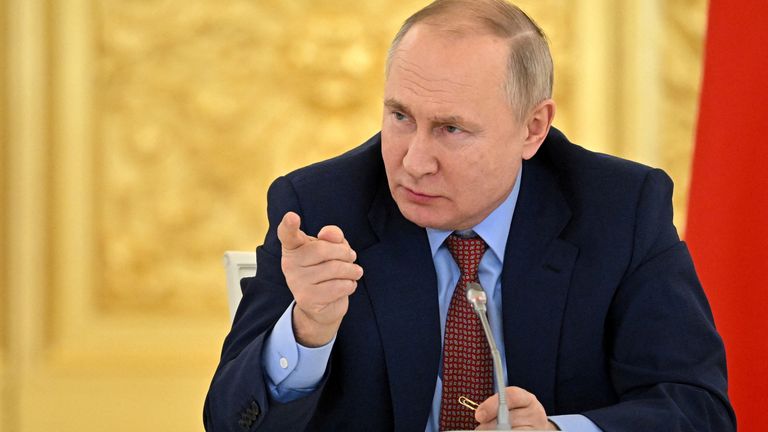
The French president has said the coming days are crucial, following a meeting with Vladimir Putin. Moscow has denied any plans to invade Ukraine but the West has become increasingly concerned by the possibility of a conflict.
Mr Johnson also wrote in the Times that the UK is considering deploying RAF fighters and Royal Navy warships to the region but said he hoped diplomacy could defuse the crisis.
Western countries have rejected a number of Moscow's demands, including ruling out Ukraine becoming a member of the Nato defence alliance, and that it reduce its military presence in eastern Europe.
The prime minister said the immediate priority was "to stand with our allies and combine deterrence with dialogue to de-escalate this crisis and prevent the catastrophe of another Russian invasion of Ukraine".
It is an urgent task, he added, as Moscow mounts the biggest military build-up in Europe since the Cold War.
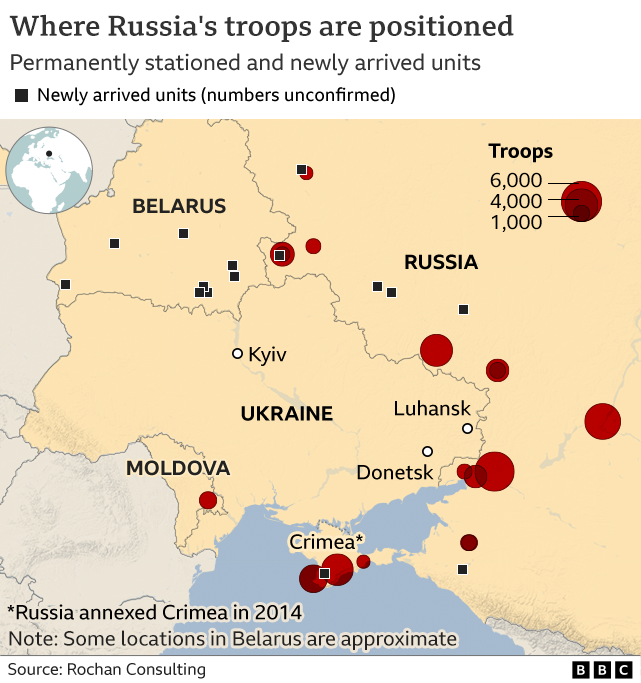
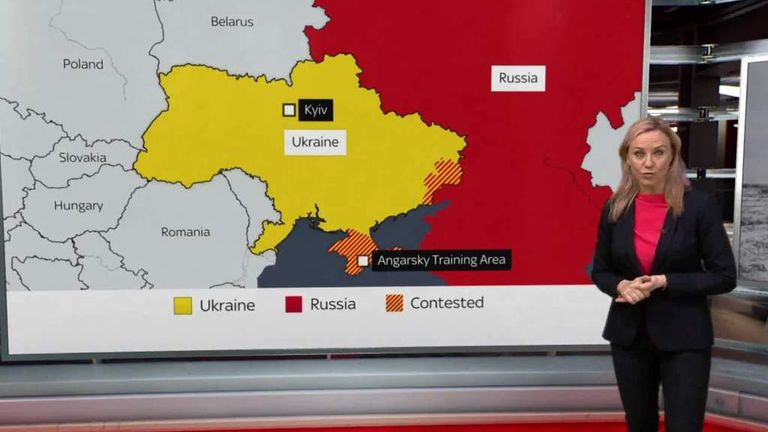
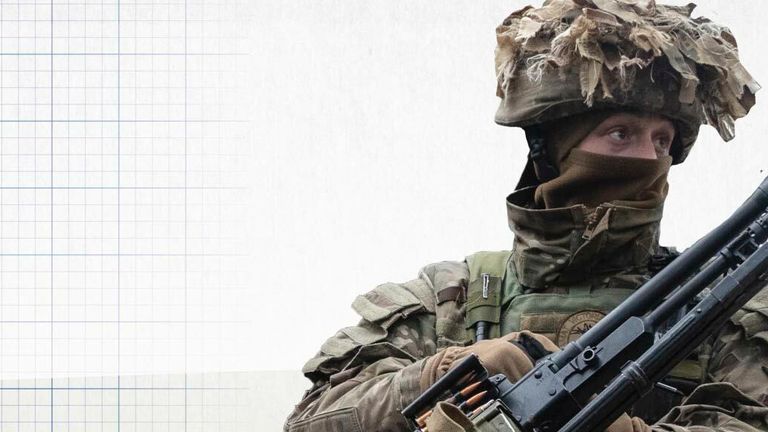
Russia has massed an estimated 100,000 troops, tanks, artillery and missiles near its borders with Ukraine.
Mr Johnson said he wanted Europe and the US to have its economic sanctions ready "the moment the first toecap of the first Russian soldier crosses further into Ukraine's sovereign territory".
"For our part, British sanctions and other measures will be ready for any renewed Russian attack," he wrote. "The government will ask Parliament for new powers to sanction a wider range of Russian individuals and entities, including any company linked to the Russian state or operating in a sector of strategic importance to the Kremlin."
This video can not be played
To play this video you need to enable JavaScript in your browser.
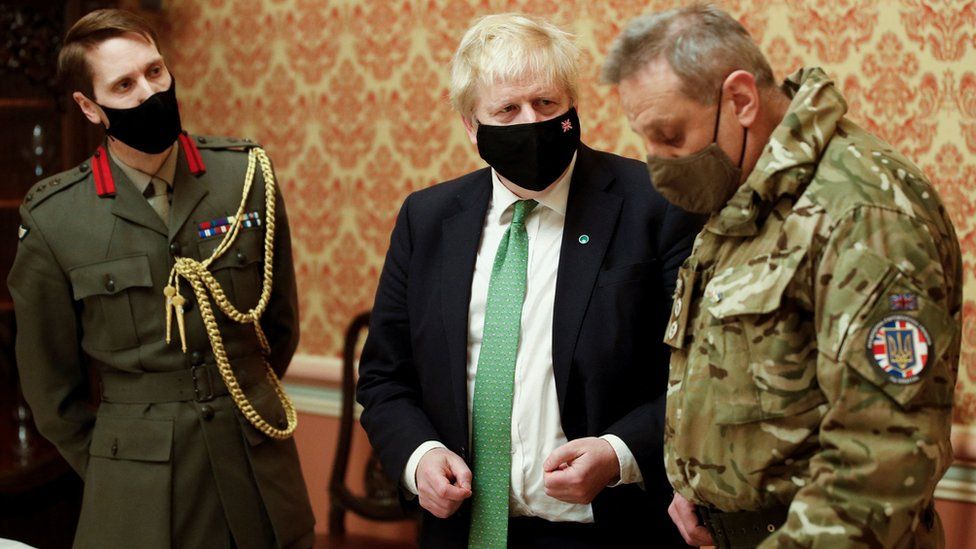
In addition, the UK - along with Nato - is "willing to send more forces to guarantee the security of our allies on the eastern flank", said Mr Johnson.
He said Estonia had asked for further support and "we stand ready to provide it", with the deployment of RAF Typhoon fighters and warships being considered, and aircraft carrier the HMS Prince of Wales acting as the command ship of Nato's Maritime High Readiness Force.
PA Media
The prime minister said he did not understand how threatening to invade Ukraine would advance President Putin's goals of keeping Nato forces from Russia.
"If he launches another invasion, he will force the West to bring about much of what he seeks to prevent," he wrote.
And he said Ukraine wanted to be able to choose its destiny and seek its own alliances, adding: "Britain has always stood for these principles and we will not flinch now."
Mr Johnson met Ukraine's president Volodymyr Zelensky in Kyiv last week, saying the pair would work together to find a diplomatic solution to the row with Russia and "avoid further bloodshed".
Ahead of his visit, the UK government announced it was giving Ukraine £88m to promote stable governance and energy independence from Russia.
Russian President Vladimir Putin has warned European countries will be drawn into military conflict if Ukraine joins NATO, following a meeting with French President Emmanuel Macron.
The Russian leader also warned there would be "no winners" from the ongoing crisis, after meeting with his French counterpart at the Kremlin, for talks he described as useful, substantive and business-like.
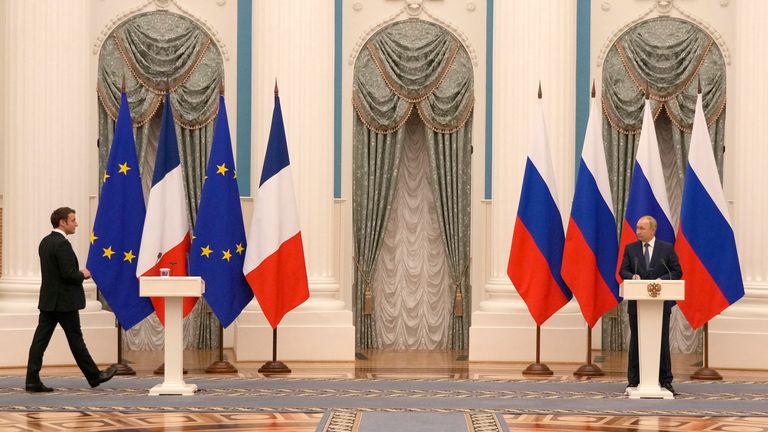
Emmanuel Macron travelled to Moscow for talks amid a stand-off over Russian military build-up near the Ukrainian border.
Image:France's President Emmanuel Macron met with Vladimir Putin. Pic: AP
Following the meeting, Mr Macron said he is sure he will get some results, even if it is not easy to secure.
Advertisement
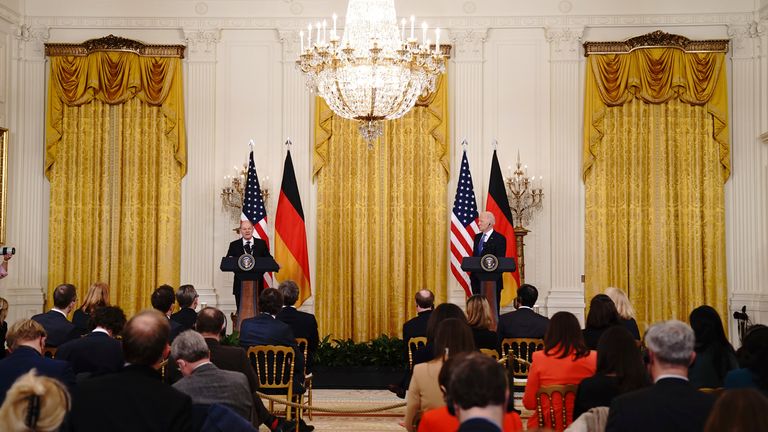
Meanwhile, in Washington, the US president met with the German chancellor for talks about the simmering crisis.
'Diplomacy can prevail' says UK PM
More on Emmanuel Macron
Related Topics:
As cross-continental talks continue on Monday, the prime minister said "we are witnessing the biggest military build-up in Europe since the Cold War" but said Britain will not "flinch" with its support to Europe and NATO "unconditional and immovable".
Writing in The Times, Boris Johnson said: "If he launches another invasion, he will force the West to bring about much of what he seeks to prevent."
He added: "We are considering deploying RAF Typhoon fighters and Royal Navy warships to protect southeastern Europe. And HMS Prince of Wales, our newest aircraft carrier, is now the command ship of Nato's Maritime High Readiness Force."
Liz Truss, the foreign secretary, will travel to Moscow on Thursday for meetings with her Russian counterpart. She will be followed by Ben Wallace, the defence secretary, on Friday, who will meet the head of the Russian military.
Image:Emmanuel Macron travelled to Russia for talks. Pic: AP
The Moscow discussion: Putin and Macron
In a joint news conference after talks, Mr Putin said that a number of Mr Macron's ideas concerning security were realistic and that the two would talk again once Mr Macron had travelled to Kyiv to meet Ukraine's leadership.
"A number of his ideas, proposals, which are probably still too early to talk about, I think it is quite possible to make the basis of our further joint steps," he said.
"We have agreed that after his trip to the Ukrainian capital we will call each other again and exchange views on this matter."
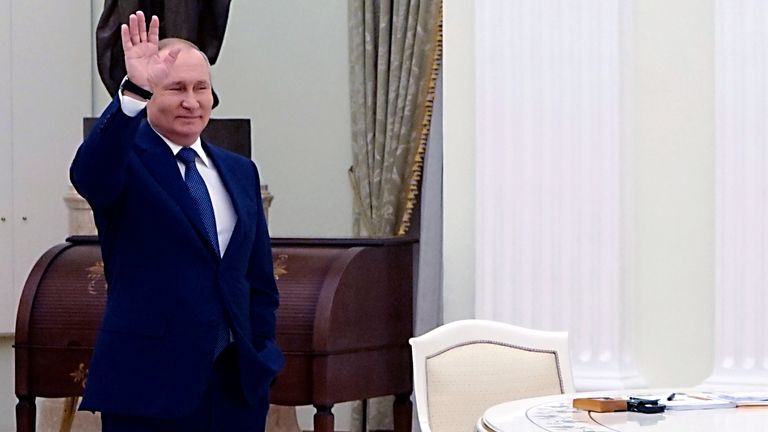
Image:Mr Putin said that a number of Mr Macron's ideas concerning security were realistic and that the two would talk again. Pic: AP
Mr Putin added Russia will do everything from its side to find compromises that suit everyone.
During talks, Mr Putin told Mr Macron: "I realise that we share concern about what's going on in Europe in the security sphere."
Mr Macron called for de-escalation as he sat down for the talks, adding: "Dialogue is necessary because that's the only thing that will help, in my view, to build a context of security and stability on the European continent."
Mr Putin's spokesman, Dmitry Peskov, described the visit as "very important," but sought to temper expectations, saying "the situation is too complex to expect a decisive breakthrough after just one meeting".
Image:Germany and the United States have been working closely together to ensure sanctions can be imposed quickly. Pic: AP
The Washington talks: Biden and Scholz
Meanwhile, thousands of miles away in the White House, the Biden administration expressed increasing alarm about the prospects of military conflict.
The Pentagon has warned that Russia is continuing to add "sizeable" troops along the Ukraine border, with a spokesman saying that with each passing day, Mr Putin is giving himself more military options.
Americans - other than essential diplomats - have been told "it would be wise" for them to leave Ukraine as President Biden said he would hate to see US nationals caught in the crossfire.
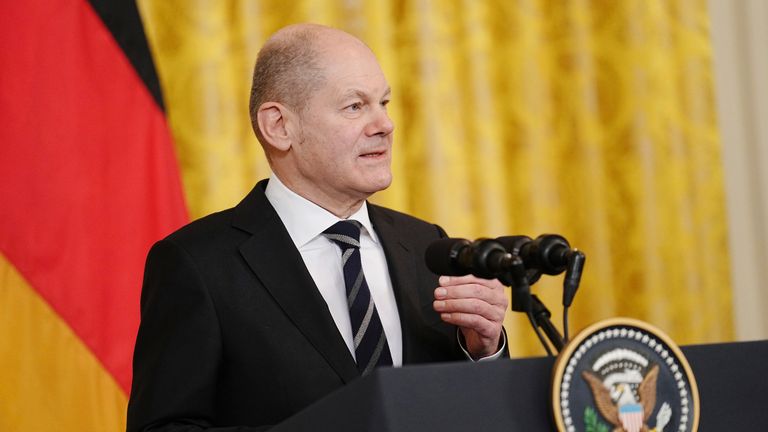
Germany and the United States have been working closely together to ensure sanctions can be imposed quickly, with Chancellor Scholz saying an invasion "will have very high costs for Russia" in a joint news briefing at the White House.
Meanwhile, President Biden warned there "will no longer be Nord Stream 2", a crucial European gas pipeline, if Russia crosses into Ukrainian territory.
Mr Scholz stressed the need to keep some ambiguity about sanctions in order to press on Russia to de-escalate the crisis.
"It's necessary for Russia to understand that a lot more could happen than they've perhaps calculated with themselves," Mr Scholz said.
Earlier on Monday, US secretary of state Antony Blinken warned: "There will be real and profound consequences should Russia choose to continue aggression.
The US is offering a reward of up to $10m (£7.39m) each for information on the leader of ISIS-K and those responsible for the deadly attack on Kabul airport.
At the time it was thought there may have been more than one bomber, and some people reported hearing gunshots as they tried to seek cover.
Image:The explosion happened during the evacuation of Kabul. Pic: Xinhua/Shutterstock
Sanaullah Ghafari has been the leader of ISIS-K since June 2020. The UN Security Council says he is responsible for approving all ISIS-K operations throughout Afghanistan and arranging funding for operations.
The UN says he has masterminded terror attacks in both Pakistan and Afghanistan and acts using IEDs and assassinations resulting in hundreds of deaths in 2021
Advertisement
He is also suspected of supplying, selling arms and recruiting for ISIS-K.
In November, the State Department designated Ghafari as a "Specially Designated Global Terrorist".
More on Afghanistan
Related Topics:
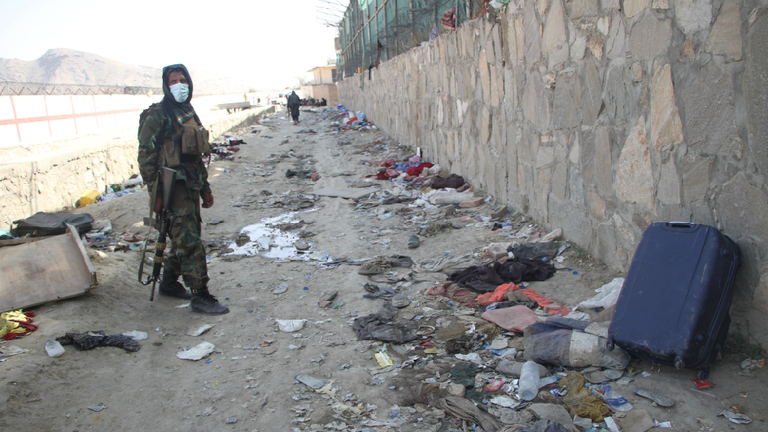
The bombing took place on 26 August, during the evacuation of Kabul in the wake of the Taliban takeover as both Americans and Afghans attempted to flee the country.
The attacker, carrying 20 pounds of explosives packed with ball bearings, blew himself up at Abbey Gate, outside the Kabul airport.
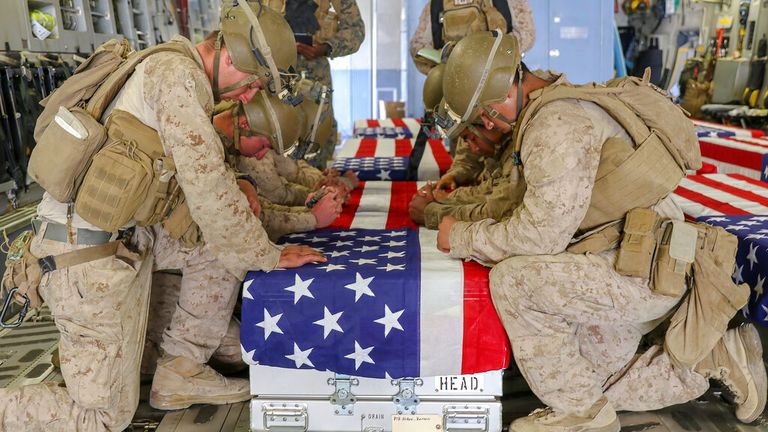
The explosion killed 13 US troops and at least 170 Afghan civilians.
Image:The ISIS-K suicide attack at the airport killed 13 US service personnel and dozens of civilians. Pic: AP
It left President Joe Biden's administration struggling to answer accusations that the State Department could have evacuated Americans sooner instead of putting US troops at risk.
US officials said in November they believed ISIS-K could develop the ability to strike outside of Afghanistan within six to 12 months.
A US investigation ruled the attack "unpreventable", and said those who died had wounds "so catastrophic" that they could not be overcome.
In the wake of sanctions imposed on the Taliban by the West, millions of Afghans - including children - are facing starvation and death from exposure to the cold.
The UK Foreign Office has pledged to release nearly £100m in emergency funds after a former UN chief warned a million children may die if unspent aid isn't distributed quickly.
Russia and France have common security concerns in Europe, Vladimir Putin told Emmanuel Macron at the start of their meeting in the Kremlin on Monday.
The French president met with his Russian counterpart in an attempt to calm tensions in the region.
At the meeting, President Macron said there needs to be a useful response for Ukraine. Putin, in turn, hailed France's role in shaping European security.
Please use Chrome browser for a more accessible video player
2:46
New signs of a Russian invasion?
"I realise that we share concern about what's going on in Europe in the security sphere," Mr Putin said.
Mr Macron called for de-escalation as he sat down for the talks, adding: "Dialogue is necessary because that's the only thing that will help, in my view, to build a context of a security and stability on the European continent."
Advertisement
Putin's spokesman, Dmitry Peskov, described the visit as "very important," but sought to temper expectations, saying "the situation is too complex to expect a decisive breakthrough after just one meeting".
Mr Macron, who heads to Ukraine on Tuesday, spoke with US President Joe Biden on Sunday about the "ongoing diplomatic and deterrence efforts," according to the White House.
More on Emmanuel Macron
Related Topics:
'Real and profound consequences' warns US
Speaking on Monday, US secretary of state Antony Blinken warned: "There will be real and profound consequences should Russia choose to continue aggression.
"We developed a high impact quick action response that would inflict massive costs on the Russian economy and financial system."
Image:France's President Emmanuel Macron travelled to Moscow
Actions, he said, would include sanctions and export controls that would "deny Russia the technology it needs in key sectors".
He said the US was working with Europe to also protect the energy supply, adding: "When energy supplies fail, economies falter".
German Chancellor Olaf Scholz is in Washington to meet US President Joe Bidenas talks take place on both sides of the Atlantic to try to find a diplomatic solution to the crisis.
A delegation of senior US officials are heading to Europe this week, to discuss coordination of potential sanctions in the event of a Russian attack. Treasury, State, and Commerce department officials will travel to the UK, France, and Belgium to meet with counterparts as the US prepares punitive actions if Russia crosses into Ukraine.
'Russia does not want Ukraine'
"The geopolitical objective of Russia today is clearly not Ukraine, but to clarify the rules of cohabitation with NATO and the EU," Mr Macron said in an interview with French newspaper Journal du Dimanche on Sunday, ahead of his meeting in Moscow.
Image:Russian President Vladimir Putin has denied he is planning an attack on Ukraine
He added: "The security and sovereignty of Ukraine or any other European state cannot be a subject for compromise, while it is also legitimate for Russia to pose the question of its own security."
But, speaking to reporters in France, the French leader admitted: "I'm very worried by the situation on the ground."
Mr Macron's visit comes less than three months before France's presidential election - and he has yet to announce whether he will run.
According to sources close to Mr Macron, the aim of his visit is to buy time and freeze the situation for several months, at least until a "Super April" of elections in Europe - in Hungary, Slovenia and, crucially for the French leader, in France.
Please use Chrome browser for a more accessible video player
5:02
This is what a Russian invasion of Ukraine could look like
'Heading to Putin's lair'
Over the past week, Mr Macron has made a frenetic series of phone calls with Western allies, as well as to Mr Putin and Ukrainian leader Volodymyr Zelenskyy.
On Sunday, a French presidency source said Mr Macron had spoken with Mr Biden on a 40-minute-long call ahead of his trip to Moscow in a "coordination logic".
The conversation is said to have allowed the two leaders to "share information about contacts made during the weekend" for good coordination ahead of the trip, the source said.