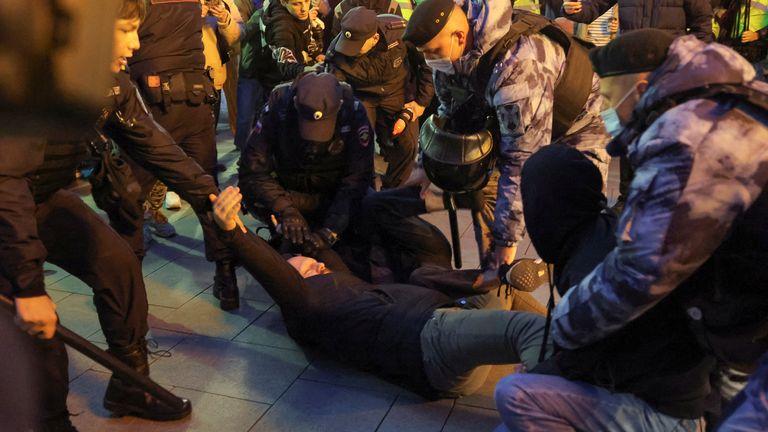
Hundreds of people have been arrested by authorities as protests against Russia's new "partial mobilisation" continue across the country, an independent rights group has said.
OVD-Info said 724 people were detained across 32 different cities on Saturday.
Widespread demonstrations have broken out since President Vladimir Putin announced plans to draft 300,000 men to fight in Ukraine.
Unsanctioned rallies are banned under Russian law.
But Mr Putin's move to draft civilians into the military has sparked large scale protests in urban areas, with more than 1,000 people being detained at demonstrations earlier this week.
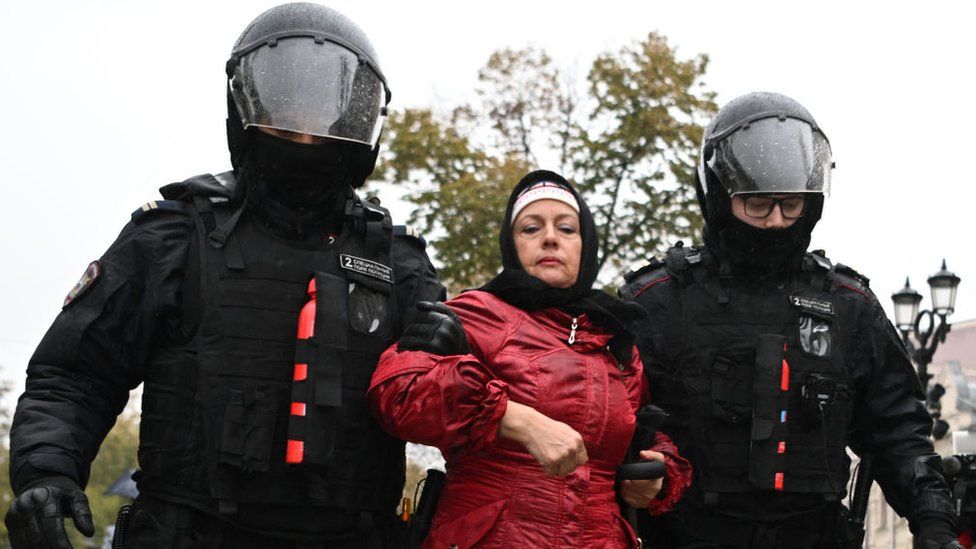
In Moscow, news agency AFP reported witnessing one demonstrator shouting "we are not cannon fodder" as she was arrested by officers.
And in St Petersburg, Russia's second city, one man told reporters: "I don't want to go to war for Putin."
Seventy-year-old Natalya Dubova told AFP that she opposed the war and confessed she was "afraid for young people" being ordered to the front.
Some of those arrested on Saturday reported being handed draft papers and ordered to report to recruiting centres while being held by security officials. The Kremlin defended the practice earlier this week, saying "it isn't against the law".
Moscow has also approved harsh new punishments for those accused of dereliction of duty once drafted.
Mr Putin signed fresh decrees on Saturday imposing punishments of up to 10 years imprisonment for any soldier caught surrendering, attempting to desert the military or refusing to fight.
The president also signed orders granting Russian citizenship to any foreign national who signs up to serve a year in the country's military.
The decree, which some observers have suggested displays how severe Moscow's shortage of troops has become, bypasses the usual requirement of five years of residency in the country.
Elsewhere, other young Russians continue to flee mobilisation by seeking to leave the country.
On the border with Georgia, queues of Russian cars stretch back more than 30km (18 miles) and the interior ministry has urged people not to travel.
Local Russian officials have admitted that there's been a significant influx of cars trying to cross - with nearly 2,500 vehicles waiting at one checkpoint.
The admission is a change of tone from Russia, with the Kremlin describing reports of Russians fleeing conscription as "fake" on Thursday.
Meanwhile, Finland has also seen a sharp increase in the number of Russians seeking to enter the country.
Matti Pitkaniitty, a spokesperson for the country's Border Guard, said said the number of Russians arriving had more than doubled since last week.
This video can not be played
To play this video you need to enable JavaScript in your browser.
On Friday, the government announced plans to stop Russian tourists entering the country.
"The aspiration and purpose is to significantly reduce the number of people coming to Finland from Russia," President Sauli Niinistö told the state broadcaster.
Several other neighbouring states have already ruled out offering asylum to Russians seeking to avoid the draft.
"Many Russians who now flee Russia because of mobilisation were fine with killing Ukrainians," Latvia's Foreign Minister Edgars Rinkēvičs said. "They did not protest then. It is not right to consider them as conscientious objectors."
On Friday, the Kremlin revealed a host of occupations it said will be exempt from conscription aimed at boosting its war effort in Ukraine.
IT workers, bankers and journalists working for state media will escape the "partial mobilisation" announced by President Putin on Wednesday.
But some have cast doubt on the truth of the Kremlin's claims, and reports have been emerging of Russian men who do not meet the criteria being called up by local recruiting officers.
Margarita Simonyan, the editor of the state-run media outlet RT, posted to Twitter a list of elderly and disabled citizens ordered to report for duty.
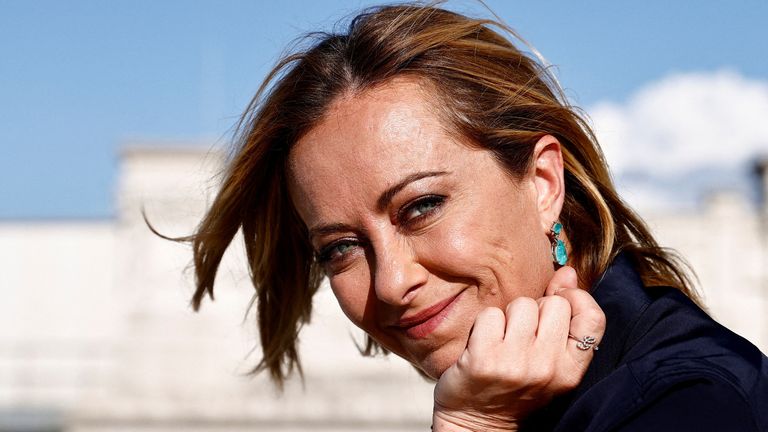
A century ago, in 1922, Benito Mussolini's Black Shirts marched on Rome, the start of 20 years of Fascist rule. Now, Italy could for the first time elect a prime minister whose party is rooted in neo-Fascism.
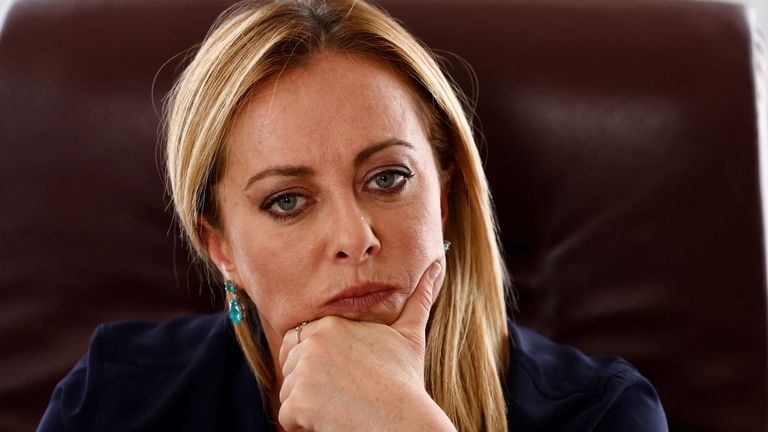
Giorgia Meloni, leader of the far-right Brothers of Italy party, is widely expected to win the national elections on Sunday, and then form a coalition government including Silvio Berlusconi's Forza Italia party and Matteo Salvini's League party.
The 45-year-old would be the first female leader in Italy, a country far behind its European allies in gender parity, and the first far-right politician to become head of government in a major eurozone economy.
Image:(L-R) Matteo Salvini, Silvio Berlusconi and Giorgia Meloni at the close of the campaign. Pic: AP
It would be an astonishing success for a politician long seen on the fringe and for a party that won just 4.3% of the vote at the last election in 2018.
Now, Brothers of Italy, which Ms Meloni founded 10 years ago, could win around 25% and become the country's largest party.
But the victory of a nationalist and eurosceptic in Italy would also raise fears in Europe, already grappling with the government of Viktor Orban's Fidesz in Hungary and the rise of Marine Le Pen's Rassemblement National in France, Vox in Spain, and Chega in Portugal.
Please use Chrome browser for a more accessible video player
1:39
Meloni tells Sky News she'd honoured to be Italy's first female PM
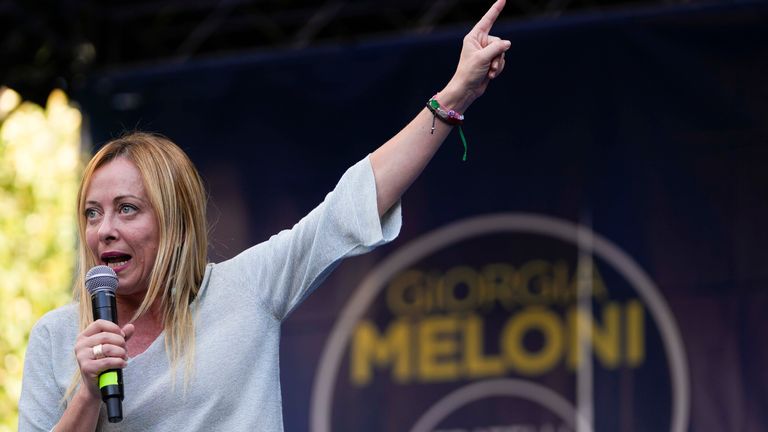
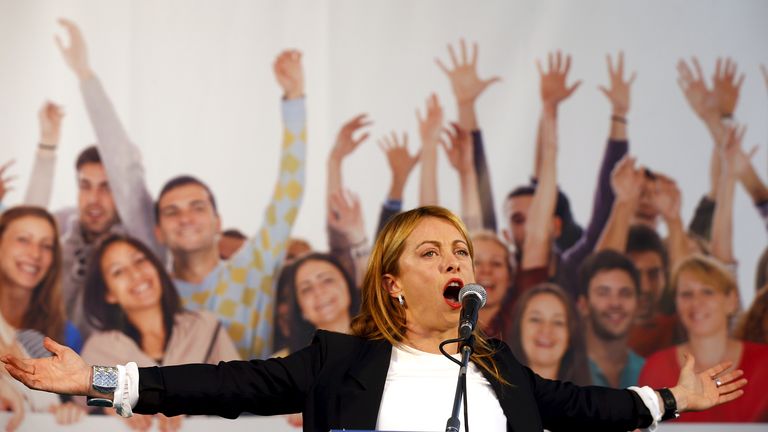
A Roman native, Ms Meloni has a no-nonsense attitude, a thick working-class accent and an ability to rouse crowds that make her stand out among the white middle-aged men who dominate Italian politics and boardrooms.
Her values of God, homeland and (traditional) family echo those promoted during the Fascist regime. Her party is named after the opening line of the national anthem, a warcry about fighting to the death for freedom.
Advertisement
Like other populists, she speaks out against "global elites" and fights what she calls the "groupthink" of political correctness and gender ideology.
But she has long been a supporter of NATO, and has spoken out against the Russian invasion of Ukraine, while many others on the far-right support Vladimir Putin.
Fascist roots
Please use Chrome browser for a more accessible video player
1:19
Meloni: Fascism 'handed over to history'
Ms Meloni, who as a young woman praised Mussolini, now repudiates the Fascist dictator and his anti-Semitic laws.
She places her party, which has roots in the Italian Social Movement (MSI) created by Mussolini supporters in 1946, firmly in the mainstream, alongside the Conservative Party here or the Republican Party in the US.
Indeed she often cites Roger Scruton, the philosopher and public intellectual who inspired Margaret Thatcher.
And she told Sky News' Europe Correspondent Adam Parsons that "there is nobody all over the world who needs to be afraid of us."
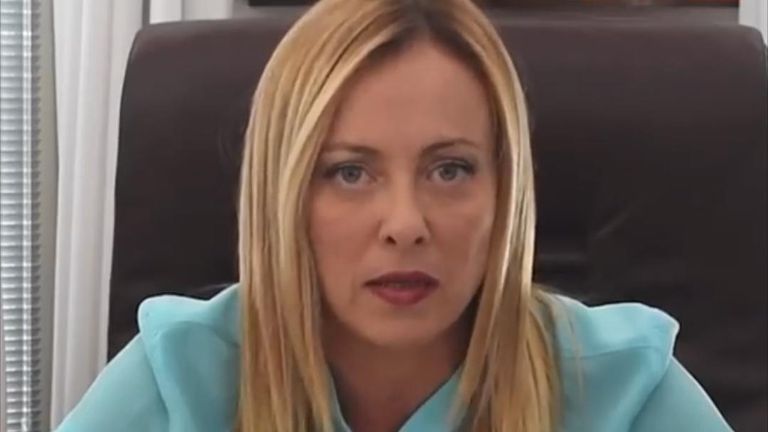
In a video posted this summer on Facebook - where she speaks English and other foreign languages for the consumption of the international media - she seeks to reassure European capitals that she poses no threat to democracy.
"The Italian right has handed Fascism over to history for decades now," she says.
Still, Brothers of Italy retains the flag-flame logo associated with Fascists (it is reputed to mean that Fascism burns on), and its rank-and-file includes Mussolini sympathisers who are sometimes caught giving the stiff-arm salute, while some local officials have Mussolini memorabilia in their offices.
Image:Giorgia Meloni in an effective public speaker Pic: AP
'I'm Giorgia'
Ms Meloni first captured widespread attention in 2019, when she gave a rousing speech that would become the most famous of her career.
Speaking to supporters in Rome piazza, she issued a rallying cry against global leftist forces that, she claimed, see family and national identity as enemies, and that want us to be "just codes".
"But we aren't just codes. We are people. And we'll defend our identity," she said.
Then, in what has become a signature line, she added: "I'm Giorgia, I'm a woman, I'm a mother, I'm Italian, I'm Christian! You won't take that away from me!"
This last flurry became a meme, remixed as a hit dance track that further spread her notoriety, and her fame. "I am Giorgia" is also the title of her autobiography.
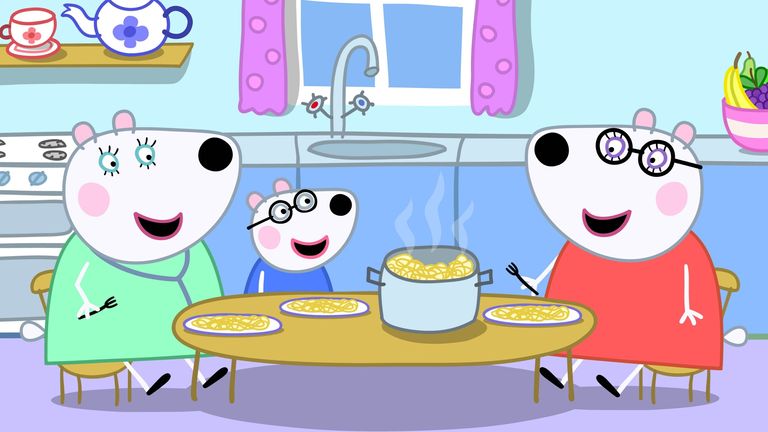
She is against adoption by same-sex couples. When Peppa Pig featured a couple consisting of two mothers, her party rushed to say that showing the episode in Italy would be unacceptable.
And though she insists she won't abolish Italy's abortion law, some fear she might try to restrict its application.
Image:This episode of Peppa Pig, featuring two mothers, irked Brothers of Italy
Naval blockade
A strong anti-immigrant stance is a cornerstone of Ms Meloni's manifesto, even as many economists note that, with Italy's low birth rate, the country's economy needs migrants.
She has called for a naval blockade of Africa's Mediterranean coast to stop migrants from reaching Italy.
In the past she alluded to the "Great Replacement" theory, a conspiracy suggesting that global elites want to substitute Europeans with immigrants.
In another notable speech, at a rally of the Spanish rightist party Vox last June, she said: "Yes to natural families, no to the LGBT lobby.
"Yes to sexual identity, no to gender ideology. Yes to the culture of life, no to the abyss of death."
"No to the violence of Islam, yes to safer borders. No to mass immigration, yes to work for our people. No to major international finance!"
In one of the most controversial moments of the electoral campaign, she retweeted the blurred video of a Ukrainian woman allegedly being raped by an asylum seeker in an Italian city, saying she could not remain silent in the face of "this atrocious episode of sexual violence". (The video was eventually removed by Twitter for violating its rules.)
'Moment of truth'
"For somebody who prides herself of being true to herself, of always saying what she really thinks, it's almost as if she's had a split personality during the electoral campaign", says Giada Zampano, a journalist and expert on the right-wing movement in Italy who has followed Ms Meloni's rise.
"On the one hand, we see the orator, the speaker who rouses the crowd, who seeks to appeal to the 10% Fascist core of her electorate.
"On the other we see the reassuring face who seeks to assuage the fears of Europe."
Zampano, who expects a decisive victory by Ms Meloni, adds: "Once she's in power, she will have to show her true colours.
"She will have to make choices when it comes to Italy's relationship with Europe, fiscal policy, nationalism, the European recovery funds. These decisions will be far more significant than labels about Fascism, post-Fascism or neo-Fascism.
"That will be the moment of truth."
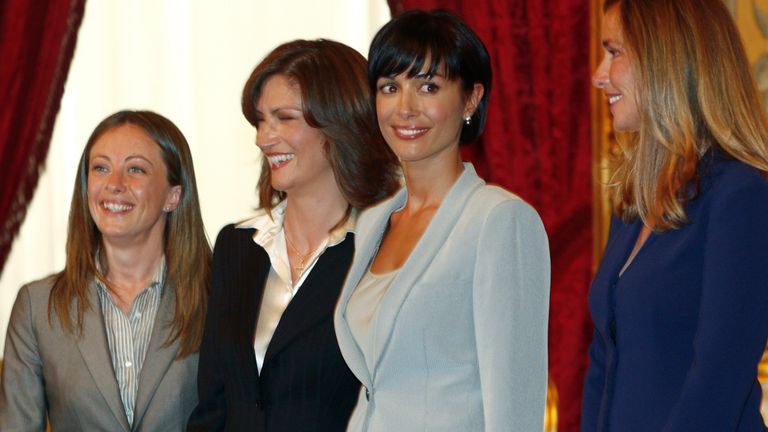
Image:Giorgia Meloni (left) with other women ministers in Silvio Berlusconi's 2008 government
Her life
Ms Meloni was raised by her mother in a working-class neighbourhood on the outskirts of Rome.
Her father left when she was one to live in the Canary Islands, with Ms Meloni and her sister visiting him once or twice a year. When she was 11, Ms Meloni stopped seeing him altogether.
As a child, she was called "fatty", something she said made her stronger.
She studied languages in high school and never went to university, instead taking up all manner of temporary jobs: she worked as a babysitter, as a stallholder at a flea market, as a bartender in a disco.
As for her political passion, it was awakened, she says, after the Mafia murdered a prosecutor in the early 1990s.
Still a teenager, she walked into the local branch of a previous iteration of the heirs to the Fascists, a party that had refashioned itself as mainstream conservative under the name of National Alliance.
Image:Meloni in 2015
By 29 she was an MP, at 31 she became the youngest minister in post-war Italy, running the youth portfolio in Mr Berlusconi's coalition government in 2008.
More recently, she was among the few who didn't participate in the unity coalition headed by Mario Draghi, the prime minister she might succeed.
She has a daughter with a TV journalist but, despite her defence of the traditional family, is not married.
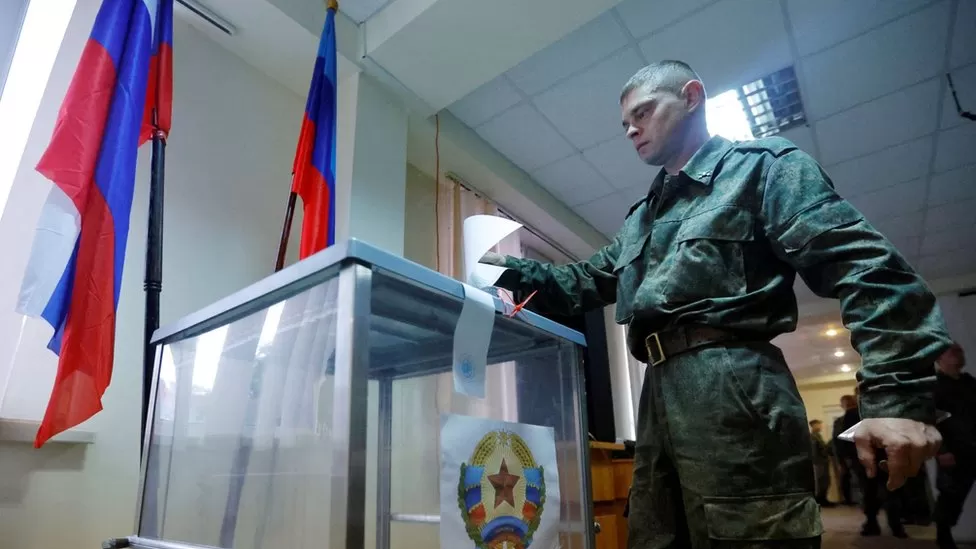
Ukrainians have reported armed soldiers going door-to-door in occupied parts of the country to collect votes for self-styled "referendums" on joining Russia.
"You have to answer verbally and the soldier marks the answer on the sheet and keeps it," one woman in Enerhodar told the BBC.
In southern Kherson, Russian guardsmen stood with a ballot box in the middle of the city to collect people's votes.
The door-to-door voting is for "security", Russian state media says.
"In-person voting will take place exclusively on 27 September," Tass reported. "On the other days, voting will be organised in communities and in a door-to-door manner."
One woman in Melitopol told the BBC that two local "collaborators" arrived with two Russian soldiers at her parents' flat, to give them a ballot to sign.
"My dad put 'no' [to joining Russia]," the woman said. "My mum stood nearby, and asked what would happen for putting 'no'. They said, 'Nothing'.
"Mum is now worried that the Russians will persecute them."
The woman also said there was one ballot for the entire household, rather than per person.
Although the evidence is anecdotal, the presence of armed men conducting the vote contradicts Moscow's insistence that this is a free or fair process.
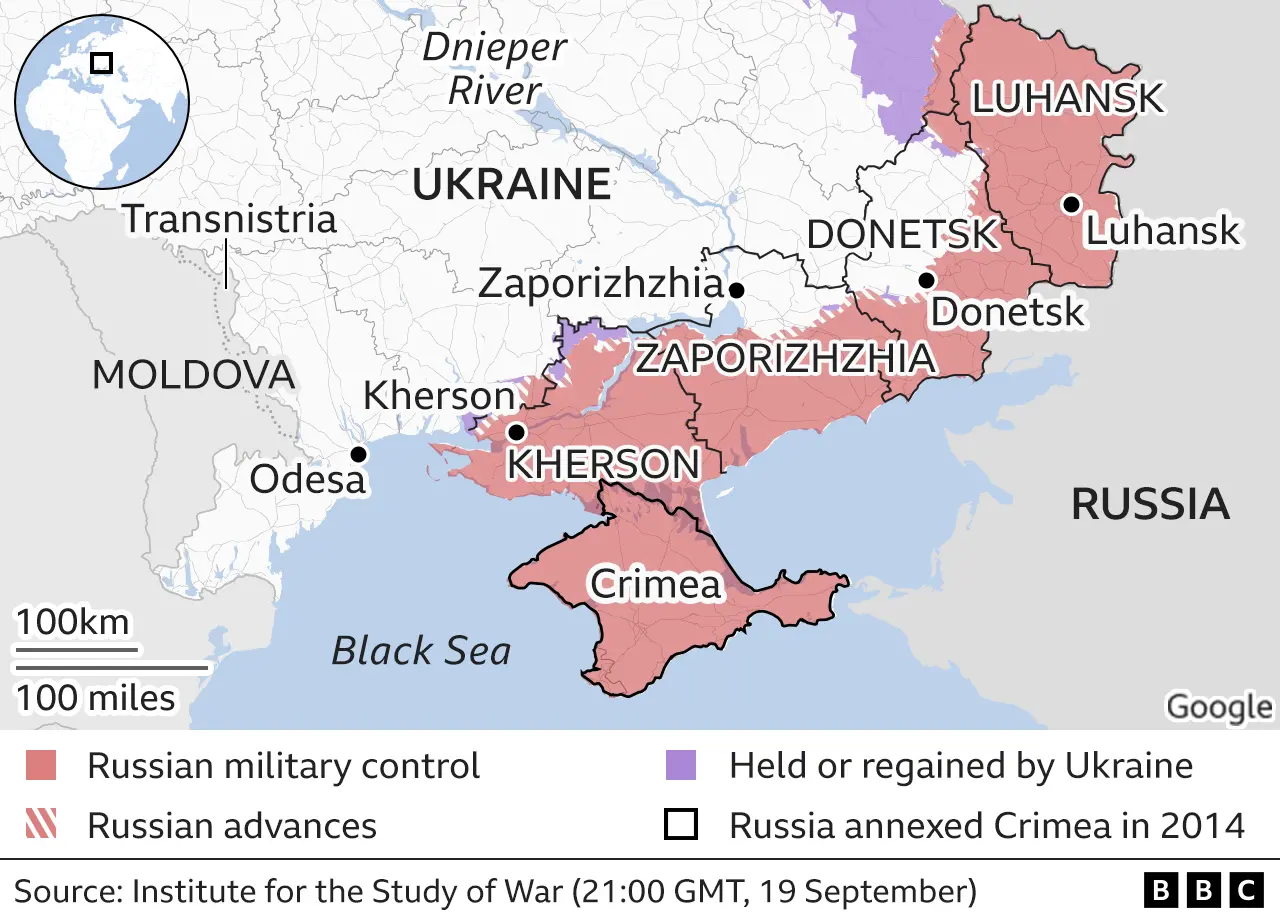
Experts say the self-styled referendums, taking place across five days, will allow Russia to claim - illegally - four occupied or partially-occupied regions of Ukraine as their own.
In other words, a false vote on annexation, seven months into Russia's invasion.
The "annexation" would not be recognised internationally, but could lead to Russia claiming that its territory is under attack from Western weapons supplied to Ukraine, which could escalate the war further.
US President Joe Biden described the referendums as "a sham", saying they were a "false pretext" to try to annex parts of Ukraine by force in violation of international law.
"The United States will never recognise Ukrainian territory as anything other than part of Ukraine," he said.
British Foreign Secretary, James Cleverly, said the UK had evidence that Russian officials had already set targets for "invented voter turnouts and approval rates for these sham referenda".
Mr Cleverly said Russia planned to formalise the annexation of the four regions - Luhansk, Donetsk, Kherson and Zaporizhzhia - by the end of the month.
Reuters
A source in Kherson told the BBC there was no public effort to encourage voting, apart from an announcement on the Russian news agency that people can vote at a port building, which had been disused for 10 years.
Another woman in Kherson said she saw "armed militants" outside the building where the vote seemed to be taking place. She pretended to forget her passport, so she didn't have to vote.
The woman said all her friends and family were against the referendum. "We don't know how our life will be after this referendum," she said. "It is very difficult to understand what they want to do."
Kyiv says the referendums will change nothing, and its forces will continue to push to liberate all of the territories.
This video can not be played
To play this video you need to enable JavaScript in your browser.
Meanwhile, Russian President Vladimir Putin's recent mobilisation of at least 300,000 extra troops has caused many Russian men of fighting age to flee.
One young Russian man who left St Petersburg for Kazakhstan to avoid the draft told BBC World Service's Outside Source programme that that most of his friends were also on the move.
"Right now, I feel like it's a total collapse. I know only maybe one or two folks that don't think about exile right now," he said.
He said some, like him, are travelling across the border, whereas others have gone to small Russian villages to hide.
"The big problem of Russia is that we didn't think about the war in Ukraine in February as we think about it right now," he said.
Additional reporting by Hanna Chornous and Daria Sipigina in Ukraine
What is being asked in the 'referendums'?
In the self-declared, unrecognised Luhansk and Donetsk "people's republics", people are being asked whether they "support their republic's accession to Russia as a federal subject"
In Zaporizhzhia and Kherson, they are being asked if they "favour the region's secession from Ukraine, creation of an independent country and subsequent accession to Russia as a federal subject"
In Luhansk and Donetsk, ballots are printed in Russian only
In Zaporizhzhia and Kherson, the ballot is in Ukrainian and Russian
Ukrainians have reported armed soldiers going door-to-door in occupied parts of the country to collect votes for self-styled "referendums" on joining Russia.
"You have to answer verbally and the soldier marks the answer on the sheet and keeps it," one woman in Enerhodar told the BBC.
In southern Kherson, Russian guardsmen stood with a ballot box in the middle of the city to collect people's votes.
The door-to-door voting is for "security", Russian state media says.
"In-person voting will take place exclusively on 27 September," Tass reported. "On the other days, voting will be organised in communities and in a door-to-door manner."
One woman in Melitopol told the BBC that two local "collaborators" arrived with two Russian soldiers at her parents' flat, to give them a ballot to sign.
"My dad put 'no' [to joining Russia]," the woman said. "My mum stood nearby, and asked what would happen for putting 'no'. They said, 'Nothing'.
"Mum is now worried that the Russians will persecute them."
The woman also said there was one ballot for the entire household, rather than per person.
Although the evidence is anecdotal, the presence of armed men conducting the vote contradicts Moscow's insistence that this is a free or fair process.
Experts say the self-styled referendums, taking place across five days, will allow Russia to claim - illegally - four occupied or partially-occupied regions of Ukraine as their own.
In other words, a false vote on annexation, seven months into Russia's invasion.
The self-styled "annexation" could lead to Russia claiming that its territory is under attack from Western weapons supplied to Ukraine, which could escalate the war further.
British Foreign Secretary, James Cleverly, said the UK had evidence that Russian officials had already set targets for "invented voter turnouts and approval rates for these sham referenda".
Mr Cleverly said Russia planned to formalise the annexation of the four regions - Luhansk, Donetsk, Kherson and Zaporizhzhia - by the end of the month.
Reuters
A source in Kherson told the BBC there was no public effort to encourage voting, apart from an announcement on the Russian news agency that people can vote at a port building, which had been disused for 10 years.
Another woman in Kherson said she saw "armed militants" outside the building where the vote seemed to be taking place. She pretended to forget her passport, so she didn't have to vote.
The woman said all her friends and family were against the referendum. "We don't know how our life will be after this referendum," she said. "It is very difficult to understand what they want to do."
Kyiv says the referendums will change nothing, and its forces will continue to push to liberate all of the territories.
This video can not be played
To play this video you need to enable JavaScript in your browser.
Meanwhile, Russian President Vladimir Putin's recent mobilisation of at least 300,000 extra troops has caused many Russian men of fighting age to flee.
One young Russian man who left St Petersburg for Kazakhstan to avoid the draft told BBC World Service's Outside Source programme that that most of his friends were also on the move.
"Right now, I feel like it's a total collapse. I know only maybe one or two folks that don't think about exile right now," he said.
He said some, like him, are travelling across the border, whereas others have gone to small Russian villages to hide.
"The big problem of Russia is that we didn't think about the war in Ukraine in February as we think about it right now," he said.
Additional reporting by Hanna Chornous and Daria Sipigina in Ukraine
What is being asked in the 'referendums'?
In the self-declared, unrecognised Luhansk and Donetsk "people's republics", people are being asked whether they "support their republic's accession to Russia as a federal subject"
In Zaporizhzhia and Kherson, they are being asked if they "favour the region's secession from Ukraine, creation of an independent country and subsequent accession to Russia as a federal subject"
In Luhansk and Donetsk, ballots are printed in Russian only
In Zaporizhzhia and Kherson, the ballot is in Ukrainian and Russian
The foreign secretary has called on countries to reject the "charade" of referenda to be held in Russian-controlled regions in eastern and southern Ukraine.
Speaking at the United Nations Security Council, James Cleverly said Vladimir Putin plans to fix the results of votes on becoming parts of Russia.
It comes as a prosecutor at the International Criminal Court (ICC), Karim Khan, told the council there were "reasonable grounds" to believe war crimes had been committed in Ukraine.
Mr Cleverly said: "We have information which means that we know that Russia is about to hold sham referenda on sovereign Ukrainian territory with no basis in law under the threat of violence after mass displacements of people in areas that voted overwhelmingly for Ukrainian independence.
"We know what Vladimir Putin is doing. He is planning to fabricate the outcome of those referenda, he is planning to use that to annex sovereign Ukrainian territory, and he is planning to use it as a further pretext to escalate his aggression.
"We call on all countries to reject this charade and to refuse to recognise any results."
The security council meeting in New York came a day after the Ukraine conflict threatened to spiral into a nuclear crisis as Mr Putin warned his country would use "all the means at our disposal" to protect itself.
Mr Khan, the ICC prosecutor, said he was dispatching more staffers next week to look into allegations emerging from eastern Ukraine.
Advertisement
He hasn't yet announced any charges linked to the conflict, but said he believes there are reasonable grounds to think that crimes within the jurisdiction of the court had been committed.
The Hague-based court handles war crimes, crimes against humanity, genocide and crimes of aggression.
"The picture that I've seen so far is troubling indeed," he said.
Please use Chrome browser for a more accessible video player
2:39
Retired Air Vice-Marshall Sean Bell explains what Putin said about Russia’s weapons in his speech
Mr Cleverly said the "devastating consequences" of Russia's invasion of Ukraine are becoming clearer every day.
Addressing his counterparts at the special foreign minister-level meeting, he said: "We see the mounting evidence of Russian atrocities against civilians, including indiscriminate shelling and targeted attacks on over 200 medical facilities and 40 educational institutions and horrific acts of sexual violence."
He said in parts of Ukraine under Russian control, civilians are subject to torture, arbitrary detention and forced deportation to Russia.
The foreign secretary spoke right after Sergei Lavrov, but the Russian foreign minister left the chamber straight after his turn.
Russia is outnumbered on the security council, but any meaningful action on Ukraine by the 15-member body has been hampered because it is a veto-wielding permanent member.
US Secretary of State Antony Blinken earlier told the meeting that "one man chose this war, one man can end it".
Image:There have been protests in Moscow after Putin issued a mobilisation order as he attempts to gain ground . Pic: Reuters
Image:There have been protests in Moscow after Putin issued a mobilisation order as he attempts to gain ground . Pic: Reuters
The conflict in Ukraine has dominated talks at the United Nations General Assembly in New York, where world leaders and senior diplomats from across the globe have descended.
On Tuesday, separatist leaders in four Russian-occupied regions of Ukraine announced plans to begin voting to become integral parts of Russia.
Mr Putin gave a rare address to the nation the following day, where he said he said he wasn't bluffing and would use "all the means available to us" if Russian territory was threatened.
In her first speech on the world stage as prime minister, Liz Truss said Mr Putin was desperately trying to justify a "catastrophic" failure in Ukraine and accused him of "sabre rattling".
Please use Chrome browser for a more accessible video player
0:17
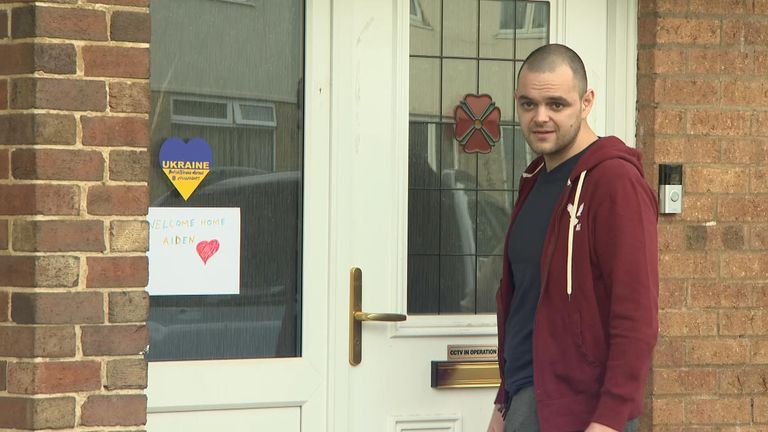
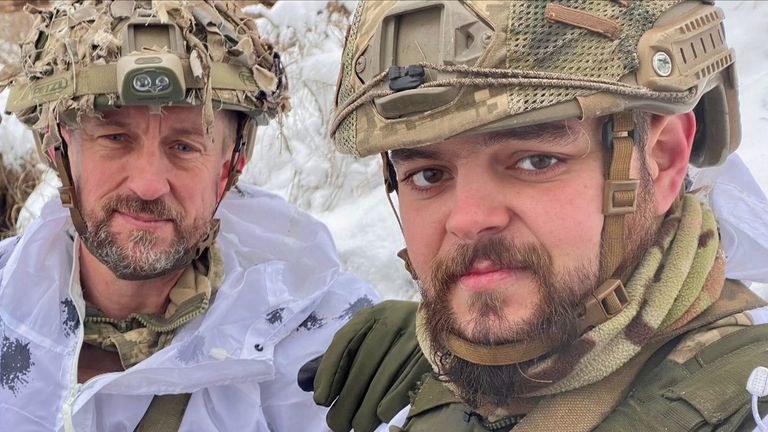
Freed POW Aiden Aslin thankful for release
Aiden Aslin, John Harding, Dylan Healy and Andrew Hill have been identified by the Foreign and Commonwealth Office as the other Britons released.
In a statement, Mr Pinner's family said: "We would like to thank everybody involved in Shaun's release, especially all at the Foreign Office, Liz Truss and her team, Boris Johnson and President Zelenskyy.
"Shaun would also like to thank the hospitality of the Saudi government and Prince Mohammed bin Salman al Saud who also assisted in the negotiations for his freedom.
Advertisement
"It's a very emotional time as you can expect and we are unable to currently discuss so early in his release any details fully.
"It's been a harrowing time for Shaun and our family which has now had such a happy resolution. Shaun is in good spirits and still has his sense of humour intact. He is looking forward to steak and a glass of red wine tonight.
"We are now enjoying some family time and would appreciate the privacy at this moment."
Image:Shaun Pinner (pictured in dark top in the middle) in a hotel with his family
As a result, they appeared in court in the self-proclaimed Donetsk People's Republic, a breakaway region in eastern Ukraine, and were threatened with death by firing squad.
At the time, Mr Pinner's family stressed he was "not a volunteer nor a mercenary, but officially serving with the Ukrainian army".
On their flight home, Mr Aslin and Mr Pinner recorded a message, thanking those who had worked to free them.
"We're now out of the danger zone and on our way home to our families," said Mr Aslin.
"By the skin of our teeth," Mr Pinner, who is from Bedfordshire, added.
Prior to their release, four of the men featured in video clips posted online or on Russian state TV.
Please use Chrome browser for a more accessible video player
1:20
Brits sentenced to death
The first hint Mr Pinner had that something was happening was after lunch on Tuesday.
"They said you have to roll your stuff up. They said you're going on a long journey," he said.
'We were moved to another location. We didn't have any idea what was happening."
He was flown with other released captives to Saudi Arabia and at 5.30pm UK time on Wednesday, he was able to speak to his mother on the phone, from the Middle Eastern country.
Wedding anniversary
"It's very emotional, as you can imagine," he said.
However, the 48-year-old, who has been living in Ukraine since 2018, has many friends still there, as well as his wife.
Today is their second wedding anniversary.
It's hoped she will be able to get a visa to also come to the UK.
In footage broadcast on Russian state TV in April, Mr Pinner said he had been fighting in the besieged port city of Mariupol for five to six weeks.
In the months before he appeared in court, he told Sky Newshe was on his fourth tour of duty in Ukraine after serving in the British Army for nine years.
After the news broke the Britons would be returning to the UK, Prime Minister Liz Truss said she "hugely welcomed" the move, adding it would end "months of uncertainty and suffering for them and their families".
Image:Shaun Pinner (centre) and Aiden Aslin (right). John Harding has his thumb up
Who else was released?
Almost 300 people were released in the prisoner swap, many of them from the Ukrainian Azov regiment, which gained fame for its defence of the final stronghold in Mariupol.
Mr Harding was among the small group of soldiers who were holed up inside the Azovstal steelworks in the southeastern city.
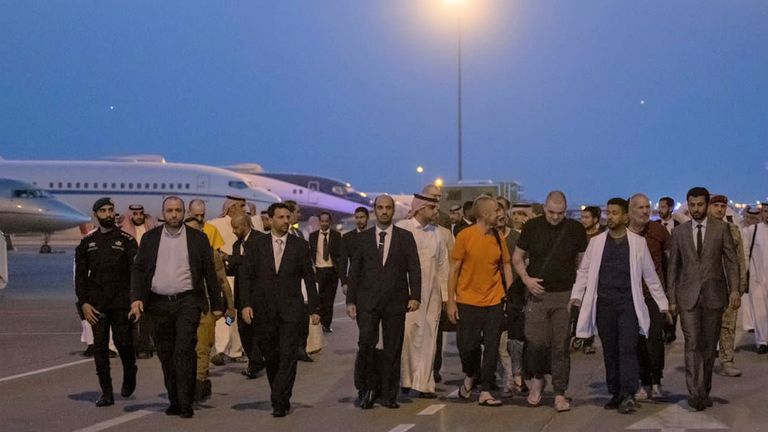
Ten other foreigners have been released to Saudi Arabia before they return home, including Moroccan Brahim Saadoun, Americans Alexander Drueke and Andy Huynh, a Croatian, and a Swedish national.
Image:Almost 300 people were freed after being held by Russian-backed separatists in Ukraine. Pic: SPA - Saudi Press Agency
Ukraine President Volodymyr Zelenskyy said: "We remember all our people and try to save every Ukrainian.
"This is the meaning of Ukraine, our essence, this is what distinguishes us from the enemy."
The exchange took place unexpectedly, coming as Russian President Vladimir Putin threatened to use nuclear weapons.
It was brokered with help from Turkey and Saudi Arabia's Crown Prince Mohammed bin Salman, who has close ties with Mr Putin.
 Getty Images