Rescuers found the helicopter that was carrying the Iranian president, as well as the country’s foreign minister Hossein Amirabdollahian and other senior officials, after it crashed in a mountainous northwest region of Iran.
Minutes after the Red Crescent Society announced its team had reached the site of the crash, state TV reported that there were “no signs of life” and an official said the helicopter had been “completely burned”.
The state-run Mehr news agency then announced that the president and foreign minister had been “martyred”.
Iran’s first vice president Mohammad Mokhber will take charge of the executive branch and has a maximum period of 50 days to hold elections following the death of president Ebrahim Raisi, Iran’s supreme leader Ayatollah Ali Khamenei said.
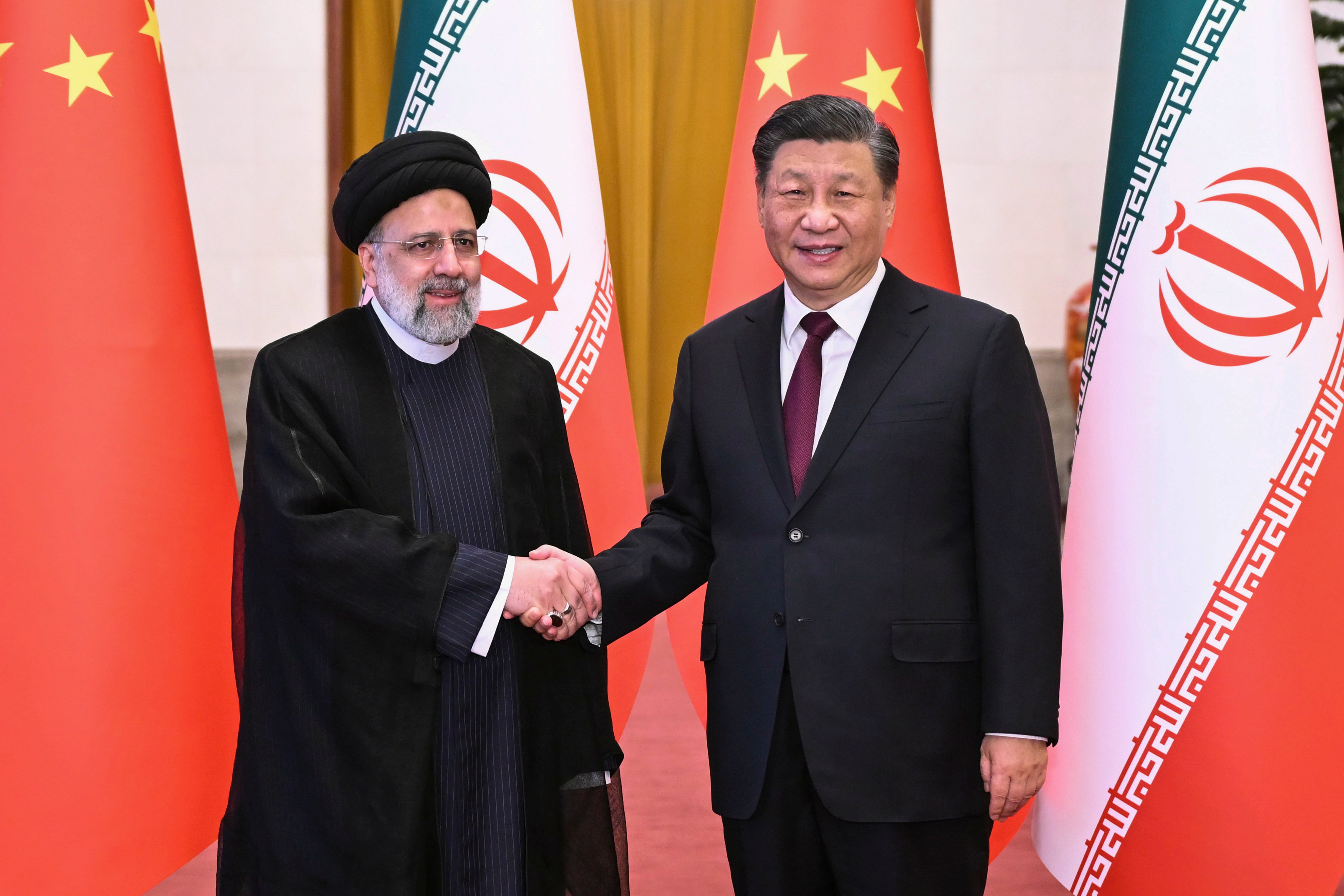
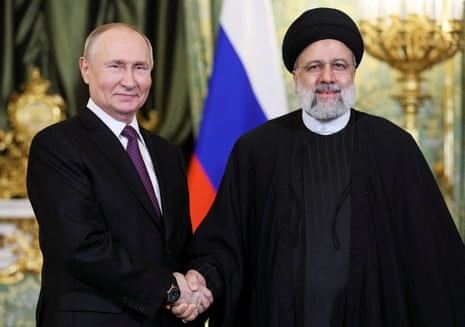
China’s Xi Jinping and Russia’s Vladimir Putin were among leaders to share their reactions on Monday morning, both of whom lamented the death of their “good friend”.
Iranian president Ebrahim Raisi dies in helicopter crash
The aircraft went down in between Jolfa and Varzaqan, a region on the border of Azerbaijani exclave Nakhchivan, around 600 kilometers (375 miles) northwest of the Iranian capital Tehran.
How were Iran’s relations with the US under Raisi’s rule?
Ebrahim Raisi’s election came at a time when relations between Tehran and Washington were particularly tense following former US president Donald Trump’s 2018 decision to unilaterally withdraw America from a nuclear deal aimed at limiting Iran’s uranium enrichment in exchange for sanctions relief.
While Mr Raisi said he wanted to rejoin the deal with world powers, his new administration instead pushed back against international inspections of nuclear facilities, in part over an alleged sabotage campaign that Tehran blamed on Israel. Talks to restore the accord remained stalled in his government’s first months.
“Sanctions are the US’s new way of war with the nations of the world,” Raisi told the United Nations in September 2021. “The policy of ‘maximum oppression’ is still on. We want nothing more than what is rightfully ours.”
Lebanon and Syria announce three-day mourning period
Lebanon and Syria have both announced three days of national mourning for the Iranian president and foreign minister.
Iran enjoys sway in both countries, backing the Lebanese armed group Hezbollah in Lebanon and helping Syria’s government and security forces to remain in power throughout more than a decade of war.
“I can’t tell you how sorry I am about this incident that happened. Especially that the foreign minister had become a friend,” his Lebanese counterpart Abdallah Bou Habib told reporters.
Meanwhile, Syria’s president Bashar al-Assad – as well as other Lebanese officials and Hezbollah – offered their condolences for the deaths.
Head of UN’s atomic watchdog holds minute’s silence for Raisi
The head of the International Atomic Energy Agency, Rafael Mariano Grossi, used a conference on nuclear security in Vienna to call for a minute’s silence in memory of Iran’s president Ebrahim Raisi, foreign minister Hossein Amirabdollahian and the other victims of the helicopter crash.
“I extend my condolences on (their) tragic passing,” Mr Grossi wrote on X/Twitter. “Our thoughts are with their families and the people of Iran during this difficult time.”
Grossi visited Iran earlier this month as his agency negotiates with Tehran over how to implement a deal struck last year to expand inspections of the Islamic Republic’s rapidly advancing atomic program.
Russia expects all agreements with Iran to be implemented in wake of Raisi’s death, minister says
Russia’s deputy foreign minister said Moscow expected all agreements with Iran to be implemented following president Ebrahim Raisi’s death, Russian state news agency RIA reported .
China’s Xi Jingping says death of ‘good friend’ Raisi is ‘a huge loss’
Chinese president Xi Jinping has expressed his condolences over the death of Ebrahim Raisi, with a spokesperson for China’s foreign ministry saying: “His unfortunate death is a huge loss to the Iranian people, and also caused China to lose a good friend.
Mr Xi also praised Raisi’s “important contributions to safeguarding Iran’s security and stability” and for “positive efforts” on China-Iran relations, the spokesperson said.
The spokesperson also expressed condolences over the death of Iran’s foreign minister Hossein Amirabdollahian and said China would continue to provide necessary assistance and support to Iran.
Hamas and Palestinian Islamic Jihad mourn Iranian officials killed in helicopter crash
Palestinian militant groups Hamas and Palestinian Islamic Jihad – both of which have received military support from Tehran – have issued statements mourning the deaths of Iran’s president and foreign minister.
Hamas said the helicopter crash had “claimed the lives of a group of the best Iranian leaders,” praising their “honorable positions in support of our Palestinian cause, and support for the legitimate struggle of our people against the Zionist entity,” referring to Israel.
“We are confident that the Islamic Republic of Iran will be able — God willing — to overcome the repercussions of this great loss. The dear Iranian people have ancient institutions capable of dealing with this severe ordeal,” the statement said.
The Islamic Jihad, similarly, called the deaths of Ebrahim Raisi and Hossein Amirabdollahian “a great loss for the Palestinian people in these difficult circumstances, as they had a prominent and clear role in supporting and assisting the Palestinian people’s struggle and resistance.”
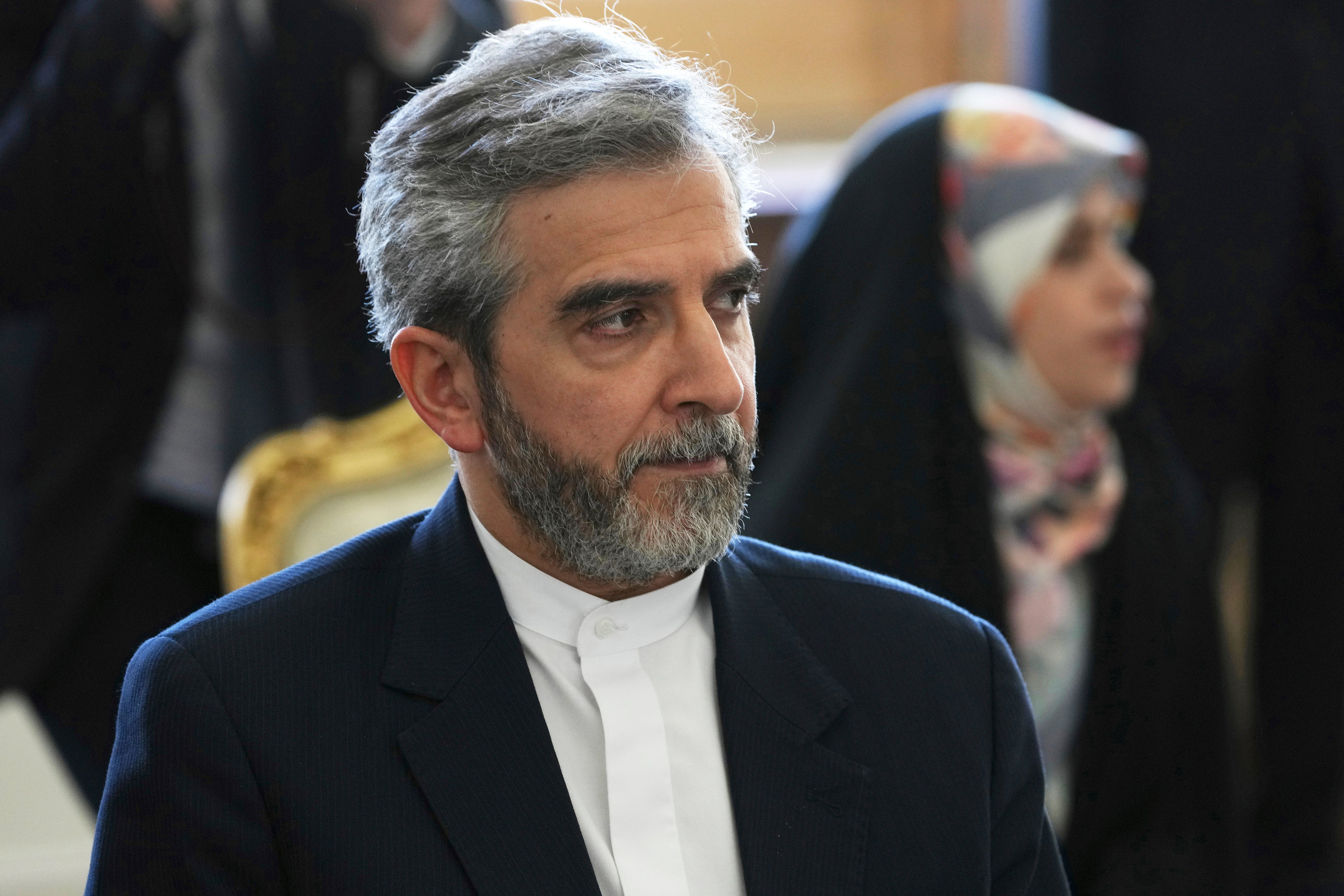
Iran’s government cabinet has appointed deputy foreign minister Ali Bagheri Kani as acting foreign minister following the death of Hossein Amirabdollahian in Monday’s helicopter crash.
Ali Bagheri Kani has served as Iran’s chief nulear negotiator (AP Photo/Vahid Salemi, File)
Born to a conservative family in eastern Iran, Ebrahim Raisi studied theology at the seminaries in Qom, report my colleagues Athena Stavrou and Shweta Sharma.
He was a teenager when the country’s popular revolution established Iran as a theocracy, but he quickly became an enthusiastic participant in enforcing the vision of Ayatollah Ruhollah Khomeini, the founder of the Islamic Republic.
At 21 years old, Raisi began serving as a prosecutor, pursuing politically charged cases in the cities of Karaj and Hamadan. He gained a reputation as one of the regime’s most severe figures – a young, brash ideologue, willing to get his hands dirty.
Within a few years, Raisi was appointed as a judge, a rapid rise that was stunning to Iranians and led to years of questions about his professional credentials. Raisi also faces sanctions from the US and other nations over his involvement in the mass execution of prisoners in 1988.
He ran unsuccessfully for president in 2017 against Hassan Rouhani, the relatively moderate cleric who as president reached Tehran’s 2015 nuclear deal with world powers.
In 2021, Raisi ran again in an election that saw all of his potentially prominent opponents barred from running under Iran’s vetting system. He swept nearly 62 per cent of the 28.9 million votes, the lowest turnout by percentage in the Islamic Republic’s history.
Iranian state-run television is reporting that Iranian President Ebrahim Raisi has died in a helicopter crash alongside foreign minister Hossein Amir-Abdollahian.
The pair were confirmed dead after the crash in a mountainous area in the province of East Azerbaijan, Press TV reported, without citing a source. The report follows similar reports from other Iranian media including the Mehr and Tasnim news agencies as well as the Reuters news agency.
No immediate cause was given for the crash, which took place amid foggy conditions on Sunday as the president was returning from a trip to neighbouring Azerbaijan to inaugurate a dam.
The governor of Iran’s East Azerbaijan province and the representative of the Leader of the Islamic Revolution to East Azarbaijan province as well as bodyguards were also on board, the state-run Irna news agency reported.
Reuters is reporting that an Israeli official has told the news agency it was not involved in the helicopter crash which has killed Iran’s president Ebrahim Raisi.
Israel rarely officially comments on its activities outside its border, which in recent months have included strikes inside Lebanon, Syria and Iran.
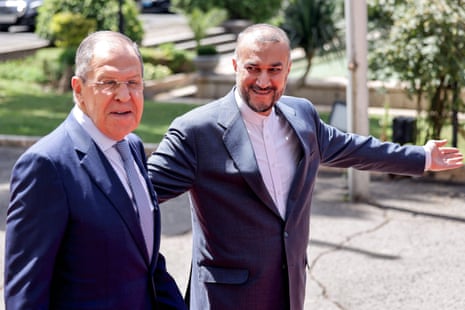
Russian foreign minister Sergei Lavrov has said Iran’s president Ebrahim Raisi had been a “true, reliable friend” of Russia, Reuters reports.
It quotes Lavrov saying:
In Russia, the president of Iran Ebrahim Raisi and the minister of foreign affairs of Iran Hossein Amir-Abdollahian were known as true, reliable friends of our country. Their role in strengthening mutually beneficial Russian-Iranian cooperation and trusting partnership is invaluable. We sincerely extend our condolences to the families and friends of the victims, as well as to the entire friendly people of Iran. Our thoughts and hearts are with you in this sad hour.
While the president of the European Council has offered “sincere condolences” to Iran on the death of Ebrahim Raisi [See 7.39 BST], by contrast Dutch far-right politician Geert Wilders posted on social media this morning that “I hope Iran will soon become a secular state again, with freedom for the Iranian people, and without an oppressive and barbaric Islamic mullah regime.”
Hamas has issued a statement thanking Iran’s president Ebrahim Raisi and foreign minister Hossein Amir-Abdollahian for their support in its war against Israel after their deaths yesterday. Reuters reports the group said:
These leaders supported the legitimate struggle of our people against the Zionist entity, provided valued support to the Palestinian resistance, and made tireless efforts in solidarity and support in all forums and fields for our people in the steadfast Gaza Strip. They also made significant political and diplomatic efforts to stop the Zionist aggression against our Palestinian people.
The European Council president, Charles Michel, said this morning that “the EU expresses its sincere condolences for the death of president Ebrahim Raisi and foreign minister Hossein Amir-Abdollahian, as well as other members of their delegation and crew in a helicopter accident.”
“Our thoughts go to the families,” he added.
Russia’s embassy in Tehran on Monday has also expressed condolences over the death of Iranian president Ebrahim Raisi, who was killed in a crash after his helicopter went down in mountains close to Iran’s border with Azerbaijan yesterday. As president, Raisi supplied Russia with arms for use in its invasion of Ukraine.
Mohammed bin Zayed Al Nahyan, president of the UAE, has said his country stands in solidarity with Iran at what he described as a “difficult time”, and extended condolences to the Iranian government and the people of Iran, Reuters reports.
Vice-president Mohammad Mokhber has led an emergency cabinet meeting following news of the death of President Raisi in a helicopter crash, state media is reporting.
In a statement, the government extended its condolences to Supreme Leader Ali Khamenei and the Iranian nation and said it would continue to operate “without disruption”, according to Press TV.
Ministers also paid tribute to the late president and his “tireless efforts”, according to the Tasnim news agency.
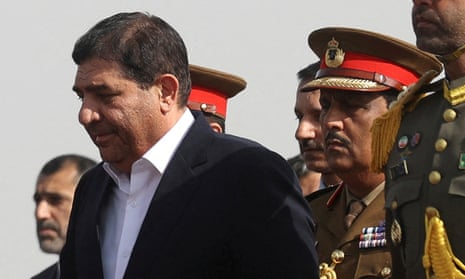
As Iran’s vice president, MohammadMokhber is expected to become the country’s interim president who will help organise a presidential election that should take place within 50 days of the president’s death.
Here’s what to know about him according to Reuters:
Born on 1 September 1955, Mokhber, like Raisi, is seen as close to Supreme Leader Ali Khamenei, who has the last say in all matters of state. Mokhber became first vice president in 2021 when Raisi was elected president.
Mokhber was part of a team of Iranian officials who visited Moscow in October and agreed to supply surface-to-surface missiles and more drones to Russia’s military, sources told Reuters at the time. The team also included two senior officials from Iran‘s Revolutionary Guards and an official from the Supreme National Security Council.
Mokhber had previously been head of Setad, an investment fund linked to the supreme leader.
In 2010, the European Union included Mokhber on a list of individuals and entities it was sanctioning for alleged involvement in “nuclear or ballistic missile activities”. Two years later, it removed him from the list.
In 2013, the US Treasury Department added Setad and 37 companies it oversaw to a list of sanctioned entities.
Setad, whose full name is Setad Ejraiye Farmane Hazrate Emam, or the Headquarters for Executing the Order of the Imam, was set up under an order issued by the founder of the Islamic Republic, Khamenei’s predecessor, Ayatollah Ruhollah Khomeini. It ordered aides to sell and manage properties supposedly abandoned in the chaotic years after the 1979 Islamic Revolution and channel the bulk of the proceeds to charity.
Iran’s Tasnim news agency has a few more details about the other people on board the helicopter when it crashed; there were nine people in total.
According to Tasnim, they included East Azerbaijan governor Malek Rahmati and Maj Gen Seyed Mehdi Mousavi, head of the president’s security team. A pilot, co-pilot and a technician were also on board.
If you’re just joining us, here is a summary of the latest developments in Iran, where it’s just gone 9am.
Iranian state-run media have confirmed the death of President Ebrahim Raisi and foreign minister Hossein Amir-Abdollahian in a helicopter crash in the province of East Azerbaijan on Sunday as they headed towards the city of Tabriz. “The servant of Iranian nation, Ayatollah Ebrahim Raisi has achieved the highest level of martyrdom whilst serving the people,” state television said.
The pair were returning from Azerbaijan, where they had attended the inauguration of a dam alongside President Ilham Aliyev, when the helicopter crashed in a mountainous region amid poor weather conditions.
The government has yet to make an official statement but the state-run news agency Irna reported that an urgent cabinet meeting had been called and a statement was expected soon.
After an hours-long search hampered by fog and rain, rescuers found the burnt-out wreckage of the helicopter on a mountainside. The head of the Iranian Red Crescent, Pir Hossein Kolivand, said as rescuers approached the wreckage, that there were “no signs of life”.
A total of nine people were on board the aircraft, according to Tasnim news agency, including the governor of East Azerbaijan, Malek Rahmati, and Ayatollah Mohammad Ali Ale-Hashem, the representative of the Leader of the Islamic Revolution to East Azarbaijan province.
On Sunday, before the wreckage had been found, supreme leader Ayatollah Ali Khamenei urged Iranians to “not worry” about the leadership of the Islamic republic, saying “there will be no disruption in the country’s work”.
The president is believed to have been travelling in Bell 212 helicopter. Iran flies a variety of helicopters in the country, but international sanctions make it difficult to obtain parts for them. Its military air fleet also largely dates back to before the 1979 Islamic Revolution.
If a president dies in office, article 131 of the Islamic Republic’s constitution says that the first vice president – in this case Mohammad Mokhber – takes over, with the confirmation of the supreme leader, who has the final say in all matters of state in Iran. A council consisting of the first vice president, the speaker of parliament and the head of the judiciary must arrange an election for a new president within a maximum period of 50 days.
Countries including Russia, Turkey and India had expressed concern and offered assistance after reports that the helicopter carrying Raisi had gone missing and after his death was confirmed expressions of condolence also began to come in.
Indian prime minister Narendra Modi said on X that he is “shocked by his tragic demise” and that his “contribution to strengthening India-Iran bilateral relationship will always be remembered.
Before news of Raisi’s death a US state department spokesperson said only that, “We are closely following reports of a possible hard landing of a helicopter in Iran carrying the Iranian president and foreign minister”. US President Joe Biden had been briefed on the situation, his spokesperson said.
If a president dies in office, article 131 of the Islamic Republic’s constitution says that the first vice president – who is Mohammad Mokhber – takes over, with the confirmation of the supreme leader, who has the final say in all matters of state in Iran.
A council consisting of the first vice president, the speaker of parliament and the head of the judiciary must arrange an election for a new president within a maximum period of 50 days, Reuters reports.
Raisi was elected president in 2021 and, under the usual timetable, a presidential election had been due to take place in 2025. Under constitutional rules, it can now be expected to take place by early July.
Indian prime minister Narendra Modi has extended his condolences to President Raisi’s family and the Iranian people, saying in a post on X that he is “shocked by his tragic demise”.
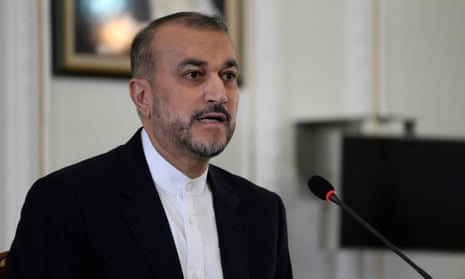
Iran’s foreign minister, Hossein Amirabdollahian, was a hard-liner close to the country’s paramilitary Revolutionary Guard who confronted the west while also overseeing indirect talks with the US over the country’s nuclear program. The Associated Press reports further:
Amir-Abdollahian represented the hard-line shift in Iran after the collapse of Tehran’s nuclear deal with world powers after then-US President Donald Trump unilaterally withdrew America from the accord. He served under President Ebrahim Raisi, a protégé of Supreme Leader Ayatollah Ali Khamenei, and followed their policies.
However, AmirAbdollahian also was involved in efforts to reach a détente with regional rival Saudi Arabia in 2023, a move eclipsed months later by tensions that arose over the Israel-Hamas war. But he remained close to the country’s paramilitary Revolutionary Guard, once praising the late Gen. Qassem Soleimani, slain in a US drone strike in Baghdad in 2020.
“You should thank the Islamic Republic and Qassem Soleimani because Soleimani has contributed to world peace and security,” Amir-Abdollahian once said. “If there was no Islamic Republic, your metro stations and gathering centres in Brussels, London and Paris would not be safe.”
Amir-Abdollahian served in the foreign ministry under Ali Akbar Salehi in 2011 through 2013. He then returned for several years under foreign minister Mohammad Javad Zarif, who was a key player in the nuclear deal reached under the administration of the relative moderate President Hassan Rouhani.
But Zarif and Amir-Abdollahian had a falling out, likely over internal differences in Iran’s foreign policy. Zarif offered him the ambassadorship to Oman, still a strategically important post given the sultanate long serving as an interlocutor between Iran and the west. But Amir-Abdollahian refused.
He became foreign minister under Raisi with his election in 2021. He backed the Iranian government position, even as mass protests swept the country in 2022 after the death of Mahsa Amini, a woman who had been earlier detained over allegedly not wearing a hijab, or headscarf, to the liking of authorities. The months-long security crackdown that followed the demonstrations killed more than 500 people and saw over 22,000 detained.
In March, a United Nations investigative panel found that Iran was responsible for the “physical violence” that led to Amini’s death.
During the Israel-Hamas war, he met with foreign officials and the leader of Hamas. He also threatened retaliation against Israel and praised an April attack on Israel. He also oversaw Iran’s response to a brief exchange of airstrikes with Iran‘s nuclear-armed neighbor Pakistan and worked on diplomacy with the Taliban in Afghanistan, with whom Iran had tense relations.
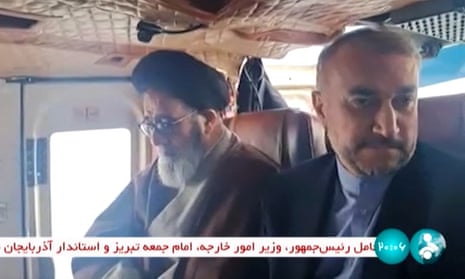
Iranian state television has released this screen grab from video footage from inside the helicopter before it crashed. It shows President Ebrahim Raisi (L) with foreign minister Hossein Amir-Abdollahian.
Here is a video of the Israeli war cabinet minister, Benny Gantz, threatening to resign if Benjamin Netanyahu fails to adopt an agreed plan for Gaza:
Here are some of the latest images coming out from the newswires:
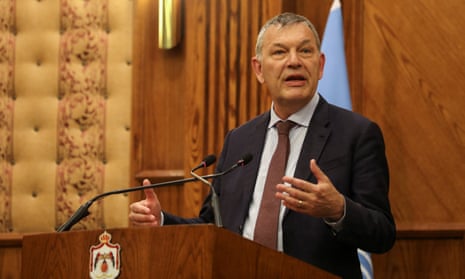
Jordan’s foreign minister, Ayman Safadi, has said the kingdom demanded an international investigation into what it said were many war crimes committed during Israel’s war in Gaza.
In remarks made during a press conference with the head of the UN Palestinian refugee agency (Unrwa), Safadi said those responsible for documented crimes should be brought to justice.
Last month, the UN human rights council adopted a resolution calling for Israel to be held accountable for possible war crimes and crimes against humanity committed in the Gaza Strip.
Twenty-eight countries voted in favour, 13 abstained and six voted against the resolution, including the US and Germany.
The resolution emphasised “the need to ensure accountability for all violations of international humanitarian law and international human rights law in order to end impunity”.
It also expressed “grave concern at reports of serious human rights violations and grave breaches of international humanitarian law, including of possible war crimes and crimes against humanity in the occupied Palestinian territory”. Israel has denied carrying out war crimes.
Iran has confirmed that it held indirect talks with the US in Oman despite the two countries having no diplomatic relations, state media reported.
Washington and Tehran have long been sharply at odds with tensions centred on Iran’s contested nuclear programme and heightened by the Gaza war between their respective allies Israel and Hamas.
On Friday, Axios reported that US and Iranian officials held indirect talks in Oman “on how to avoid escalating regional attacks”.
The official IRNA news agency confirmed on Saturday evening that “the representative of the Islamic Republic of Iran to the United Nations confirmed indirect negotiations between Iran and the United States in Oman”.
It quoted him as saying that “these negotiations were not the first and will not be the last”, without giving the time and place of the talks.
The barrage came in response to a deadly 1 April airstrike, widely blamed on Israel, that levelled Iran’s consulate in Damascus and killed seven Revolutionary Guards, two of them generals.
The White House has said the US national security adviser, Jake Sullivan, is due to hold talks with senior Israeli government officials on Sunday and will stress the need to target Hamas in a specific way, not with a full-scale assault on the southern Gaza city of Rafah, according to reports.
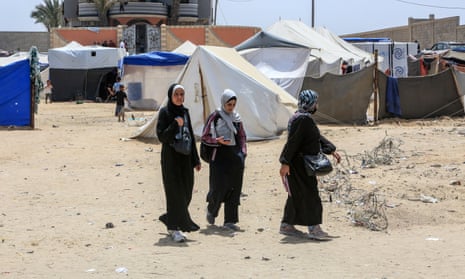
Hundreds of thousands of Palestinians have fled Rafah over the past fortnight after Israeli warnings to evacuate.
Sullivan is set to meet with Israeli national security adviser Tzachi Hanegbi, followed by Israel’s prime minister, Benjamin Netanyahu, and security officials, an Israeli official told the Washington Post. Earlier on Sunday, Sullivan met with Crown Prince Mohammed bin Salman in Dhahran, Saudi Arabia (see opening summary for more details).
Netanyahu has previously suggested he will reject US pressure to hold off on a full-scale attack on Rafah, where about 1 million Palestinians had sought shelter after fleeing fighting earlier in the conflict. The Israeli prime minister says the city is Hamas’ last stronghold.
The Gaza Civil Emergency Service said rescue teams have recovered the bodies of 150 Palestinians killed by the Israeli army in recent days.
On Saturday, Israeli troops and tanks pushed into parts of a congested northern Gaza Strip district, killing and inuring dozens of Palestinians, medics and residents said.
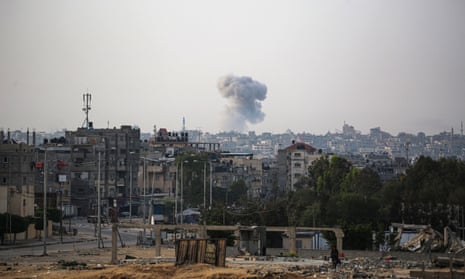
Separately, residents said Israeli planes and tanks have struck areas across the Gaza Strip overnight, and that Israeli forces have pushed deeper into Jabalia in northern Gaza, returning to an area that they said they had cleared earlier in the war.
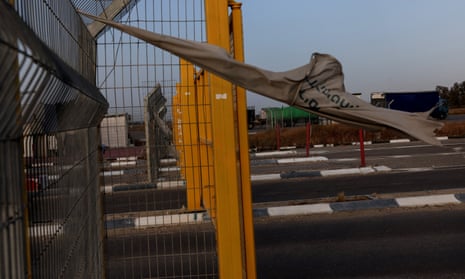
Israel is reportedly continuing the closure of the Rafah border crossing (located between Egypt and southern Gaza).
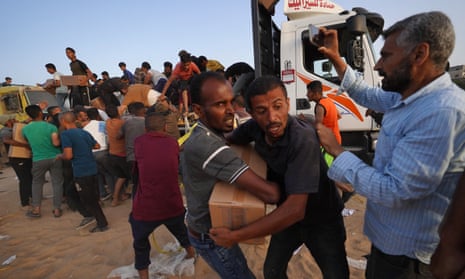
It has been a vital route for aid to the coastal territory, where an acute humanitarian crisis has deepened with many Palestinians at risk of famine.
On 7 May, Israel seized control of the crossing as it intensified its long-threatened offensive around the southern city of Rafah. Since then aid has accumulated on the Egyptian side.
Israel said it was up to Egypt to reopen the crossing and allow humanitarian relief into Gaza, prompting Cairo to denounce what it described as “desperate attempts” to shift blame for the blockage of aid.
The UN and other international aid agencies said the closing of two crossings into southern Gaza – Rafah and Israeli-controlled Kerem Shalom – had virtually cut off the territory from outside aid.
At least nine Palestinians, including two children, have been arrested by Israeli occupation forces in the occupied West Bank, Wafa, the Palestinian news agency, reported.
In the months since the 7 October Hamas attacks on Israel, in which about 1,200 people were killed, the Palestinian prison population has almost doubled after Israeli forces began conducting regular raids across the West Bank, detaining more than 8,755 people, according to the Palestinian prisoners and ex-detainees commission.
Most were held under administrative detention, meaning without charge.
In the early hours of Sunday morning, Al Jazeera Arabic’s journalists on the ground reported Israeli raids in Rafah in the south of enclave and in the vicinity of the Kamal Adwan hospital in northern Gaza, where raids were also reported in the sheikh Zayed and Zeitoun neighbourhoods.
Hello and welcome to the Guardian’s live coverage of Israel’s war on Gaza and the wider crisis in the Middle East.
The al-Aqsa Martyrs hospital, in central Gaza, said on Sunday that an Israeli airstrike targeting a house at a refugee camp killed at least 20 people.
“We received 20 fatalities and several wounded after an Israeli airstrike targeted a house belonging to the Hassan family in al-Nuseirat refugee camp in central Gaza,” the hospital said.
Witnesses said the strike occurred about 3am local time. Palestinian official news agency Wafa reported that several children were among the injured people, and that rescuers were searching for missing people trapped under the rubble.
Fierce battles and heavy Israeli bombardments have been reported in the central Nuseirat camp since the military launched an offensive on Rafah in early May.
Meanwhile, the United Nations said 800,000 people had been “forced to flee” Israel’s offensive in Rafah, the southern city where hundreds of thousands of Palestinian civilians had sought refuge from Israeli bombardments. Israel’s military says Hamas militants are located there.
“800,000 people are on the road having been forced to flee since the Israeli forces started the military operation in the area on 6 May”, the Unrwa chief said on X.
Here is a recap of the other latest developments:
Two Israeli soldiers were killed in a battle in the southern part of the Gaza Strip, the Israeli military said on Sunday. It said airstrikes hit more than 70 targets across Gaza with ground troops conducting raids in eastern Rafah, killing 50 militants.
Joe Biden’s national security adviser Jake Sullivan met early on Sunday with Saudi Arabia’s Crown Prince Mohammed bin Salman to discuss what the kingdom described as the “semi-final” version of a security agreement between the countries. “The semi-final version of the draft strategic agreements between the kingdom and the United States of America, which are almost being finalized – and what is being worked on between the two sides in the Palestinian issue to find a credible path – were discussed,” the statement released after the talks said. That included “a two-state solution that meets the aspirations and legitimate rights of the Palestinian people” and “the situation in Gaza and the need to stop the war there and facilitate the entry of humanitarian aid,” the statement added.
Hamas’s armed wing, the Ezzedine Al-Qassam Brigades, said it fired a barrage of rockets towards Israel’s port of Ashkelon and targeted an Israeli command centre at the Jabalia refugee camp in northern Gaza. On Saturday evening, Israel’s military issued new evacuation orders for parts of northern Gaza, saying militants in the area had fired rockets at Israel.
In northern Gaza’s Beit Lahia, witnesses reported airstrikes near Kamal Adwan hospital.
Israeli war cabinet minister Benny Gantz demanded on Saturday that prime minister Benjamin Netanyahu commit to an agreed vision for the Gaza conflict that would include stipulating who might rule the territory after the war. In a news conference, Gantz said he wanted the war cabinet to form a six-point plan by 8 June. If his expectations are not met, Gantz said he would withdraw his centrist party from the emergency government. Netanyahu hit back, calling the threat “washed-up words” that would mean “defeat for Israel”.
Aid has begun entering Gaza via a temporary US-built floating pier. The Israeli army said 310 pallets began moving ashore in “the first entry of humanitarian aid through the floating pier”. Satellite pictures showed more than a dozen trucks lining up Saturday on its approach road. In the coming days, about 500 tonnes of aid are expected to be delivered via the pier, according to US Central Command.
British security firm Ambrey said on Saturday it had received information that a Panama-flagged crude oil tanker had been attacked approximately 10 nautical miles southwest of Yemen’s Mokha. Ambrey later added that the tanker had received assistance and one of its steering units was reportedly functional. It did not indicate who provided the assistance.
Austria said on Saturday it will restore its funding to the UN agency for Palestinian refugees (Unrwa) after suspending it over allegations that staff were involved in the 7 October Hamas attacks. A total of €3.4m ($3.7m) in funds have been budgeted for 2024, and the first payment is expected to be made in the summer, Austria’s foreign ministry said in a statement.
Members of a Ukrainian brigade have described how they were secretly relocated to help defend a section of the country's border with Russia a few days before a new invasion began.
The commander of an artillery unit from 57 Brigade said his guns were even firing at Russian troops the day before the ground incursion into the northeastern region of Kharkiv, which started on 10 May. He said the forces had been "brazenly" amassing on the Russian side of the border.
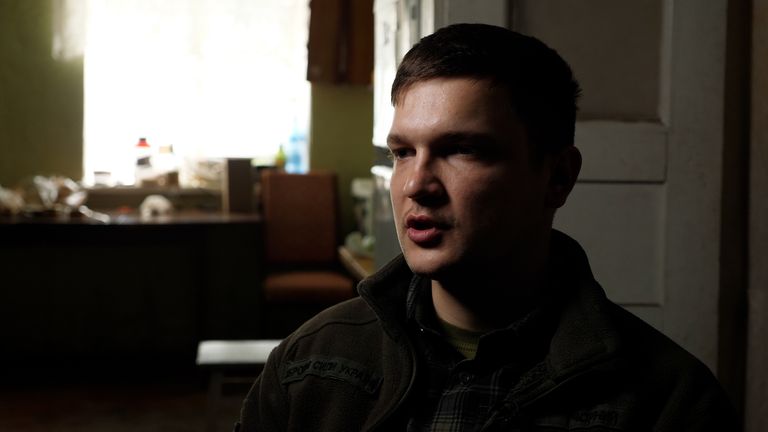
"We were hitting tanks on the border… it was already a real war," said Sasha, 26, who uses the callsign "black".
The commander of a second artillery unit similarly confirmed the brigade had been moved early to bolster defences in this direction.
The troops had previously been defending the city of Kupiansk, also in Kharkiv.
Image:Sasha, an artillery battery commander of the 57 Brigade
The comments offer a sense of how Ukraine attempted - ahead of time - to scramble forces to counter a Russian build-up along its long, northeastern border.
But the move was nowhere near enough to prevent the largest assault into Ukraine since Russia launched its full-scale invasion almost two and a half years ago.
A Ukrainian source, describing the first few days of the Kharkiv offensive just over a week ago, said there had been moments when he feared "we had lost the frontline".
The source said the situation had since stabilised but warned: "We don't know how long it could be like this".
Advertisement
Sky News on Saturday tried to visit an artillery position, manned by soldiers from 57 Brigade, just outside the town of Vovchansk - a key target of the Russian offensive.
Image:While trying to reach an artillery position, a Sky News crew was told to turn back for safety
As we approached at speed by road, a soldier travelling with us said we had to pull over because he needed to communicate via radio with troops on the gunline.
Suddenly a voice over the radio could be heard saying: "Don't come here. Don't come at all."
We were told it was too dangerous to travel further and we had to leave. It was not immediately clear what was happening on the ground.
At a makeshift base, safely back from the frontline, the artillery unit commander Sasha uses electronic maps on a tablet and laptop to confirm targets for his guns to attack.
He said he and his team relocated from the Kupiansk front on the 4 to 5 May.
"We were indeed moved here earlier," Sasha said. But he signalled he would have liked longer to prepare.
"I don't know all the situation and why it happened like this. But I know for sure that to better repel [an attack], we might need either more time or better-prepared positions," he said.
"Ahead of the assault, we were already hitting targets on Russian territory because we knew they were gathering there. They were brazenly assembling."
Sasha described the moment the Russians started to advance.
He said it began with three hours of artillery fire against Ukrainian targets before ground troops crossed the border.
"I would love that they [the Russians] had been stopped at the border," he said.
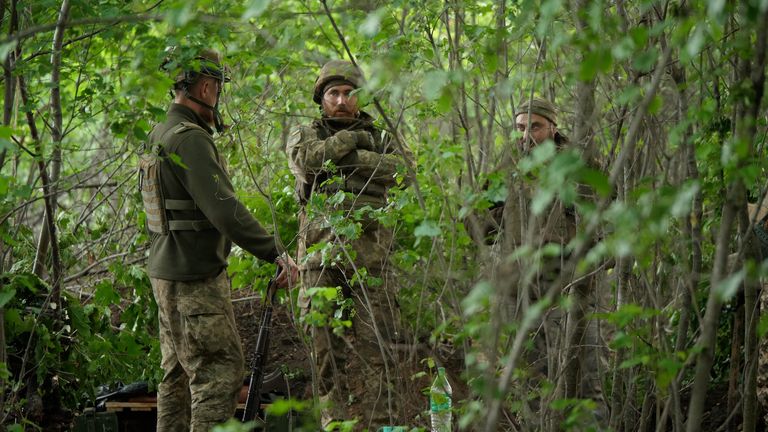
Image:Soldiers say they could inflict more damage on Russian soldiers if they had more ammunition and better weapons
Instead, a fierce battle erupted, as Russian infantry, backed by airstrikes, drone attacks and artillery fire, pushed forward.
"For the first few days, they [the Russians] were storming our positions - columns of 30 to 50 soldiers. We were hitting them."
In the chaos, Sasha said he worked to gather information to ensure his troops were able to operate.
"I am proud that my guys managed to do their best," he said. "All credit to those who stayed on their artillery positions."
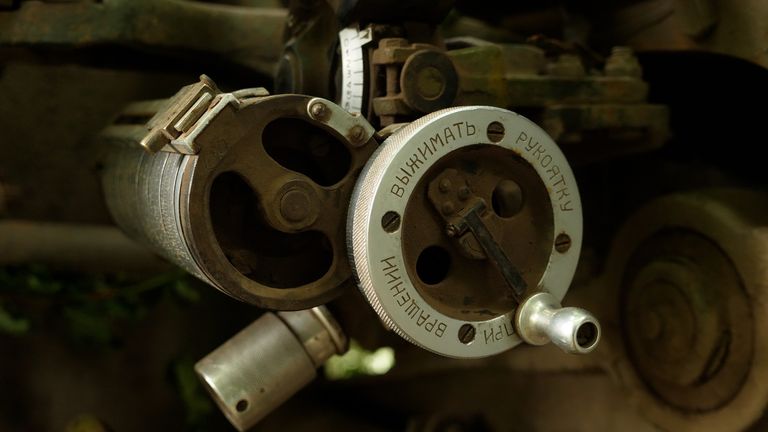
Image:A Soviet-era D-20 Howitzer artillery piece nicknamed "grandma" by soldiers
He described the frontline as initially being "fragile" but said reinforcements were now in place. The commander said Russia had lost the opportunity to make a significant breakthrough.
"Until now they had a chance. Even in my area, I knew where we had gaps where they could have slipped through. Now we don't have such gaps," he said.
"I am satisfied that we have managed to stabilise the situation."
At a second artillery position, on a different section of a frontline that has expanded by some 40 miles in the wake of the new attack, a Soviet-era gun, hidden under netting and tree branches, points in the direction of Russia.
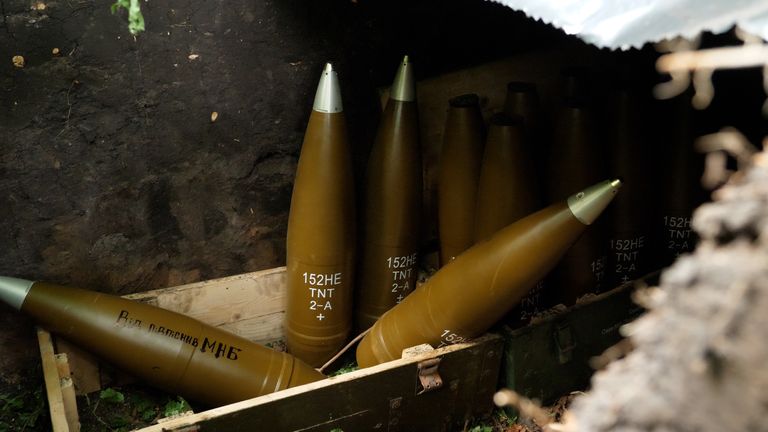
Image:Shells used by the D-20 Howitzer artillery piece, which was built in the 1970s
Soldiers here said they would be able to inflict a lot more damage on the invaders if they had more ammunition and better weapons.
Nicknamed "grandma", their D-20 Howitzer artillery piece, which fires 152mm shells, was built in the 1970s.
Follow Sky News on WhatsApp
Keep up with all the latest news from the UK and around the world by following Sky News
"We're saving our artillery shells right now. We fire one, they fire back five," said one of the servicemen, who - at 50 years old - has the callsign "Grandpa".
A second soldier said Russia has more weapons than his side.
Asked what difference additional munitions would make, he said with a laugh: "It would increase the number of dead Russians - 100%".
Additional reporting by Azad Safarov, Ukraine producer