Rabu, 05 Juni 2024

Mass graves and body bags: al-Shifa hospital after Israel's withdrawal - BBC

Palestinians inspect damages at Al Shifa HospitalReuters

After Israeli forces pulled out of Gaza City’s vast al-Shifa hospital complex on 1 April, following their second raid there, stunned Palestinians who pored over the burnt-out ruins said it reeked of death.

During the past eight months of war, hospitals have come under repeated attack, with Israel claiming they are used as bases by Hamas; something the group denies.

But events at al-Shifa – once the biggest and best equipped medical facility in the Gaza Strip – have arguably been the most dramatic.

The two-week surprise raid, launched after Israel said Hamas had regrouped at the site, was described by the Israeli government as "precise and surgical".

Its spokesman, Avi Hyman, asserted that it had set "the gold standard of urban warfare". He said: “We took out over 200 terrorists. We apprehended over 900 terrorists with not a single civilian casualty.”

With decaying bodies sticking out of the sand piled up by combat bulldozers in the courtyards of al-Shifa, the claim that there had been no civilian casualties was immediately questioned.

In recent weeks, four mass graves have been uncovered at the site, with Palestinian search teams saying that several hundred bodies have been found.

We have worked with a journalist in Gaza to follow developments.

Palestinian forensic and civil defence recover bodies at the grounds of Al-Shifa hospital
Getty Images

“We’ve extracted martyrs, many of whom are decomposed and completely unidentifiable,” a Palestinian Civil Defence worker, Rami Dababesh told us grimly on 8 May as he stood by a line of white plastic body bags at al-Shifa, wearing a face mask and full protective gear.

“We’ve found corpses of women, children and individuals without heads as well as torn body parts,” he added.

The Civil Defence lacks forensic equipment and expertise, but its teams have been using photos and videos to document the remains. A director, Dr Mohamed Mughir, told us there were suspicious finds; describing how “signs of field executions, binding marks, gunshot wounds to the head and torture marks on the limbs were observed on the bodies of some martyrs".

The UN Security Council has expressed “deep concern” at the discovery of mass graves at both al-Shifa and Nasser hospital in southern Gaza. Along with the US and the European Union, it has called for an independent investigation into possible war crimes.

The Israel Defense Forces (IDF) says that during its raids of the Gaza hospitals, its soldiers exhumed bodies that Palestinians had buried earlier as part of its search for the remains of some 250 hostages captured during the deadly Hamas attacks on Israel on 7 October.

It maintains bodies were examined respectfully and those not belonging to Israeli captives were returned to their place.

However, at least some of the corpses found recently at al-Shifa were those of patients who died during Israel’s latest military action. A paramedic involved in the search said some had IV catheters still attached.

On 15 April, the BBC met two men whose dead mothers were last seen being treated at the hospital. Their bodies had just been recovered from a mass grave.

“I came running here when they told me of the grave,” said Mohammed al-Khatib, who had spent days searching for his mother, Khawla. “By the grace of almighty God her body was found.”

Walid Fteima said his elderly mother, Lina Abu Leila, was being treated for malnutrition and severe dehydration when she died. Her body was decomposed, and he could only identify her from injuries she had from an Israeli bombing last year. “[She] had a toe amputated on each foot,” he explained.

After it began its operation at the hospital early on 18 March, the IDF ordered thousands of civilians sheltering there and living in the vicinity to leave and head south. However, it said the hospital could continue to function. By the end of two weeks, only some 140 patients and medics reportedly remained.

Dr Rik Peeperkorn

The local WHO representative, Dr Rik Peeperkorn, says this group endured “horrific conditions”. After being repeatedly moved around the complex, he says, they “actually ended up in the human resources building which was completely unfit for treatment". Ultimately, he says, 20 patients died.

Several surviving patients – all wounded in previous Israeli strikes – told us they were given only tiny quantities of food such as canned tuna. They said there were severe shortages of drinking water and medication.

“The bombing surrounded us 24/7,” said Mohamed al-Nadeem who is half paralysed. “I am sick and unable to move. I was sleeping on the floor without blankets.”

“There were no dressings or painkillers,” said Rafif Doghmush, 15, whose foot has been amputated.

The IDF has told journalists that no staff or patients died as a “direct result” of its action, but that some may have died of “natural causes".

During its raid, it said it helped patients by moving them out of harm’s way and that medical supplies and devices as well as food, water, and a generator were brought to the hospital.

Grainy drone footage shared by the IDF after it launched its raid on 18 March showed Palestinian gunmen apparently shooting at soldiers from inside al-Shifa hospital. Later, the gunmen were said to have barricaded themselves in wards and corridors, opening fire and throwing explosives.

Three Israeli soldiers were confirmed to have been killed during the two-week long operation.

The IDF briefed journalists that its action at the hospital was taken based on “concrete intelligence” that Hamas and Palestinian Islamic Jihad had taken over parts of the site, suggesting their operatives had been using it to access basic supplies as well as power and the internet.

A graphic showing destruction of al-Shifa over time

While Hamas denied using al-Shifa as a base, its officials did not deny the presence of some members inside the complex, indicating that they may have been among displaced people sheltering there.

Israel has said that “over 200 terrorists” were killed in and around al-Shifa, as well as the hundreds detained, but has only given some names.

These include Faiq al-Mabhouh, described as head of operations in Hamas’ internal security service. The Hamas-run government’s media office said he was a police commander who had been co-ordinating aid deliveries to northern Gaza.

Others killed were identified as a senior Hamas commander, Raed Thabet, said to have been head of recruitment and supply acquisition, and Mahmoud Zakzouk, said to have been deputy commander of the Hamas rocket unit in Gaza City. Two other Hamas operatives were named as Fadi Dweik and Zakaria Najib, said to have been involved in organising attacks in the occupied West Bank.

In April, the IDF also released footage which it said was from the interrogation of Tarek Abu Shaluf, spokesman for the political wing of Islamic Jihad. It said he had been captured at al-Shifa.

Hamas and Islamic Jihad do not routinely confirm the names of low-level fighters killed by Israeli military action, making it very difficult to estimate how many were killed at the hospital and in the vicinity. It is likely that a number were among the dead found in mass graves.

A picture shows the destruction in the dialysis unit at Gaza's devastated Al-Shifa hospital
Getty Images

Despite the Israeli claim that there was “not a single civilian casualty” from its raid, we have been given strong testimony that there were Palestinian civilians killed by heavy Israeli bombardment and intense shooting in the surrounding neighbourhood.

The Palestinian Civil Defence told us that hundreds of Palestinians were still reported to be missing following the raid in March.

There have repeatedly been conflicting narratives about what has happened in and around al-Shifa.

During its first controversial raid there, the Israeli military raised expectations that Israeli hostages might be found at the site. It also released a graphic depicting a vast underground tunnel network that it suggested was underneath the hospital, serving as a major Hamas command and control centre.

While the IDF said it retrieved the bodies of two Israeli hostages near to the hospital, it did not announce that it had found any within the complex. Security camera footage that was recovered did show that at least two foreign captives were taken there on 7 October.

The IDF showed what it said was a fortified 55-metre tunnel on the hospital grounds. This fell short of its initial claims about the extent of hidden tunnels, although later reporting suggested the passage – which was blown up – had actually been longer and was most likely connected to a wider network under Gaza City.

When it returned to the site in March, the IDF suggested its key discoveries were of a different nature, releasing pictures of cash, weapons, and ammunition it said it had found there along with Hamas documents.

Weapons that the Israeli army claims were found in al-Shifa hospital
IDF

Al-Shifa has been at the heart of a debate about whether Hamas uses medical sites as a cover. Israel has consistently claimed that the group hides its fighters and infrastructure behind the sick and wounded, which it suggests has rendered hospitals legitimate military targets.

Hamas denies misusing civilian sites and accuses Israel of violating international humanitarian law by targeting hospitals.

In April, when the UN called for “a clear, transparent and credible investigation” of mass graves in Gaza, its spokesman Stephane Dujarric told reporters that more journalists needed to be able to work safely in the territory to report on the facts. During the war, Israel and Egypt have denied free access to foreign media.

Mr Dujarric also said: “It’s important that all forensic evidence be well preserved.” So far, that is proving to be a challenge.

International forensic specialists have been unable to reach Gaza to investigate what happened at al-Shifa. That has left much of the focus locally on registering and identifying the dead where possible, and giving them proper burials.

The disturbance of the mass grave sites, experts say, will ultimately make it much harder to uncover the truth about them.

Meanwhile, although al-Shifa has been largely destroyed, there have been recent efforts to restart very limited medical services on site. These gained momentum as Israel targeted other health facilities which it said were being used by Hamas, particularly Kamal Adwan Hospital in northern Gaza.

In late May, in a hastily repaired room of the kidney dialysis unit at al-Shifa, the journalist working with us met four patients as they sat connected to steadily beeping machines. After so many deaths at the hospital, it is once again providing some life-saving treatment.

Adblock test (Why?)


https://news.google.com/rss/articles/CBMiMGh0dHBzOi8vd3d3LmJiYy5jby51ay9uZXdzL2FydGljbGVzL2M1MTFrMW5xeDgxb9IBNGh0dHBzOi8vd3d3LmJiYy5jby51ay9uZXdzL2FydGljbGVzL2M1MTFrMW5xeDgxby5hbXA?oc=5

2024-06-05 05:41:13Z
CBMiMGh0dHBzOi8vd3d3LmJiYy5jby51ay9uZXdzL2FydGljbGVzL2M1MTFrMW5xeDgxb9IBNGh0dHBzOi8vd3d3LmJiYy5jby51ay9uZXdzL2FydGljbGVzL2M1MTFrMW5xeDgxby5hbXA


India elections: Shock for Modi as ruling BJP set to fall short of outright majority - The Independent

Indian opposition leader Sanjay Singh on why voters are unhappy with Modi

Narendra Modi is set to meet his allies today to discuss forming the next government, a day after his Hindu nationalist party lost its outright majority in parliament in a surprisingly close election.

Mr Modi’s Bharatiya Janata Party (BJP) won 240 seats on its own in the general election, 32 short of the halfway mark in the 543-member decision-making lower house, according to official results announced late yesterday.

The National Democratic Alliance (NDA) led by the BJP won 293 seats, more than 20 ahead of the 272 needed to form a government.

The opposition INDIA alliance, led by Rahul Gandhi’s centrist Congress party, won 230 seats, far more than was forecast. Congress alone won 99, almost double the 52 it won in 2019. The surprise jump has not just boosted Mr Gandhi’s standing, but the alliance is also discussing its own next steps and they have so far not conceded defeat.

The role of kingmaker for the next government now falls to two of the BJP’s key allies – Nitish Kumar and Chandrababu Naidu. Their parties, Janata Dal (United) and Telugu Desam Party, who have 12 and 16 seats respectively.

1717570945

Son of Indira Gandhi’s assassin wins

Sarabjeet Singh Khalsa, son of one of the assassins of former Indian prime minister Indira Gandhi, has been elected as an MP.

He won election from the Faridkot parliamentary seat, after securing 298,062 votes. An independent candidate, he won by a margin of 70,053 votes ahead of his nearest rival from the Aam Aadmi Party, Karamjit Singh Anmol.

Singh Khalsa’s father Beant Singh and another bodyguard, Satwant Singh, killed Ms Gandhi on 31 October 1984 at her residence.

This was the fourth time Singh Kalsa fought for election. He made unsuccessful attempts in the 2004 and 2014 general elections, as well as the 2007 Punjab polls.

His mother, Bimal Kaul, was also an MP from Ropar in 1989.

During the campaign, he raised issues of drug problems, water shortages and farmers’ protests.

Namita Singh5 June 2024 08:02
1717568901

Key ally reiterates support for Modi

Chandrababu Naidu, a key alliance partner of Narendra Modi’s Bharatiya Janata Party, has reiterated support for the Hindu nationalist party.

“You always want news. I am experienced and I have seen several political changes in this country. We are in NDA, I’m going to the NDA meeting. In course of time, we will report it,” he said referring to National Democratic Alliance.

His Telugu Desam Party won 16 seats in the general election and is a key ally of BJP, which under Mr Modi, fell way short of 272 majority mark, winning 240 seats.

Namita Singh5 June 2024 07:28
1717568400

Markets down again in early trade on Wednesday

India’s two main indexes, the NSE Nifty 50 and S&P BSE Sensex, are trading down again today by about 0.1 per cent each, after dropping about six per cent each yesterday.

The weaker-than-expected mandate for Narendra Modi triggered record foreign outflows and spooked investor sentiment on worries over the pace of pro-business reforms.

Volatility rose to the highest since March 2022, before easing a bit this morning.

The weakened majority for Mr Modi’s alliance could pose challenges for the more ambitious elements of the government’s reform agenda, ratings agency Fitch said.

However, it added: “Despite the slimmer majority, we do expect broad policy continuity to persist, with the government retaining its focus on its capex push, ease of doing business measures, and gradual fiscal consolidation.”

Namita Singh5 June 2024 07:20
1717567482

Indian election reveal voters prioritise ‘social justice, secularism and federalism’

The election results reveal that Indian voters still prioritise values of social justice, secularism and federalism that are enshrined in the Constitution, says Dr Shubranshu Mishra, lecture in Politics and International relations at the University of Exeter.

“The much-publicised inauguration of the Ram Temple in Ayodhya, a significant constituency that the ruling BJP has ended up losing in the Hindi heartland Uttar Pradesh, did not turn out to be the key issue for the voters as the ruling party had anticipated,” he says in a statement to The Independent as he refers to the much-publicised consecration ceremony in January that critics saw as the launch of Mr Modi’s electoral campaign.

The hate speeches made by the BJP, including the prime minister, did not resonate well with the electorate, he says in an apparent reference to Mr Modi’s targeting Muslims in a series of election speeches, referring to the 200 million people as “infiltrators”.

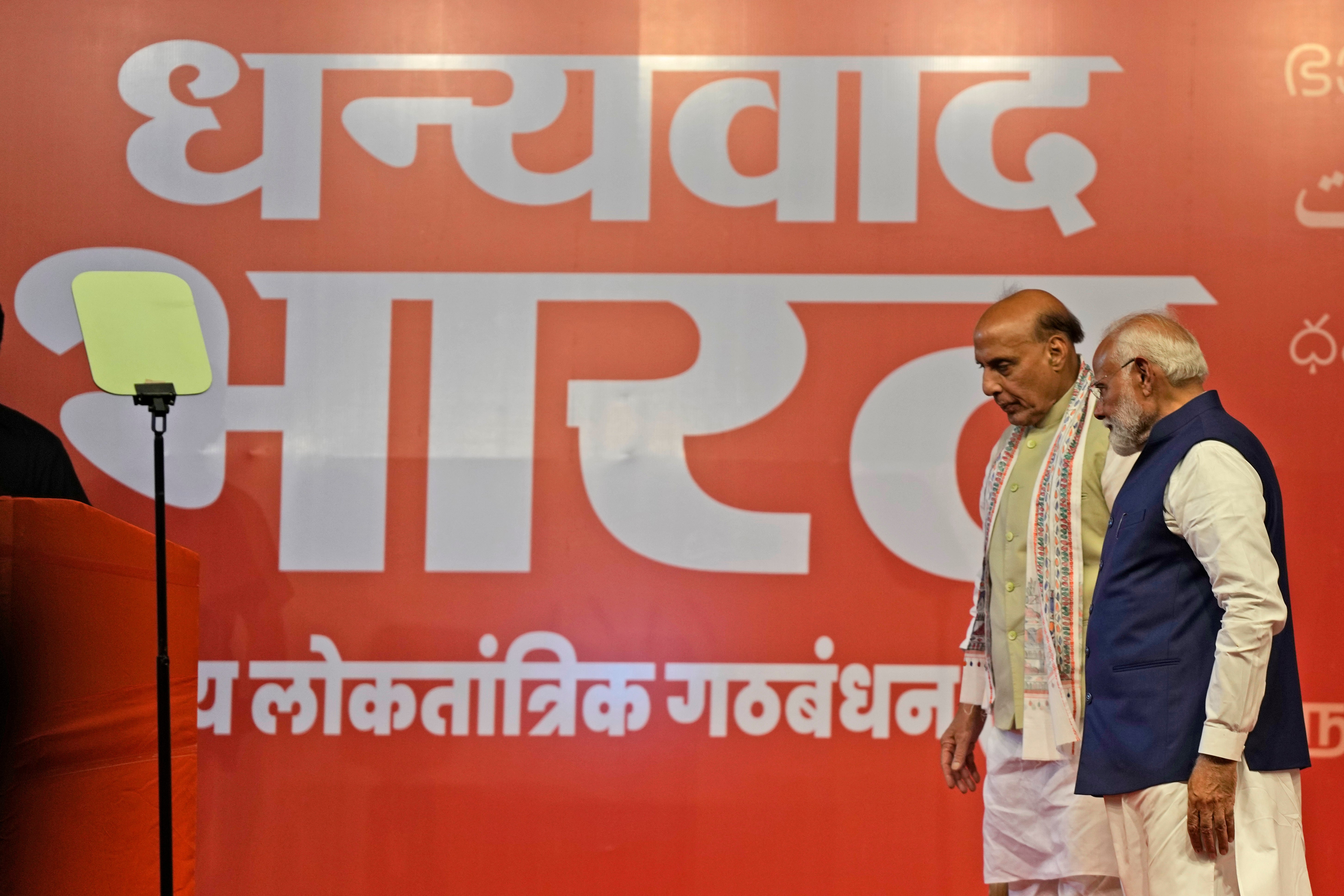
Prime minister Narendra Modi, right, with Defense Minister Rajnath Singh leaves after addressing supporters at the Bharatiya Janata Party (BJP) headquarters, in New Delhi, India, Tuesday, June 4, 2024
Prime minister Narendra Modi, right, with Defense Minister Rajnath Singh leaves after addressing supporters at the Bharatiya Janata Party (BJP) headquarters, in New Delhi, India, Tuesday, June 4, 2024 (AP)

Highlighting the importance of gains made by the Congress-led opposition alliance, he says: “Though PM Modi will return to power for a third consecutive term, his majority will decrease, as the Congress party-led INDIA alliance has made an impressive comeback, defying all exit poll predictions.

“The significant takeaway is this strong resurgence of Rahul Gandhi that occurred in this election, despite the fact that it was not conducted on a level-playing field.

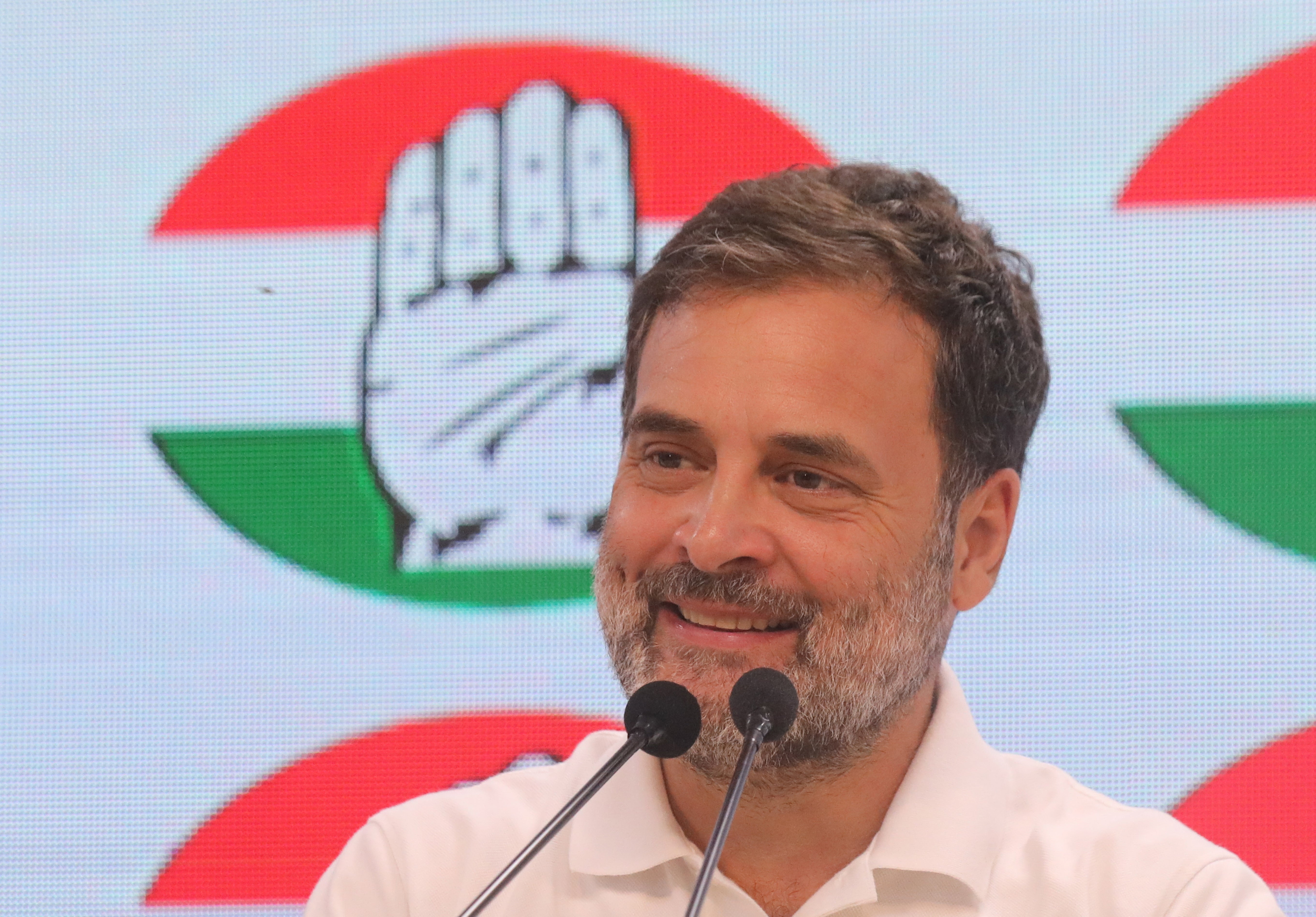
Indian National Congress Party senior leader Rahul Gandhi attends a press conference at Congress headqaurters in New Delhi, India, 04 June 2024
Indian National Congress Party senior leader Rahul Gandhi attends a press conference at Congress headqaurters in New Delhi, India, 04 June 2024 (EPA)

“The complete control over key pillars of democracy, including the Election Commission and the judiciary, limited space for dissent, challenges to federalism, and biased lapdog media, was strikingly evident.

“This mandate will play a crucial role in holding the government accountable, and their key contentious and divisive initiatives, such as the Citizenship Amendment Act (CAA) and National Register of Citizens (NRC), are likely to take a back seat.”

Namita Singh5 June 2024 07:04
1717565729

Who is Mahua Moitra? Expelled Indian parliamentarian set to make a comeback

Mahua Moitra, a firebrand politician from Trinamool Congress and a fierce critic of Indian prime minister Narendra Modi, is set to make a comeback to parliament, months after she was unceremoniously expelled over accusations of taking bribes in exchange for asking questions in the lower house.

She secured a resounding victory from Krishnagar seat in West Bengal over her nearest rival Amrita Roy of the Bharatiya Janata Party, winning by a margin of 50,000 votes.

She worked as an investment banker in New York and London, before entering grassroots political activism in 2009. She eventually found a home in Trinamool Congress. =

Known for her unapologetic candour, her impassioned speeches in parliament have earned her acclaim from across the political spectrum.

In December last year, India’s parliament expelled her after MP Nishikant Dubey of Mr Modi’s BJP accused her of accepting bribes from businessman Darshan Hiranandani to pose questions in parliament.

The parliament’s Ethics Committee initiated a probe after Mr Dubey wrote to Lok Sabha speaker Om Birla, alleging bribery and impropriety against Ms Moitra.

Ms Moitra, who has denied the allegations, said she was expelled “without proof”.

Namita Singh5 June 2024 06:35
1717565525

Controversial Bollywood actor Kangana Ranaut wins parliamentary election

Bollywood actor Kangana Ranaut has been elected an MP in India, joining a small crowd of people from the film industry in the country’s new parliament.

Ranaut stood as the candidate for prime minister Narendra Modi’s Bharatiya Janata Party in Mandi, a seat in her northern home state of Himachal Pradesh, and won by a margin of just under 75,000 votes.

The breakout star of 2013’s well-received Bollywood hit Queen, Ranaut became the most prominent of Indian celebrities to openly, and closely, align herself with Modi’s ruling party after it first came to power in 2014, and has championed its Hindu nationalist cause.

My colleague Shahana Yasmin reports:

Namita Singh5 June 2024 06:32
1717562993

How did Indian media cover election results?

Indian newspapers said Narendra Modi’s aura of invincibility had been dimmed, as his Bharatiya Janata Party fell short way short of majority mark. His NDA alliance has enough seats to form a coalition government, but it was still a remarkable result for the opposition INDIA bloc.

The Indian Express’s splash had a headline reading “India gives NDA a third term, Modi a message”.

The Hindustan Times read: “NDA leading, INDIA shining”.

“India Cuts Modi Down,” read the Telegraph.

The Hindu played it straight, saying: “BJP falls short, needs allies to govern”.

Namita Singh5 June 2024 05:49
1717561027

Who are Modi's key coalition allies?

Narendra Modi’s coalition allies have found themselves in an unexpected position after yesterday’s results – that of kingmaker.

The two most important, Nitish Kumar and Chandrababu Naidu, will be in Delhi for a meeting today with the BJP, after Modi’s party fell way short of an outright majority in its own right.

Mr Modi, for the first time, is dependent on these allies to take the total tally of seats won by their National Democratic Alliance to 292.

It’s a position the BJP would have wanted to avoid – Modi’s party has a rocky political relationship with both.

Prime minister Narendra Modi, right, chats with defence minister Rajnath Singh before addressing supporters at the Bharatiya Janata Party (BJP) headquarters, in New Delhi, India, Tuesday, 4 June 2024
Prime minister Narendra Modi, right, chats with defence minister Rajnath Singh before addressing supporters at the Bharatiya Janata Party (BJP) headquarters, in New Delhi, India, Tuesday, 4 June 2024 (AP)

Janata Dal (United)’s Nitish Kumar, 73, is the chief minister of India’s poorest state of Bihar. He has been credited with steadying the state and pursuing economic development after accusations of widespread corruption and crime in previous administrations.

However, Kumar has switched his political alliances several times. He returned to Modi’s coalition earlier this year after previously having helped to form an opposition alliance of more than two dozen parties for the general election.

TDP boss Chandrababu Naidu, 74, was the chief minister of the undivided state of Andhra Pradesh from 1995 to 2004. He played a key role in developing the state capital Hyderabad as a technology hub, while attracting foreign investors including Microsoft.

Namita Singh5 June 2024 05:17
1717558109

Modi says India will see ‘a new chapter of big decisions’

Prime minister Narendra Modi says India will see a “new chapter of big decisions” in his third term in office, despite falling short of an outright BJP majority.

After claiming victory for his coalition alliance, which got him past the 272-seat midway point after a lacklustre performance from his own party, Mr Modi told a crowd at party headquarters he would not shirk from pushing forward with his agenda.

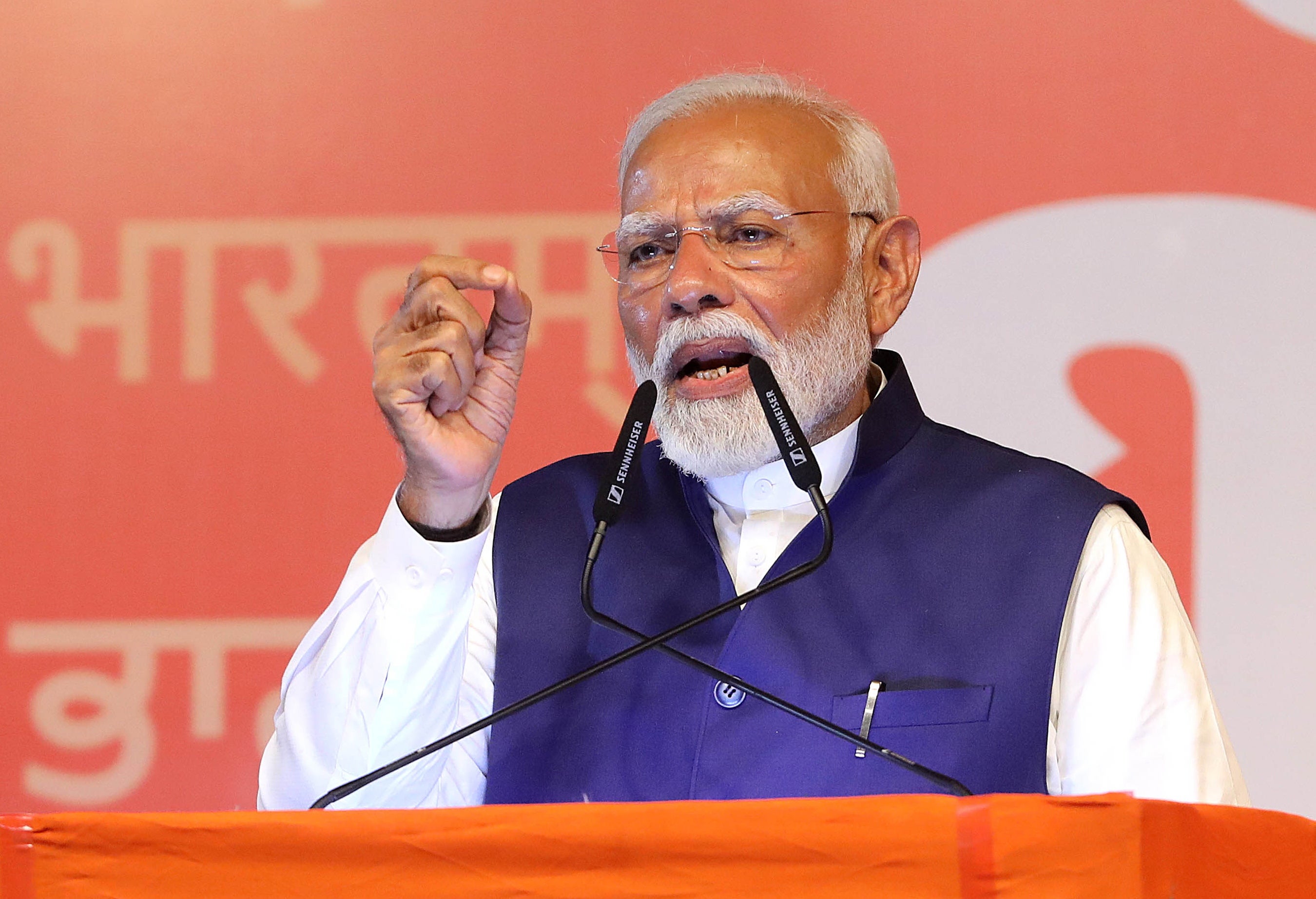
Bharatiya Janata Party (BJP) leader and Indian prime minister Narendra Modi speaks at the party headquarters in New Delhi, India, 04 June 2024
Bharatiya Janata Party (BJP) leader and Indian prime minister Narendra Modi speaks at the party headquarters in New Delhi, India, 04 June 2024 (EPA)

He said he would advance India’s defence production, jobs for youth, raise exports and help farmers, among other things.

“This country will see a new chapter of big decisions. This is Modi’s guarantee,” he said, speaking in the third person.

Namita Singh5 June 2024 04:28
1717557933

Best memes as Indians react to unexpectedly close election: ‘Public is smart’

My colleague Shweta Sharma has rounded off some of the best ones in this report:

Namita Singh5 June 2024 04:25

Adblock test (Why?)


https://news.google.com/rss/articles/CBMibWh0dHBzOi8vd3d3LmluZGVwZW5kZW50LmNvLnVrL2FzaWEvaW5kaWEvaW5kaWEtZWxlY3Rpb24tcmVzdWx0cy0yMDI0LW1vZGktY29uZ3Jlc3MtYmpwLWNvdW50aW5nLWIyNTU2MzA1Lmh0bWzSAQA?oc=5

2024-06-05 03:01:43Z
CBMibWh0dHBzOi8vd3d3LmluZGVwZW5kZW50LmNvLnVrL2FzaWEvaW5kaWEvaW5kaWEtZWxlY3Rpb24tcmVzdWx0cy0yMDI0LW1vZGktY29uZ3Jlc3MtYmpwLWNvdW50aW5nLWIyNTU2MzA1Lmh0bWzSAQA

Selasa, 04 Juni 2024

Joe Biden set to close border with Mexico after signing order capping asylum seekers crossing into the US - Sky News

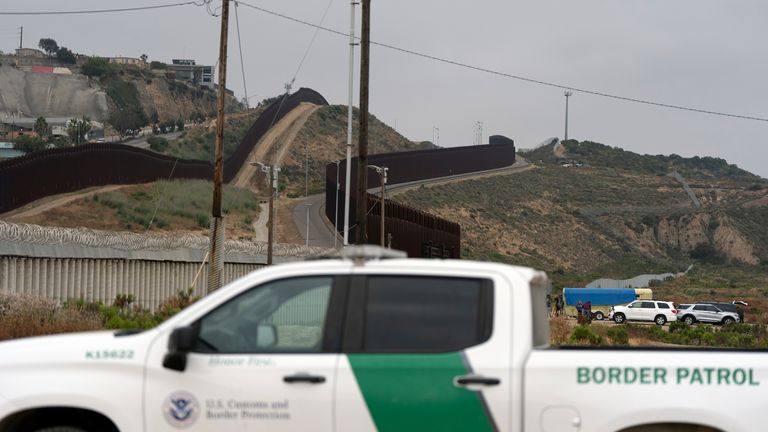
Joe Biden is set to close the border with Mexico under a new executive order clamping down on asylum seekers.

Signed on Tuesday, the order allows the US to suspend entry of non-citizens crossing from Mexico once the average number of daily encounters hits 2,500 between official ports of entry.

A senior administration official said that under the order, the border would be shut down immediately as the threshold has already been met.

They added the border - which the White House says is "overwhelmed" - would only reopen once the number of migrant encounters at the US border falls to 1,500 a day.

Once the order is in effect, migrants who don't express fear at returning to their home countries will be subject to immediate removal from the US. They could also face a five-year ban on re-entering the country, and possibly be criminally prosecuted.

Speaking at the White House after signing the order, Biden said Republicans "have left me no choice" but to "do what I can on my own to address the border".

Pic: AP
Image: Pic: AP

In a statement, the White House added the order has "humanitarian exceptions" including for unaccompanied children and victims of trafficking.

More on Joe Biden

But the Biden administration does expect legal challenges against the order, with the American Civil Liberties Union (ACLU) already saying it intends to do so.

ACLU attorney Lee Gelernt said: "A ban on asylum is illegal just as it was when [Donald] Trump unsuccessfully tried it."

Lindsay Toczylowski, the executive director for the California-based Immigrant Defenders Law Center, also told Sky's partner network NBC: "It is a betrayal of what we were told in [Biden's] campaign four years ago.

"We were told that President Biden would be restoring humanity at our border... But what we are seeing is that history is repeating itself."

Read more on Sky News:
Paedophiles could be castrated in Louisiana
Stormy Daniels urges Melania to leave Trump
Cyber attack affects major hospitals

Pic: AP
Image: Pic: AP

The former president attempted to enact similar restrictions in 2018, only to be blocked by courts. During the 2020 presidential election, Biden called Trump's policies on immigration "criminal".

And speaking on Tuesday, the president further distanced himself from Trump and said: "I will never demonise immigrants. I'll never refer to immigrants as poisoning the blood of a country.

"And further, I'll never separate children from their families at the border. I will not ban people from this country because of the religious beliefs."

Follow Sky News on WhatsApp

Keep up with all the latest news from the UK and around the world by following Sky News

Tap here

In January, Biden said he had "done all I can do" to control the border. He has also regularly accused Republicans of refusing to pass laws on strengthening restrictions, and in February demanded they show "spine".

Read more: Trump and Biden promise tough action on immigration in rival Texas visits

Posting on Truth Social after Biden signed the order, Trump said the Democrat has "totally surrendered our Southern Border" and that the order was "all for show" ahead of their 27 June presidential debate.

At a press conference, Republican house speaker Mike Johnson also said: "It's window dressing. Everybody knows it... If he was concerned about the border, he would have done this a long time ago."

Adblock test (Why?)


https://news.google.com/rss/articles/CBMijQFodHRwczovL25ld3Muc2t5LmNvbS9zdG9yeS9qb2UtYmlkZW4tc2V0LXRvLWNsb3NlLWJvcmRlci13aXRoLW1leGljby1hZnRlci1zaWduaW5nLW9yZGVyLWNhcHBpbmctYXN5bHVtLXNlZWtlcnMtY3Jvc3NpbmctaW50by10aGUtdXMtMTMxNDc5MTXSAZEBaHR0cHM6Ly9uZXdzLnNreS5jb20vc3RvcnkvYW1wL2pvZS1iaWRlbi1zZXQtdG8tY2xvc2UtYm9yZGVyLXdpdGgtbWV4aWNvLWFmdGVyLXNpZ25pbmctb3JkZXItY2FwcGluZy1hc3lsdW0tc2Vla2Vycy1jcm9zc2luZy1pbnRvLXRoZS11cy0xMzE0NzkxNQ?oc=5

2024-06-04 19:24:01Z
CBMijQFodHRwczovL25ld3Muc2t5LmNvbS9zdG9yeS9qb2UtYmlkZW4tc2V0LXRvLWNsb3NlLWJvcmRlci13aXRoLW1leGljby1hZnRlci1zaWduaW5nLW9yZGVyLWNhcHBpbmctYXN5bHVtLXNlZWtlcnMtY3Jvc3NpbmctaW50by10aGUtdXMtMTMxNDc5MTXSAZEBaHR0cHM6Ly9uZXdzLnNreS5jb20vc3RvcnkvYW1wL2pvZS1iaWRlbi1zZXQtdG8tY2xvc2UtYm9yZGVyLXdpdGgtbWV4aWNvLWFmdGVyLXNpZ25pbmctb3JkZXItY2FwcGluZy1hc3lsdW0tc2Vla2Vycy1jcm9zc2luZy1pbnRvLXRoZS11cy0xMzE0NzkxNQ

Senin, 03 Juni 2024

India election results 2024 live updates: Modi widely expected to win historic third term as BJP eyes two-thirds majority - The Guardian

  • The BJP’s manifesto promises a national code that will replace religion-specific civil laws in the country, a move many Muslims say is aimed at curbing centuries-old religious practices that the minority follows. Currently, Indians from different religions can follow laws specific to their faith or opt for a secular code. Laws on who and how many people a person can marry, how to end a marriage, and inheritance differ by religion. The new code will spell out the same set of rules for everyone.

  • After Modi inaugurated a temple to the Hindu God Ram at a fiercely contested site earlier this year, fulfilling a long-held promise, party leaders have said another emphatic electoral victory would help them build temples on other disputed sites. Hindu groups have for long claimed that for centuries Muslim invaders built mosques over demolished Hindu temples. Courts are hearing cases against two such mosques in BJP-run Uttar Pradesh state: in Modi’s Varanasi constituency and in Mathura.

  • Modi’s party has promised to implement an official report recommending elections to India‘s 28 state assemblies and national parliament at the same time, every five years. Currently, state elections do not need to coincide with national elections, leading to a situation where the country hosts one election or another every few months.

  • Modi’s party also promises to maintain peace in the nation’s northeast, without mentioning the BJP-run and violence-torn state of Manipur where ethnic clashes have killed at least 220 people and displaced thousands. Many state residents say there is widespread disappointment over the inability of Modi’s government to end what critics have called a mixture of anarchy and civil war. Rahul Gandhi, Modi’s key rival from the Congress party, has repeatedly questioned Modi’s failure to visit the state despite the prolonged conflict.

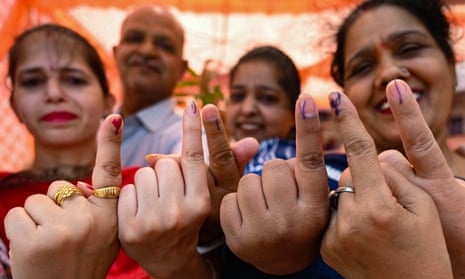
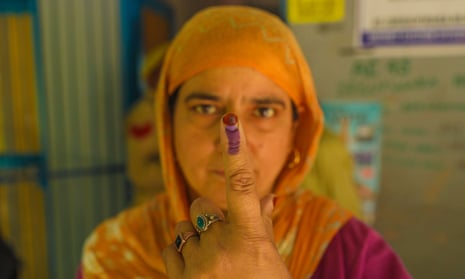
Voters show their index fingers marked with indelible ink after casting their ballots to vote at a polling station in Amritsar on 1 June 2024, during the seventh and final phase of voting in India’s general election.

There is little doubt among Indians that Narendra Damodardas Modi’s 10 years in power have already left an indelible mark on the country. To some it is the optimistic story of India rising to become the world’s fastest-growing economy, courted by powerful western leaders and multinational corporations; of efficient governance and technological advancements that have benefitted the public; and of the country freeing itself from the politics of elites and the “chains of colonisers” while reclaiming its historic Hindu civilisational greatness.

Yet to others it is a story of democratic backsliding and growing authoritarianism; of crony capitalism and a growing chasm between rich and poor; of the erosion of freedom of the media and judicial independence; attacks on secularism, liberal institutions and civil society; of publicly condoned Islamophobia and growing state-sponsored persecution of minorities, primarily India’s 200 million Muslims.

Such is the power of “brand Modi” that the BJP sits firmly in the shadow of its strongman leader. Modi’s face and name are attached to almost every government welfare scheme, and are visible on every government poster and even on people’s food rations and Covid vaccination certificates. The prime minister primarily refers to himself in the third person in speeches and will often address the people as “Modi ka parivar” [Modi’s family]. The party’s election manifesto was simply named “Modi’s guarantee”.

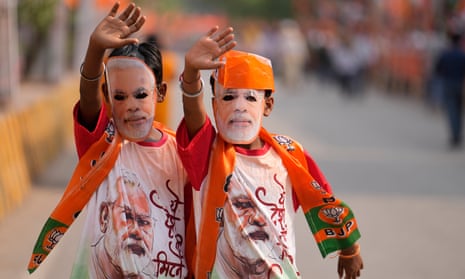
Supporters of Bharatiya Janata Party(BJP) wear masks in the likeness of Indian Prime Minister Narendra Modi during a roadshow by Modi in Varanasi, India.

According to Modi’s biographer Nilanjan Mukhopadhyay, even as a child Modi displayed traits that would later define his political career. Recalling a conversation with one of Modi’s teachers from his time at school, Mukhopadhyay said: “Modi liked theatre a lot in school, but would only do leading roles. If he did not have the main role, he would not perform in that play. It’s a small glimpse into how he has always put himself at the centre of his own universe.”

Modi was born in 1950 in a small town in northern Gujarat, as the third of six children, to a poor, lower caste family. Growing up, their house did not have electricity and his father produced cooking oil and ran a small tea shop next to the local railway station.

It was as an eight-year-old child that Modi first wandered into the offices of the Rashtriya Swayamsevak Sangh (RSS), the rightwing Hindu paramilitary organisation that has worked for almost a century to push India towards becoming a Hindu state.

To this day, over six decades on, RSS ideology remains the foundation of Modi’s political beliefs and his agenda as prime minister. Under his two terms, militant Hindu nationalism has become the dominant political ideology in India, while core RSS policies have been brought to fruition and RSS figures are present in almost all main institutions.

Critics of Modi and the BJP say his government has become increasingly authoritarian, fracturing the country along religious lines and threatening India’s secular democracy. At the same time, the space for freedom of speech has been shrinking while disinformation and hate speech has exploded on social media.

The Guardian’s video team travelled through India to explore how fake news and censorship might be shaping the outcome of the election:

Just under an hour into the count the bloc led by Modi’s BJP is leading in 272 seats to the opposition INDIA bloc’s 178 seats.

Modi has set a target for the NDA bloc, led by the BJP, of winning 400 of the 543 seats, well over the two-thirds majority needed to amend the constitution.

While it is unlikely that the opposition INDIA bloc will win a majority, it will be hoping to win at least 181 seats to prevent a two-thirds majority for the NDA.

At least 33 Indian polling staff died on the last day of voting from heatstroke in just one state, a top election official said Sunday, after scorching temperatures gripped swathes of the country.

While there have been reports of multiple deaths from the intense heatwave – with temperatures above 45 degrees Celsius (113 degrees Fahrenheit) in many places – the dozens of staff dying in one day marks an especially grim toll.

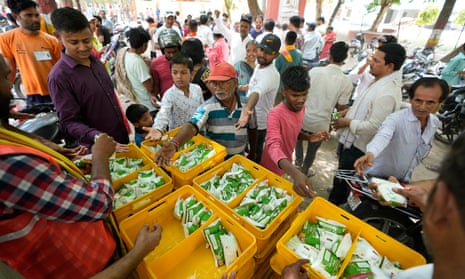
A group of people cold distribute buttermilk outside a polling station as the heat wave continues to grip the northern India during the last round of a six-week-long national election in Varanasi, India, Saturday, 1 June 2024.

The India Meteorological Department said temperatures at Jhansi in Uttar Pradesh reached 46.9C (116F).

Navdeep Rinwa, chief electoral officer for the northern state of Uttar Pradesh, where voting in the seventh and final stage of elections ended Saturday, said 33 polling personnel died due to the heat.

The figure included security guards and sanitation staff.

“A monetary compensation of 1.5 million rupees ($18,000) will be provided to the families of the deceased,” Rinwa told reporters.

False information was detected across the political spectrum but the leader of the opposition Congress party, Rahul Gandhi, was one of the leading targets, AFP reports.

His statements, videos and photographs were shared on social media, but often incompletely or out of context.

Here are some examples, all widely shared by BJP supporters, according to AFP:

  • One digitally altered video analysed by AFP used Gandhi’s real boast that the opposition alliance would triumph, but flipped it to say Modi would win a third term when the result is declared on Tuesday.

  • Others purported to show Gandhi falsely appealing to people to vote for Modi.

  • Among the more egregious examples were those falsely linking him to India’s rival neighbours, Pakistan and China. Those included a photograph that claimed Gandhi was waving the “Chinese constitution” during an election rally. It was in fact that of India.

  • Other posts portrayed Gandhi, a Hindu, as being against India’s majority religion, capitalising on Modi’s efforts to cast himself as the country’s most staunch defender of the faith.

  • One video of a ruined Hindu temple, a real image from Pakistan, was widely shared. However, the post falsely claimed it was from Gandhi’s constituency and that he was responsible for its destruction.

  • Another manipulated video falsely showed him refusing to accept a statue of a Hindu god.

  • Another claimed he was paying young people to support him on social media, when in reality he was talking about youth unemployment.

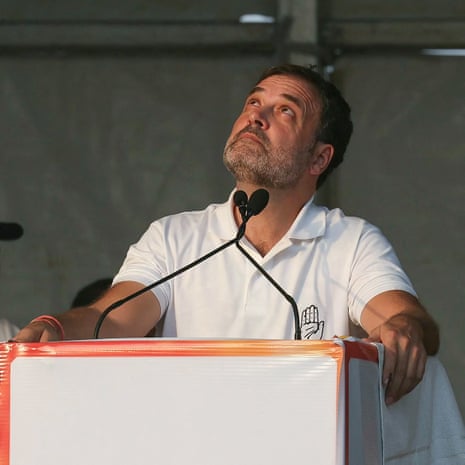
Indian National Congress (INC) Party leader Rahul Gandhi looks up during an election rally of Indian National Developmental Inclusive Alliance (INDIA) on the outskirts of Varanasi on 28 May 2024, during country’s ongoing general election.

India’s six-week election was staggering in its size and logistical complexity, but also in the “unprecedented” scale of online disinformation, APF reports.

The biggest democratic exercise in history brought with it a surge of false social media posts and instant messaging, ranging from doctored videos to unrelated images with false captions.

Raqib Hameed Naik, from the US-based India Hate Lab, said they had “witnessed an unprecedented scale of disinformation” in the elections.

“Conspiracy theories... were vigorously promoted to deepen the communal divide,” said Naik, whose organisation researches hate speech and disinformation.

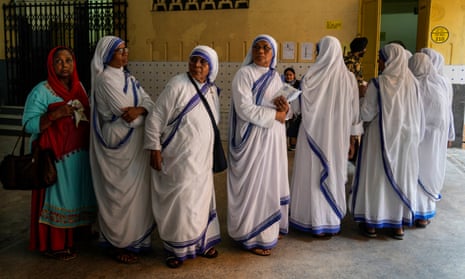
Nuns of the Missionaries of Charity, the order founded by Saint Teresa, stand in queue to cast their votes in Kolkata, India, Saturday, 1 June 2024.

With seven stages of voting stretched over six weeks, AFP factcheckers carried out 40 election-related debunks across India’s political divide.

There were fake videos of Bollywood stars endorsing the opposition, as well as those purporting to show one person casting multiple votes. Some were crude or poked fun. Others were far more sinister and sophisticated productions aimed to deliberately mislead.

Indian Prime Minister Narendra Modi’s Bharatiya Janata Party (BJP)-led alliance, the NDA bloc, is enjoying an early lead as votes are counted, pulling ahead in 154 seats of the total 543 in the lower house of parliament.

Early trends show the opposition INDIA alliance leading in 120 seats.

The first votes counted are postal ballots, which are paper ballots, mostly cast by troops serving outside their home constituencies or officials away from home on election duty.

This year, postal votes were also offered to voters over 85 years of age and people with disabilities to allow them to vote from home.

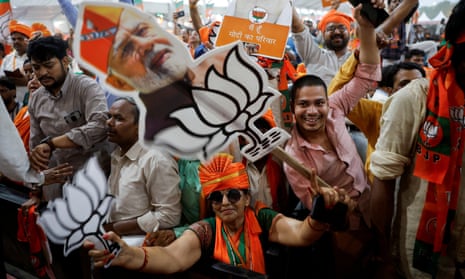
Bharatiya Janata Party's (BJP) supporters hold cut-outs of India's Prime Minister Narendra Modi during his election campaign rally, in New Delhi, India, 22 May 2024.

According to some exit polls, Modi and the BJP could be headed for a two-thirds majority in parliament, giving them an even stronger victory than in the 2019 elections.

Should the BJP achieve such a historic win, it could have far-reaching consequences for India’s future. The greatest fear among many is that this would enable the BJP to have the votes to amend India’s constitution, which currently enshrines India as a secular democracy where all religions are regarded as equal.

But during his decade in power, Modi and the BJP have pursued a Hindu nationalist agenda, an ideological project which believes India should be a Hindu state. Opponents say that the ultimate aim of the BJP would be to remove references to secularism from the constitution document, reshaping India - particularly for its minorities - forever. Modi has denied he plans to change the constitution but during the campaign several BJP candidates spoke of the need to get a two-thirds majority in order to protect India as a nation for Hindus.

A Kashmiri Muslim woman shows her marked finger after casting her vote outside a polling station during the sixth phase of the Indian general elections on the outskirts of Anantnag in south Kashmir, the summer capital of Indian Kashmir, 25 May 2024.

“We have created a world record of 642 million proud Indian voters. This is a historic moment,” Chief Election Commissioner Rajiv Kumar told reporters on Monday.

Although the 2024 turnout is higher than the 612 million voters who cast their ballots in 2019, it is about one percentage point lower than the 67.4% turnoutin 2019.

Analysts have partly blamed the lower turnout on a searing heatwave across northern India with temperatures in excess of 45C (113F).

At least 33 polling staff died from heatstroke on Saturday in Uttar Pradesh state alone, where temperatures hit 46.9C (116.4F).

Polling should have been scheduled to end a month earlier, Kumar acknowledged. “We should not have done it in so much heat”, he said.

Just under 20 minutes into the count, and only postal votes counted so far, the NDA bloc leads in 45 seats to the opposition INDIA bloc’s 31, out of 543 total seats.

Before counting even began the BJP had won one seat, in the constituency of Surat, where Mukesh Dalal, from the ruling Bharatiya Janata party (BJP), won the seat by default after every other candidate was either disqualified or dropped out of the race. It was the first time in 73 years that Surat’s candidate was appointed, not elected.

Guardian correspondent Hannah Ellis-Petersen reported at the time: Surat is not the only constituency in Gujarat to witness swathes of candidates going up against the BJP suddenly withdrawing from the race. In Gandhinagar, where Amit Shah, the home minister and prime minister Narendra Modi’s right-hand man, is running, 16 opposition candidates dropped out before last Tuesday’s voting.

With counting underway for just 10 minutes, the NDA bloc, led by Modi and his BJP, is leading in 11 seats to the opposition INDIA bloc’s four seats.

Along with the electronic record of each vote cast through the Electronic Voting Machines, a corresponding paper slip is also produced, which is visible to the voter, and then stored in a sealed box.

The poll watchdog, the Electoral Commission of India (ECI), counts and verifies these paper slips against electronic votes at five randomly selected polling stations – drawn by lots – in different segments of each constituency.

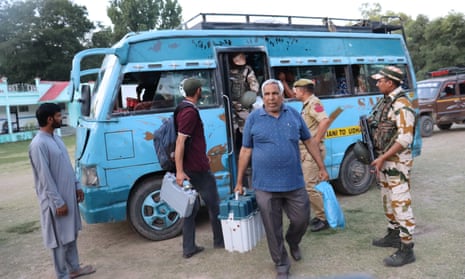
Polling officials are arriving to submit voting machines at the end of voting in Mendhar area of Poonch district, on 25 May 2024.

While critics and some members of civil society, including some political parties, want verification to be done at more booths to increase transparency, the Supreme Court has declined to order any change in the vote-counting process.

The ECI has dismissed allegations that EVMs can be tampered, calling them foolproof.

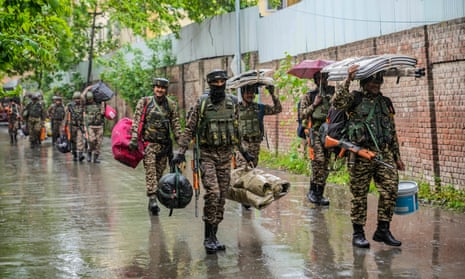
Indian paramilitary soldiers arrive in the rain to guard a venue for the distribution of Electronic Voting Machines and other election material in Srinagar, Indian controlled Kashmir, Sunday, 12 May 2024.

Vote counting is now underway at counting stations in India’s 543 constituencies. Paper ballots, cast by those who cannot vote electronically, will be counted first. Then electronic votes will be counted. These are cast on electronic voting machines, which have been used since 2,000.

Results are announced for each constituency as soon as counting is completed. India follows the first-past-the-post system, under which a candidate with the highest number of votes wins, regardless of garnering a majority or not.

Result trends generally become clear by the afternoon of counting day and are flashed on television news networks. The official count from the Election Commission of India can come hours later.

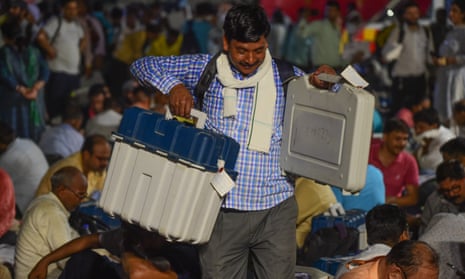
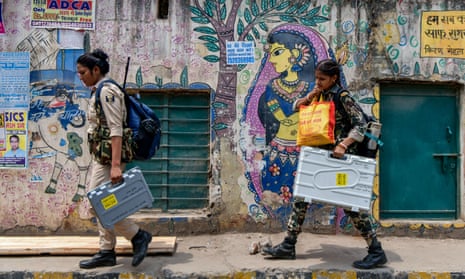
Polling officials carry electronic voting machines (EVMs) at at a secure location.

In past years, key trends have been clear by mid-afternoon with losers conceding defeat, even though full and final results may only come late on Tuesday night.

Celebrations are expected at the headquarters of Modi’s BJP if the results reflect exit poll predictions.

The winners of the general election are expected to form a new government by the middle of June.

After the ECI announces the results for all 543 seats, the president invites the leader of the party, or an alliance, which has more than half the seats to form the government.

The party or coalition with 272 or more seats then chooses a prime minister to lead the government.

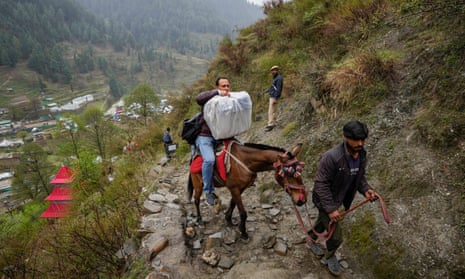
A man transports an electronic voting machine on a pony as election officials walk to a polling booth in a remote mountain area on the eve of the first round of voting at Dessa village in Doda district, Jammu and Kashmir, India, 18 April.

Vote counting in India is decentralised and done simultaneously at counting stations in each of the 543 constituencies around the country.

Counting is set to begin at 8 am (02.30 GMT) with the tallying of postal ballots that only select groups can use, including people with disabilities, or those involved in essential services including security forces and some government officials.

After paper ballots, votes from the Electronic Voting Machines are counted. India has used the machines since 2000, moving away from paper ballots for national and state elections.

Security personnel carry Electronic Voting Machines (EVMs) and other voting materials as they leave for polling stations in Patna on 31 May 2024, on the eve of the seventh and final phase of voting in India’s general election

Hello and welcome to the Guardian’s live coverage of India’s election results with me, Helen Sullivan.

This election was the largest in world history, with almost a billion eligible voters and 642 million people turning out to vote, according to the Election Commission of India.

The Lok Sabha, “House of the People” or lower house, election started in mid-April and progressed over seven phases until 1 June, as a deadly heatwave gripped the country. Dozens of voters and election officials died during the process as temperatures approached 50C in some areas.

Most voters used electronic voting machines, which means results will be declared today. Exit polls predict the election will be easily won by the prime minister, Narendra Modi, and his ruling Bharatiya Janata party-led alliance.

But Modi will be eyeing a two-thirds majority, which would have significant implications for India’s 1.4 billion citizens. The opposition INDIA bloc needs to win more than 180 of the 543 seats to prevent the two-thirds majority for the BJP-led National Democratic Alliance.

Vote counting is about to start, around 8am IST (in roughly 15 minutes’ time). We’ll have more detail shortly on how the process works.

Here is what we know so far:

  • According to exit polls released on Saturday night, Modi and the BJP are looking at a decisive win and may even gain enough seats to win a two-thirds majority in parliament, which would allow the government to make far-reaching amendments to the constitution.

  • Voting in the seventh and final staggered round of the six-week poll ended on Saturday, held in brutally hot conditions across swaths of the country. At least 33 polling staff died from heatstroke in Uttar Pradesh state alone on Saturday, where temperatures hit 46.9C (116.4F), election officials said.

  • A top opponent of Narendra Modi vowed on Sunday to keep fighting “dictatorship” before he returned to jail, following elections widely expected to produce another landslide victory for the Hindu-nationalist leader. Arvind Kejriwal is among several opposition leaders under criminal investigation, with colleagues describing his arrest the month before the general elections began in April as a “political conspiracy” orchestrated by Modi’s BJP.

  • Modi’s political opponents and international rights groups have long sounded the alarm about threats to India’s democracy. US thinktank Freedom House said this year the BJP had “increasingly used government institutions to target political opponents”.

  • Modi’s party won the regional vote in Arunachal Pradesh, a state bordering China, while a local party swept to power in Sikkim, a Himalayan state, officials and politicians said on Sunday. Provincial elections in Arunachal Pradesh and Sikkim were held on 19 April simultaneously with the first phase of the national polls.
    The BJP comfortably retained power in Arunchal Pradesh by winning 46 of the 60 seats.

Adblock test (Why?)


https://news.google.com/rss/articles/CBMicmh0dHBzOi8vd3d3LnRoZWd1YXJkaWFuLmNvbS93b3JsZC9saXZlLzIwMjQvanVuLzA0L2luZGlhLWVsZWN0aW9uLXJlc3VsdHMtMjAyNC1saXZlLXVwZGF0ZXMtbW9kaS1ianAtdm90ZS1jb3VudGluZ9IBcmh0dHBzOi8vYW1wLnRoZWd1YXJkaWFuLmNvbS93b3JsZC9saXZlLzIwMjQvanVuLzA0L2luZGlhLWVsZWN0aW9uLXJlc3VsdHMtMjAyNC1saXZlLXVwZGF0ZXMtbW9kaS1ianAtdm90ZS1jb3VudGluZw?oc=5

2024-06-04 03:09:29Z
CBMicmh0dHBzOi8vd3d3LnRoZWd1YXJkaWFuLmNvbS93b3JsZC9saXZlLzIwMjQvanVuLzA0L2luZGlhLWVsZWN0aW9uLXJlc3VsdHMtMjAyNC1saXZlLXVwZGF0ZXMtbW9kaS1ianAtdm90ZS1jb3VudGluZ9IBcmh0dHBzOi8vYW1wLnRoZWd1YXJkaWFuLmNvbS93b3JsZC9saXZlLzIwMjQvanVuLzA0L2luZGlhLWVsZWN0aW9uLXJlc3VsdHMtMjAyNC1saXZlLXVwZGF0ZXMtbW9kaS1ianAtdm90ZS1jb3VudGluZw

Mexico’s Claudia Sheinbaum poised to secure supermajority after historic win - The Guardian

Claudia Sheinbaum seems poised to cement her historic victory as Mexico’s first female president with a supermajority in congress that would let her party pass legislation and budgets unopposed – and perhaps even change the constitution without need for compromise.

Sheinbaum, a 61-year-old climate scientist and former mayor of Mexico City, won the presidency with 59.5% of the vote, according to a rapid sample count by Mexico’s electoral authority.

During the campaign, Sheinbaum portrayed herself as a continuity candidate, vowing to keep the policies of her populist predecessor, Andrés Manuel López Obrador, known popularly as Amlo, who founded the Morena party in 2014 and forged a bond with voters disenchanted with democracy.

López Obrador was constitutionally unable to run again, but chose Sheinbaum as his successor – and she appears to have won 5m votes more than he did six years ago.

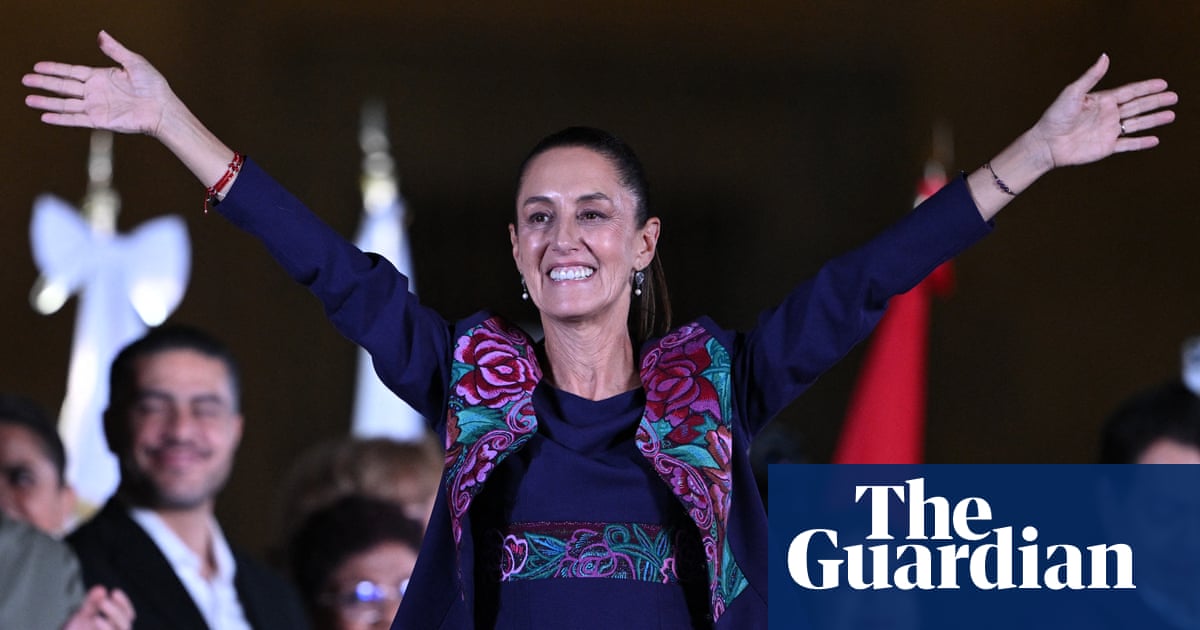
“In the 200 years of the republic, I will become the first woman president of Mexico,” Sheinbaum told supporters in a victory speech late on Sunday, to loud cheers of “presidenta, presidenta” – the feminine form of the country’s top political post.

Thanks in part to a constitutional amendment that set the goal of gender parity in all races for elected office and in appointments for top jobs in government, women now hold half the seats in Mexico’s congress and almost half the jobs in cabinet and one-third of the governorships.

Activists will hope to see this prominence of female leaders translate into policy.

In 2023, Mexico’s supreme court ruled that prohibiting abortion was unconstitutional, but this has been slow to manifest in safe and accessible abortion at the state level. Meanwhile, gender-based violence continues to rise.

Although female presidents have been elected in countries across Latin America, Sheinbaum’s victory makes her the first woman to lead a North American country.

Sheinbaum’s main challenger was another woman, Xóchitl Gálvez, who won 27.6% of the vote as candidate of the opposition coalition. She was unable to overcome the unpopularity of the traditional parties backing her, which many voters view as serving the elites.

Aside from the presidency, more than 20,000 posts were up for grabs in Mexico’s biggest election ever.

Morena and its allies are poised to win a two-thirds supermajority in one and perhaps both houses of congress, which would allow it to amend the constitution at will.

Amlo has already laid out a desired packet of reforms that is wide-ranging and occasionally eccentric, including pension reform but also outlawing animal abuse, as well as banning fracking and the sale of vapes.

But the most controversial would be a reform to elect supreme court justices by popular vote. The court has often stood against Amlo, and such a reform could place it under Morena’s control.

On Monday, Amlo said he did “not want to impose anything” on Sheinbaum, before later adding: “I do think we have to address the issue of judicial reform … There has to be a judiciary that represents the Mexican people, that is incorruptible, because if not, we will not move forward.”

Of the nine gubernatorial races, Morena held six and won the state of Yucatán, meaning it now controls 24 of Mexico’s 32 federal entities.

Altogether, Morena will hold more political power than any party since Mexico’s transition to democracy in 2000. The peso slid against the dollar as investors reacted with jitters to Morena’s projected hegemony.

Sheinbaum will take power on 1 October with a huge mandate but substantial challenges to address – not least the violence, corruption and impunity that failed to improve under Amlo, as organised crime groups fight to deep their control of territory and local businesses.

“Security, and the wake of victims, of pain, of anger, sown through great parts of the country – these are the hardest parts of the legacy that [Amlo] leaves Claudia,” said Blanca Heredia, a political analyst.

Amlo also hugely expanded the role of the military into areas typically reserved for civil society, such as domestic security and infrastructure construction. “Managing the army will require great intelligence from Sheinbaum, because they have been given many responsibilities, many resources,” said Heredia.

“Another pending issue is perhaps national reconciliation,” said Vanessa Romero, a political analyst. “These elections were particularly incendiary, as if there were two Mexicos and they don’t talk to each other.”

A month after Sheinbaum takes power, the US is set for its own election and a showdown between Joe Biden and Donald Trump.

The countries’ economies are deeply intertwined, with Mexico the top trading partner of the US. Mexico is also the immediate source of the fentanyl that kills 70,000 Americans a year, and a transit country for US-bound migrants – meaning it will play a key role in the US election.

“I look forward to working closely with President-elect Sheinbaum in the spirit of partnership and friendship that reflects the enduring bonds between our two countries,” said Biden in a statement.

In her victory speech, Sheinbaum said the US-Mexico relationship would be based on “mutual respect” before adding: “We will always defend Mexicans who are on the other side of the border.”

Adblock test (Why?)


https://news.google.com/rss/articles/CBMibGh0dHBzOi8vd3d3LnRoZWd1YXJkaWFuLmNvbS93b3JsZC9hcnRpY2xlLzIwMjQvanVuLzAzL2NsYXVkaWEtc2hlaW5iYXVtLXByZXNpZGVudC1tZXhpY28tcGFydHktc3VwZXJtYWpvcml0edIBbGh0dHBzOi8vYW1wLnRoZWd1YXJkaWFuLmNvbS93b3JsZC9hcnRpY2xlLzIwMjQvanVuLzAzL2NsYXVkaWEtc2hlaW5iYXVtLXByZXNpZGVudC1tZXhpY28tcGFydHktc3VwZXJtYWpvcml0eQ?oc=5

2024-06-04 01:30:00Z
CBMibGh0dHBzOi8vd3d3LnRoZWd1YXJkaWFuLmNvbS93b3JsZC9hcnRpY2xlLzIwMjQvanVuLzAzL2NsYXVkaWEtc2hlaW5iYXVtLXByZXNpZGVudC1tZXhpY28tcGFydHktc3VwZXJtYWpvcml0edIBbGh0dHBzOi8vYW1wLnRoZWd1YXJkaWFuLmNvbS93b3JsZC9hcnRpY2xlLzIwMjQvanVuLzAzL2NsYXVkaWEtc2hlaW5iYXVtLXByZXNpZGVudC1tZXhpY28tcGFydHktc3VwZXJtYWpvcml0eQ

Mexico’s Claudia Sheinbaum poised to secure supermajority after historic win - The Guardian

Claudia Sheinbaum seems poised to cement her historic victory as Mexico’s first female president with a supermajority in congress that would let her party pass legislation and budgets unopposed – and perhaps even change the constitution without need for compromise.

Sheinbaum, a 61-year-old climate scientist and former mayor of Mexico City, won the presidency with 59.5% of the vote, according to a rapid sample count by Mexico’s electoral authority.

During the campaign, Sheinbaum portrayed herself as a continuity candidate, vowing to keep the policies of her populist predecessor, Andrés Manuel López Obrador, known popularly as Amlo, who founded the Morena party in 2014 and forged a bond with voters disenchanted with democracy.

López Obrador was constitutionally unable to run again, but chose Sheinbaum as his successor – and she appears to have won 5m votes more than he did six years ago.

“In the 200 years of the republic, I will become the first woman president of Mexico,” Sheinbaum told supporters in a victory speech late on Sunday, to loud cheers of “presidenta, presidenta” – the feminine form of the country’s top political post.

Thanks in part to a constitutional amendment that set the goal of gender parity in all races for elected office and in appointments for top jobs in government, women now hold half the seats in Mexico’s congress and almost half the jobs in cabinet and one-third of the governorships.

Activists will hope to see this prominence of female leaders translate into policy.

In 2023, Mexico’s supreme court ruled that prohibiting abortion was unconstitutional, but this has been slow to manifest in safe and accessible abortion at the state level. Meanwhile, gender-based violence continues to rise.

Although female presidents have been elected in countries across Latin America, Sheinbaum’s victory makes her the first woman to lead a North American country.

Sheinbaum’s main challenger was another woman, Xóchitl Gálvez, who won 27.6% of the vote as candidate of the opposition coalition. She was unable to overcome the unpopularity of the traditional parties backing her, which many voters view as serving the elites.

Aside from the presidency, more than 20,000 posts were up for grabs in Mexico’s biggest election ever.

Morena and its allies are poised to win a two-thirds supermajority in one and perhaps both houses of congress, which would allow it to amend the constitution at will.

Amlo has already laid out a desired packet of reforms that is wide-ranging and occasionally eccentric, including pension reform but also outlawing animal abuse, as well as banning fracking and the sale of vapes.

But the most controversial would be a reform to elect supreme court justices by popular vote. The court has often stood against Amlo, and such a reform could place it under Morena’s control.

On Monday, Amlo said he did “not want to impose anything” on Sheinbaum, before later adding: “I do think we have to address the issue of judicial reform … There has to be a judiciary that represents the Mexican people, that is incorruptible, because if not, we will not move forward.”

Of the nine gubernatorial races, Morena held six and won the state of Yucatán, meaning it now controls 24 of Mexico’s 32 federal entities.

Altogether, Morena will hold more political power than any party since Mexico’s transition to democracy in 2000. The peso slid against the dollar as investors reacted with jitters to Morena’s projected hegemony.

Sheinbaum will take power on 1 October with a huge mandate but substantial challenges to address – not least the violence, corruption and impunity that failed to improve under Amlo, as organised crime groups fight to deep their control of territory and local businesses.

“Security, and the wake of victims, of pain, of anger, sown through great parts of the country – these are the hardest parts of the legacy that [Amlo] leaves Claudia,” said Blanca Heredia, a political analyst.

Amlo also hugely expanded the role of the military into areas typically reserved for civil society, such as domestic security and infrastructure construction. “Managing the army will require great intelligence from Sheinbaum, because they have been given many responsibilities, many resources,” said Heredia.

“Another pending issue is perhaps national reconciliation,” said Vanessa Romero, a political analyst. “These elections were particularly incendiary, as if there were two Mexicos and they don’t talk to each other.”

A month after Sheinbaum takes power, the US is set for its own election and a showdown between Joe Biden and Donald Trump.

The countries’ economies are deeply intertwined, with Mexico the top trading partner of the US. Mexico is also the immediate source of the fentanyl that kills 70,000 Americans a year, and a transit country for US-bound migrants – meaning it will play a key role in the US election.

“I look forward to working closely with President-elect Sheinbaum in the spirit of partnership and friendship that reflects the enduring bonds between our two countries,” said Biden in a statement.

In her victory speech, Sheinbaum said the US-Mexico relationship would be based on “mutual respect” before adding: “We will always defend Mexicans who are on the other side of the border.”

Adblock test (Why?)


https://news.google.com/rss/articles/CBMibGh0dHBzOi8vd3d3LnRoZWd1YXJkaWFuLmNvbS93b3JsZC9hcnRpY2xlLzIwMjQvanVuLzAzL2NsYXVkaWEtc2hlaW5iYXVtLXByZXNpZGVudC1tZXhpY28tcGFydHktc3VwZXJtYWpvcml0edIBbGh0dHBzOi8vYW1wLnRoZWd1YXJkaWFuLmNvbS93b3JsZC9hcnRpY2xlLzIwMjQvanVuLzAzL2NsYXVkaWEtc2hlaW5iYXVtLXByZXNpZGVudC1tZXhpY28tcGFydHktc3VwZXJtYWpvcml0eQ?oc=5

2024-06-03 23:03:00Z
CBMibGh0dHBzOi8vd3d3LnRoZWd1YXJkaWFuLmNvbS93b3JsZC9hcnRpY2xlLzIwMjQvanVuLzAzL2NsYXVkaWEtc2hlaW5iYXVtLXByZXNpZGVudC1tZXhpY28tcGFydHktc3VwZXJtYWpvcml0edIBbGh0dHBzOi8vYW1wLnRoZWd1YXJkaWFuLmNvbS93b3JsZC9hcnRpY2xlLzIwMjQvanVuLzAzL2NsYXVkaWEtc2hlaW5iYXVtLXByZXNpZGVudC1tZXhpY28tcGFydHktc3VwZXJtYWpvcml0eQ